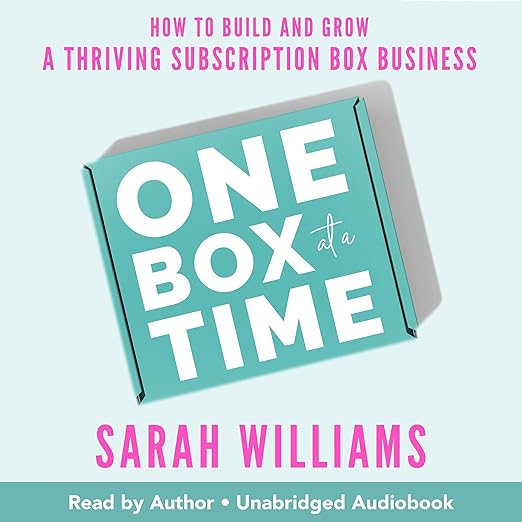
Sarah Williams narrates One Box at a Time herself, and the decision matters more than it might seem for a business audiobook. Williams, known as the Subscription Box Queen and host of the Launch Your Box podcast, built her business from the ground up, and the self-narration means every tactical recommendation arrives in the voice of someone who made that specific mistake and then corrected it. At 5 hours and 36 minutes, the audiobook covers the full arc from concept to customer, and the accompanying PDF, available in your Audible library, provides the worksheets and reference material that the audio format cannot carry.
Tactical Recommendations Arrive in a Voice That Erred
The subscription box industry has a specific set of structural problems that Williams treats with uncommon directness. Finding and validating an audience before building inventory. Curating a box that feels like a considered gift rather than a clearance sale. Managing supplier relationships in a model where your leverage depends on consistent, growing order volumes. Calculating a price point that accommodates margins, shipping, and subscriber acquisition costs without pricing out the customers you built the business for. These are not glamorous subjects, and Williams does not pretend otherwise, but she works through them systematically enough that a listener can build a functional mental model of the business even before returning to the PDF for specifics.
What distinguishes the book from the abundance of general e-commerce guides is Williams's focus on the subscription dimension: the psychology of monthly anticipation, the importance of curation as a differentiator when larger competitors can ship anything faster and cheaper, and the particular challenge of retaining subscribers past the first three months, when the novelty premium wears off and the box has to earn its place in a monthly budget on its own merits. Those dynamics are granular enough to be useful and general enough to apply across niches, from beauty and wellness to bookish gifts to pet supplies. One reviewer who had been in the Launch Your Box community for two years called Williams a genius at distilling the operational complexity of subscription commerce into actionable frameworks, and the audiobook bears that out.
The section on buying, sourcing, and working with brand partners is where Williams's practical specificity pays off most clearly. She covers the difference between purchasing inventory outright and negotiating promotional inserts from brands who benefit from the exposure, the leverage mathematics that determine which arrangement makes sense at which scale, and the relationship management that turns a one-time product placement into a reliable supply chain. These are not abstract frameworks but operational decisions that a listener founding a subscription box will face within the first year, and Williams's willingness to share what she actually negotiated, rather than what looks good in a case study, is what separates the book from business advice that reads well and fails to implement.
The Audio Earns the Concept, the PDF the Tools
Williams's voice has the quality that the best podcast hosts develop: she makes complex operational logistics sound navigable without understating the difficulty. Listeners who have followed the Launch Your Box podcast will recognize the register immediately, and the audiobook functions as a structured companion to that community's ongoing conversation. For listeners new to Williams, the self-narration serves as an implicit credential; she is clearly someone who has solved these problems, not someone who has theorized about them from the outside.
The book's step-by-step structure also lends itself to audio in a way that discursive business books often do not. Each section has a clear deliverable: by the end of the audience-finding chapter, you know what questions to ask; by the end of the sourcing chapter, you know what relationships to pursue. This makes the audiobook navigable even without the PDF, though that document handles the specific checklists and frameworks that Williams references in audio. Note that the PDF is an essential companion for any listener planning to act on the material rather than simply understand it. The audio earns the concept; the PDF delivers the tools.
Launch-Phase Advice That Stops Before Scaling
The book is explicitly targeted at the launch phase. Listeners who already have a subscription box running and are struggling with scaling, churn management at significant volume, or multi-SKU logistics will find the material covers familiar ground and does not reach the operational complexity of their current challenges. Williams positions herself as a launch guide and the book delivers on that promise, but it is not a comprehensive operations manual for an established business at scale.
Some sections dealing with working with brands and manufacturers are necessarily general, since the specifics of any given supplier negotiation depend on the niche and the leverage the entrepreneur can bring. Williams gives useful principles without being able to simulate the actual conversation, which is an inherent limitation of any book-length guide to relationship-dependent business development. The Launch Your Box podcast and community are where those real-time tactical questions get answered, and Williams points listeners there accordingly as a logical next step beyond the book.
A Road Map From Idea to Shipping Operation
Targeted squarely at entrepreneurs in the idea or early launch phase who want a structured process for building a subscription box business. Particularly valuable for women building product-based businesses with no prior e-commerce experience, the book's primary audience. Accessible to anyone who has an identified audience and a product concept and needs a road map from those two assets to a shipping operation. Less useful as a sole resource for experienced operators; the tactical value is concentrated at the beginning of the business lifecycle rather than distributed across the whole arc of growth. Combined with the PDF and the broader Launch Your Box ecosystem, it represents a solid foundation for a business type that most general entrepreneurship books barely acknowledge.