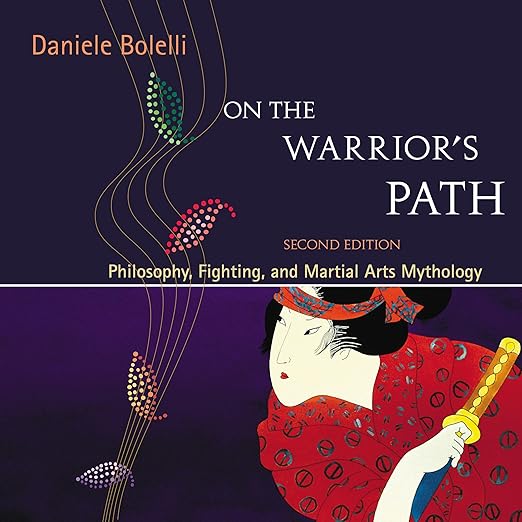
Quick Take
- Narration: Kirk Magoon handles Bolelli’s wide-ranging philosophical prose cleanly, though the material rewards a reader willing to pause and think more than one primarily listening for entertainment.
- Themes: Martial arts as philosophy, the warrior archetype across cultures, the paradox of training violence to renounce it
- Mood: Intellectually expansive, occasionally dense, rewarding for the patient listener
- Verdict: A serious work of martial arts philosophy that earns its comparisons to Bruce Lee’s own writings, best approached as an essay collection rather than a how-to guide.
On the Warrior’s Path is the kind of book that gets recommended between training sessions rather than at them, passed along by the martial artist who has been training for twenty years and wants to talk about what it actually means. I came to it through exactly that route, a friend who trains Brazilian jiu-jitsu pressing a copy on me after a conversation about Jeet Kune Do philosophy. I listened to it across several evenings during a week when I had more time to think than usual, and that turned out to be the right context. This is not a book you run with or drive to.
Daniele Bolelli is an academic and martial artist, a combination that produces a specific kind of writing, one that is comfortable ranging from Nietzsche to Bruce Lee to the Star Wars trilogy within a single chapter and treating all three as equally valid philosophical sources. That approach will either delight you or exhaust you, and it is worth knowing which camp you fall into before committing. For the listener willing to follow Bolelli across that territory, the payoff is genuine: a treatment of why martial arts persists as a human practice, what the warrior archetype actually represents across cultures, and how the training of violence can paradoxically lead to a renunciation of it. The book’s intellectual range is one of its great pleasures, there are not many places where you get Nietzsche and Bruce Lee sharing the same analytical frame without it feeling forced.
Our Take on On the Warrior’s Path
The second edition adds two chapters specifically on spirituality in martial arts and the author’s personal journey, which grounds the more theoretical material in lived experience. That grounding helps considerably. The extended essay on Bruce Lee and the principles of Jeet Kune Do is singled out by reviewers as the book’s standout section, and it earns that assessment, Bolelli understands Lee not as a movie star who also trained but as a genuine philosophical innovator within the martial arts tradition, and his analysis is the most coherent treatment of JKD’s underlying logic I have encountered outside of Lee’s own notes. The connections to radical Taoism and Buddhism are drawn with care rather than convenience, and the basketball and American Indian culture comparisons, while surprising, hold up under examination.
Why Listen to On the Warrior’s Path
If you have been training in any martial art for long enough to notice that the technical instruction is only part of what the practice is doing, this book names what the rest of it is. Bolelli is particularly good on the tension between martial arts’ traditional structures and the modern impulse to dissolve them, a tension that Bruce Lee made explicit but that every serious practitioner eventually encounters. The historical and mythological contexts throughout are genuinely worth the runtime. Kirk Magoon’s narration handles the academic register without making it feel like a lecture, maintaining enough pace to carry the ideas forward rather than letting the philosophical density slow everything to a crawl.
What to Watch For in On the Warrior’s Path
This is an essay collection in structure, which means the coherence is thematic rather than linear. Listeners who prefer a clear narrative arc may find the associative movement between philosophy, martial arts history, pop culture, and personal reflection harder to track than they expect. One reviewer who appreciated the book nonetheless noted the absence of a deeper engagement with market forces shaping martial arts, a fair critique. The 4.5 rating from 250 reviews reflects broad appreciation with some reservations about reach occasionally outpacing grasp in certain chapters.
Who Should Listen to On the Warrior’s Path
Martial artists at any level who want to think seriously about what they are doing and why will find this essential. Readers interested in philosophy of sport, warrior cultures, or the intersection of Eastern and Western thought have a lot to work with here. Newcomers to martial arts looking for technical guidance should understand that this book is entirely philosophical, there is no instruction in the sense of technique, and that is entirely by design.
Frequently Asked Questions
Does On the Warrior’s Path require prior martial arts experience to appreciate?
Not strictly, but it rewards familiarity. Bolelli writes for a broad audience and explains his references, but readers who have spent time on a mat will find the material resonates more immediately with their own experience.
How does the second edition differ from the original?
Two additional chapters focus specifically on spirituality within martial arts and Bolelli’s personal journey in the field. These additions make the more theoretical material feel more personally grounded and are generally considered improvements to the original structure.
Is the Bruce Lee section worth the price of admission alone?
Multiple reviewers say yes. Bolelli’s extended essay on Jeet Kune Do and its philosophical underpinnings is widely regarded as the book’s strongest chapter and offers a more rigorous treatment of Lee’s ideas than most martial arts writing manages.
How does Kirk Magoon handle the philosophical and academic passages?
Competently and clearly. He does not inject theatricality the material does not call for, which suits the essayistic tone. Listeners looking for an expressive, character-driven narration will find this functional rather than spectacular.