Quick Take
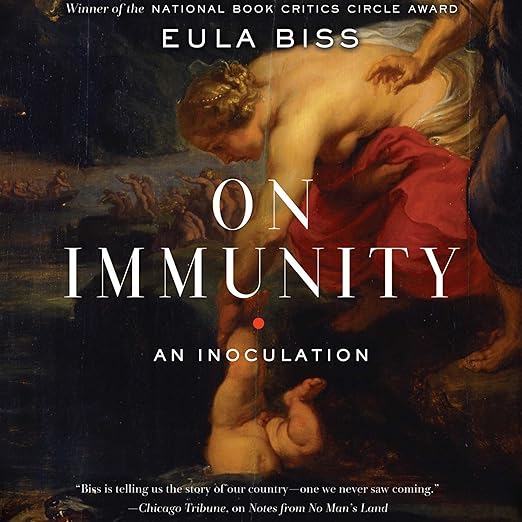
- Narration: Tamara Marston reads Biss’s layered, essayistic prose with intelligence and restraint, she honors the literary texture without over-performing it.
- Themes: Vaccination, social interconnection, fear and the body politic
- Mood: Contemplative and carefully argued, with an undercurrent of maternal urgency
- Verdict: This is one of the most intellectually rigorous things written about the vaccine debate, and Marston’s narration makes it a genuine listening experience rather than a converted text.
I came to this one during a particularly fractious week online, in which my social media feeds had turned into competing screeds about childhood vaccines. I needed something that would help me think rather than just feel, and a colleague had been recommending Eula Biss for a while. I downloaded it on a Thursday night, started it during my Friday morning walk, and did not stop until I had finished it across the weekend. That is not always how essay collections work in audio. This one worked.
On Immunity is not primarily a book about vaccines. It is a book about fear, specifically the kind of fear that attaches itself to new parenthood, that finds its object in whatever the current cultural moment offers, and that has, in Biss’s generation of educated, worried, often affluent American mothers, settled on the question of what to put in a baby’s body. Biss is a poet and essayist by training, and she brings that background to bear on a question that most people approach either as pure science communication or pure culture war. She refuses both framings.
A Literary Critic Writing About Vaccination
What distinguishes this book from nearly everything else in the vaccine-debate genre is the range of its reference points. Biss moves between Voltaire’s Candide, Bram Stoker’s Dracula, Rachel Carson’s Silent Spring, and Susan Sontag’s AIDS and Its Metaphors with the ease of someone who has spent years thinking about how metaphor shapes public understanding of health. This is not name-dropping. Each reference illuminates something specific about how we conceptualize the body, contamination, risk, and collective responsibility. The Dracula section alone, tracking the vampire as a figure for anxieties about blood and transmission, is one of the more original pieces of cultural criticism I have encountered in health writing.
Reviewer Andrew Krone notes that Biss goes deeper than the question of what is good for my child, engaging the sociology and history of who tends to resist vaccination and why. He is right that the book does not spare the wealthy and educated from its analysis. Biss is unflinching about the class dynamics of vaccine hesitancy, observing that privilege often produces its own particular forms of risk aversion that then externalize harm onto more vulnerable communities.
The Social Body Argument
The book’s central ethical move is to insist that immunity is never purely individual. Herd immunity is not just a medical fact but a form of civic participation, a way of protecting those who cannot protect themselves. Biss does not make this argument polemically. She arrives at it through personal narrative, through conversations with other mothers, through her own research into what the science actually says and does not say. The effect is that by the time she states the ethical position explicitly, you have already arrived there yourself through the reasoning she has laid out. That is the work of a genuine essayist, not a polemicist.
Reviewer David Tribe calls it the best book about vaccination for intelligent, thoughtful parents, and I would not argue with that. What he captures is that Biss treats her reader as someone capable of holding complexity, uncertainty about specific ingredients alongside confidence in the overall safety profile, without demanding that they adopt a predetermined conclusion.
Tamara Marston’s Navigation of the Prose
Biss’s prose is dense and allusive. Sentences carry multiple registers simultaneously: the personal, the historical, the scientific. Tamara Marston reads with a quality of attentiveness that serves this well. She does not rush the aphoristic moments or underplay the emotional ones. Her voice has a neutral warmth that suits the confessional but rigorously intellectual register of the book. There are passages where Biss is essentially writing poetry, and Marston handles those without tipping into theatrical recitation. It is a performance that has clearly been prepared carefully.
What Kind of Listener Will Find This Rewarding
Anyone who wants to think more carefully about what fear does to public health decisions will find this rewarding. It is not a primer on vaccine science. Biss is not an epidemiologist, and the book does not pretend to be a medical reference. It is a humanistic argument for why we are responsible to each other’s bodies, made through the personal experience of a new mother who chose to do her own research and came out the other side with a more, not less, sophisticated understanding of the question.
Listeners who want clinical data and straightforward medical guidance will be frustrated. Those who want to understand the cultural and philosophical dimensions of one of the most contested health debates of the past thirty years will find it an essential listen.
Frequently Asked Questions
Does Eula Biss take a clear pro-vaccine position, or does she present both sides equally?
Biss ultimately supports vaccination, but the book is not structured as a pro-vaccine argument. It is an investigation into the fears and metaphors surrounding immunity. She examines the origins and logic of vaccine hesitancy with genuine intellectual sympathy while also being clear about the social harm that widespread hesitancy causes. It reads as honest inquiry rather than advocacy.
The book references literary works like Dracula and Silent Spring extensively. Does that make it inaccessible for non-literary readers?
Biss contextualizes each reference carefully enough that you do not need prior familiarity with the works she cites. She is using them to illuminate arguments about contamination and fear, and the connections she draws are clear even if you have never read Stoker or Carson. That said, readers who enjoy essay writing and literary criticism will get more pleasure from the texture of the argument.
How does Tamara Marston’s narration handle the passages where Biss writes in a more poetic, lyrical style?
Marston navigates the tonal shifts well. She reads the more measured analytical passages and the more personal or lyrical ones at different registers without making the transitions feel jarring. She does not over-perform the emotional moments, which suits the book’s restrained but deeply felt voice.
Is On Immunity still relevant given how much has changed in public health debates since it was published?
The book’s argument is essentially historical and philosophical, which gives it unusual durability. The specific vaccine debates Biss references have evolved, but the underlying dynamics of fear, metaphor, privilege, and collective responsibility she analyzes have not. If anything, subsequent events have confirmed the patterns she identifies rather than dating them.