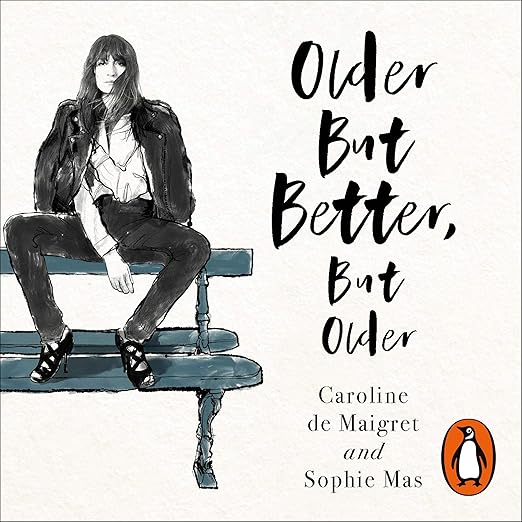
Quick Take
- Narration: Carrington MacDuffie reads with a light touch that suits the book’s aphoristic style, she captures the Parisian register of studied nonchalance without overdoing any affected accent.
- Themes: aging with irreverence, redefining femininity past forty, the Parisian philosophy of imperfection
- Mood: Wry and affectionate, like listening to two clever friends gossip about getting older over a very good bottle of wine
- Verdict: At under three hours this is more an extended essay collection than a thorough guide, but the wit is real and the perspective is genuinely refreshing, ideal for a Sunday afternoon when you want to laugh at the absurdity of aging.
I finished this one on a Saturday afternoon between errands, which is probably exactly the right context for it. Caroline de Maigret and Sophie Mas are not asking for your sustained intellectual attention, they are asking for the kind of companionship you bring to a conversation with someone who is funny about things that are actually a little painful, and they deliver that companionship reliably across just under three hours.
This is the follow-up to How to Be Parisian Wherever You Are, the 2014 book that made de Maigret briefly famous in lifestyle media for articulating a particular French attitude toward beauty and nonchalance. That book worked because it was playful about its own premise. This one, which tackles the more vulnerable terrain of aging, specifically, what happens to the mischievous Parisienne when the world starts categorizing her as madame rather than mademoiselle, works for similar reasons. The authors know they are dealing in archetypes and they play with that self-awareness rather than ignoring it.
The Parisian Aging Archetype and What It Actually Contains
The book is organized around the adjustments de Maigret and Mas are making to the habits and attitudes that defined their younger selves. The chapter on seduction past forty is the most interesting, they argue, with some precision, that the tools change but the principle does not: confidence, mystery, and an authentic relationship with your own desire remain functional regardless of decade. The chapter on imperfection, which circles around the French cultural preference for flaws that are acknowledged rather than concealed, is charming and contains a few observations I found genuinely useful.
Reviewer Shani called this “an elegant celebration of age that acknowledged the not-so nice parts of aging without diminishing a woman’s value”, and that is accurate. The book does not pretend that getting older is uniformly excellent. It makes space for the things that are difficult, changing bodies, shifting relationship dynamics, the particular weirdness of watching your parents age while managing your own, without collapsing into complaint. That tonal balance is harder to achieve than it looks.
The Three-Hour Question
The primary limitation is the runtime. At under three hours, the book can only sketch rather than develop. The chapters on love and dating, on family dynamics, on accepting imperfection, each could have been twice as long without outstaying their welcome. What you get feels like the first paragraph of an argument that should have run four more pages. The wit is there; the depth is intermittent.
Carrington MacDuffie’s narration handles the aphoristic style competently. The book is structured around short, declarative observations, the kind of wry assertions that land differently when spoken than when read, and MacDuffie reads them with appropriate dryness without making them feel dismissive. The Parisian register is present without feeling performed.
The Book’s Best Use
This works best as a mood piece rather than a reference guide. It will not change your approach to aging in the way a book grounded in physiology or psychology might. It will give you a two-hour-fifty-six-minute respite from taking aging seriously, which is a different and occasionally more useful service. The reviewer who read it “in quiet moments or moments of hecticness to be reminded of a softer way” understood its function exactly. It is a perspective shift rather than a system, and at its brief length, a perspective shift is what it has time to be.
The 753 ratings averaging 4.2 suggest a book that pleases most of its audience without fully satisfying any of them. That is about right. It is a book you enjoy and then slightly wish had been bolder. The Parisian archetype has limits, and de Maigret and Mas approach them without quite crossing into territory that would make this feel genuinely necessary rather than simply pleasant.
Who Should Listen and Who Should Skip
Listen if: you want a witty, unpretentious companion on the experience of aging past forty from a distinctly French perspective; you are a fan of the first Parisian book and want more from the same sensibility; you have an afternoon free and want something that makes you laugh rather than lecture you. Skip if: you want a thorough guide to navigating midlife with practical strategies and depth; you find the Parisian archetype more exhausting than charming; you need a runtime that justifies a full audiobook credit.
Frequently Asked Questions
Do you need to have read How to Be Parisian Wherever You Are first?
No. Older, but Better, but Older stands independently. Familiarity with the first book gives you context for the authors’ voice and the archetypes they are working with, but the subject matter here, aging, imperfection, redefining femininity in midlife, is self-contained.
Is the tone more philosophical or practical?
Primarily philosophical and anecdotal, with occasional practical observations. This is not a step-by-step guide to anything. It is closer to an extended essay collection on what getting older feels like when you approach it with irreverence rather than dread.
Does the book address aging specifically as French women experience it, or is the advice culturally transferable?
The frame is explicitly Parisian, which means the advice assumes certain cultural values around imperfection, nonchalance, and a particular relationship with beauty. Much of it is transferable, but the perspective is culturally specific and part of the book’s charm is its unapologetic specificity.
Is under three hours enough to make this worth an Audible credit?
Marginal. At 2 hours and 56 minutes, this is on the shorter end for a full audiobook credit. It is best experienced as a low-stakes afternoon listen rather than a major investment. Consider it if you are in a mood for wit and perspective rather than comprehensive coverage.