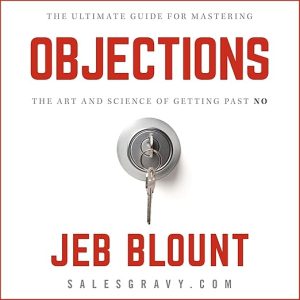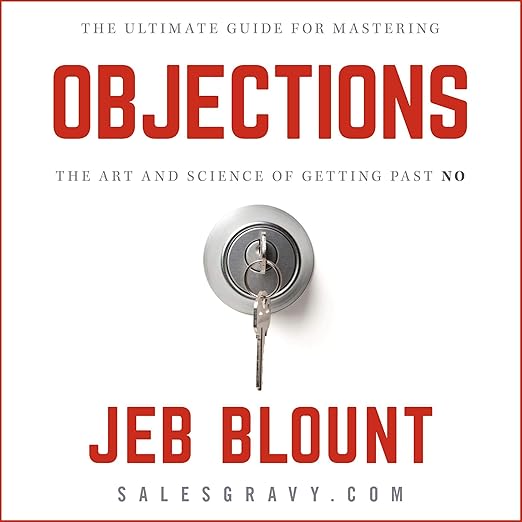
Jeb Blount's Objections earns a spot next to his own Fanatical Prospecting and Sales EQ on the strength of one clear-eyed observation: every other part of selling varies wildly by industry and buyer, but objections are the one truly universal experience in sales, and this audiobook builds an entire framework around that single insight. Blount narrates it himself, and that choice alone tells you a lot about what kind of listening experience this is.
James Muir's Best Book Ever, Seconded by a Professor
The premise is disarmingly simple once Blount states it directly: complex sales differ from one-call closes, B2B differs from B2C, and every industry has its own quirks, but no salesperson, anywhere, at any experience level, gets through a career without hearing no repeatedly before eventually hearing yes. James Muir's review calls this 'the best book ever written on the subject of addressing concerns and objections,' crediting Blount's amazing streak of top-selling sales titles, and the throughline connecting Objections to Blount's earlier work is exactly this pattern of finding the one universal mechanic underneath sales' surface-level variety.
What separates this from a generic objection-handling script book is the psychological grounding underneath the tactics. Barbara Weaver Smith's review, written by a former English professor turned sales trainer, specifically credits Blount with teaching human-influence frameworks rather than memorized rebuttals, and that framing matters: the goal here is understanding why a prospect objects in the first place, not just handing you a canned line to counter whatever pushback comes your way.
A Leveler Narrower Than Prospecting or Sales EQ
Blount's own framing is that objections function as a kind of leveler within sales, indifferent to seniority, product, or industry, which is a deliberately democratic way of describing what most salespeople experience as a deeply personal, even demoralizing, gauntlet. Reframing rejection as a universal structural feature of the job rather than a personal failing is itself a piece of psychological reframing worth the price of admission, before you even get to the specific tactical frameworks that follow.
Objections is also notably narrower in its own title than Blount's other bestsellers, and that specificity is a deliberate positioning choice: where Fanatical Prospecting promises a broad prospecting methodology and Sales EQ promises emotional-intelligence range across a whole career, this book promises to solve exactly one recurring pain point. Readers can judge before ever pressing play whether that narrower promise matches what they actually need right now, which makes Objections a genuinely useful supplement rather than a competing, overlapping purchase.
Blount Sustains Urgency Without Becoming Exhausting
Blount's self-narration removes any performance distance between the author's actual voice and the coaching you are hearing, and across a career built on live sales training, his ability to sustain urgency across an extended runtime without becoming exhausting shows clearly here. This does not read like a professional voice actor performing enthusiasm for hire; it sounds like someone who has delivered these exact frameworks from a stage many times and genuinely believes in them, which matters for a genre where conviction is half the sale.
Ratings alone tell part of the story: Objections has drawn more than 900 individual ratings on its own, a meaningfully high-engagement number for a business title, and that scale of audience response is itself evidence the self-narration approach works at scale rather than only appealing to Blount's existing fan base. One reviewer captures the appeal in a single line, calling the book 'simple, but profound' and 'logical, analytical, but practical,' three qualities that are genuinely difficult to combine in one delivery.
Barbara Weaver Smith's review adds an unusually credentialed data point: she describes her first career as an English professor, where she taught a specific technique for structuring persuasive explanation, before crediting Blount with taking his own frameworks to a new level in this book. A reviewer with formal rhetoric training specifically praising the structural clarity of Blount's teaching method is a meaningfully different kind of endorsement than a general enthusiasm review, and it lines up with how methodically the book itself is organized.
Right-to-the-Point Almost to the Point of Bluntness
At just under six hours, this runs shorter than some of Blount's other titles, and that brevity is mostly a strength: the book stays tightly focused on objection handling specifically rather than sprawling into the broader sales-process territory Fanatical Prospecting already covers. Listeners wanting a comprehensive soup-to-nuts sales methodology should know this is intentionally narrower in scope, a deep dive on one specific skill rather than a full playbook.
Blount's delivery is also, by his own reputation and by James Muir's description, 'right-to-the-point' almost to the point of bluntness. He is not gentle about calling out what is really holding you back from closing deals, and salespeople who prefer a softer, more encouraging coaching style might find the directness occasionally more confrontational than comforting, even when the underlying advice is sound.
Pushing Back on Sellers as Long as Selling Existed
It's worth being precise about what this book is not: a general resilience or mindset title about coping with rejection in life broadly. Blount stays tightly focused on the mechanics of a specific professional moment, a prospect pushing back on a specific ask, and readers looking for broader emotional or motivational content about handling setbacks generally should look toward his more expansive titles or elsewhere entirely.
Blount frames objections as a perennial feature of the profession rather than a modern problem, buyers have been pushing back on sellers for as long as selling itself has existed, according to the book's own framing, and that historical perspective is part of what makes the book's tone feel less like trend-chasing sales advice and more like a durable skill worth mastering once and returning to for years. It is a useful corrective for any salesperson tempted to treat a string of rejections as evidence something is uniquely wrong with their current pitch or product.
Price Objections Versus Trust Versus Timing
This is built for working salespeople at any experience level who want a focused, practical toolkit for the single moment that decides most deals: the point where a prospect pushes back. It also rewards listeners already familiar with Fanatical Prospecting or Sales EQ, since Objections builds on frameworks Blount established in those earlier titles rather than starting from zero, though newcomers to his catalog will not be lost.
Sales trainers and team leads specifically will also find this useful as shared team vocabulary: assigning Objections across an entire sales floor gives everyone a common language for categorizing pushback, price objections versus trust objections versus timing objections, which makes coaching conversations after a lost deal considerably more precise than a vague postmortem.
Skip this one if you are looking for a broad introduction to sales as a discipline rather than a focused treatment of one specific skill, or if Blount's blunt, no-cushioning delivery style in his other work has not worked for you before, since Objections keeps that same direct register throughout.
Common Questions
Do I need to listen to Fanatical Prospecting before this audiobook?
No, Objections works as a standalone listen, though it builds naturally on frameworks Blount established in his earlier books for listeners already familiar with his catalog.
Is Jeb Blount's self-narration different from a professional voice actor reading his work?
Yes, his delivery carries the direct urgency of live sales training rather than a performed reading, which is a meaningful part of this audiobook's appeal.
Does this audiobook work for B2C sales, or mainly B2B?
Blount addresses objection handling as a universal sales skill applicable across both contexts, though many of his specific examples lean toward complex, relationship-driven sales.
How long is this audiobook and is it dense enough to revisit?
At just under six hours, it's a focused, revisitable listen rather than a sprawling reference, well suited to returning to specific sections before high-stakes sales conversations.