Quick Take
- Narration: Alex Partridge narrates his own book, and the result is exactly what it should be: a man thinking out loud about his own brain, with all the warmth and occasional tangential energy that implies.
- Themes: Late ADHD diagnosis, identity reconstruction, neurodivergent strengths
- Mood: Candid and unexpectedly funny, with real emotional weight underneath
- Verdict: The best ADHD memoir-meets-guide currently available in audio, especially if you were diagnosed as an adult and are still figuring out what that means.
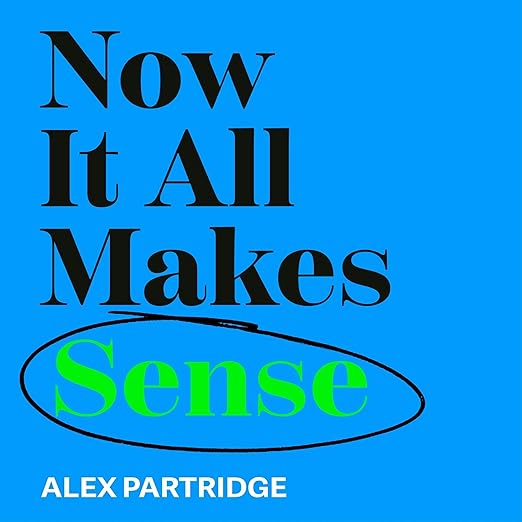
I was halfway through my Thursday morning walk when one of the reviewers of this book made me stop on the pavement and stand still for a moment. He described running across Alex Partridge in a social media reel and spending the next hour bingeing content because everything Partridge described had happened to him too, for fifty years. Everything. I know that feeling. Not necessarily about ADHD specifically, but the sensation of hearing someone articulate something you had been living inside of without language for it. That moment of sudden vocabulary is what the best nonfiction does, and it is what Now It All Makes Sense sets out to deliver.
Alex Partridge co-founded UNILAD and LADBible at twenty-one, built platforms with a combined following of a hundred million people, then nearly lost everything to a legal dispute and a descent into alcoholism before being diagnosed with ADHD at thirty-four. That arc is the spine of the book, but the book is not really about the arc. It is about what the diagnosis made legible in retrospect. The appointments forgotten, the hyperfocus tunnels, the YouTube rabbit holes mid-sentence. Partridge has the particular gift of describing these experiences with enough specificity that they feel personal and with enough humor that they do not feel like a grief catalog.
The Self-Narration That Earns Its Keep
Partridge hosts the ADHD Chatter podcast, which has the highest chart position of any ADHD-focused podcast globally, and the man simply knows how to talk. His narration here is conversational in the way that distinguishes genuinely good audio from a read-aloud print book. You feel him thinking alongside you. The pace varies in ways that suit the content. When he is being wry, you hear it. When the emotional weight lands, there is no professional distance to insulate you from it.
Edward Hallowell, who co-wrote Driven to Distraction and is arguably the most respected ADHD clinician of the past thirty years, called this one of the most complete and moving accounts he has ever read. That is not blurb hyperbole from a publicist. Hallowell knows the literature more thoroughly than almost anyone. The fact that a book written by a podcast host and former social media entrepreneur earned that from him says something about the quality of the synthesis Partridge achieves between lived experience and clinical knowledge.
What the Podcast Format Brings to the Page
The book’s subtitle promises that an ADHD diagnosis changed Partridge’s life, and the content delivers on that by treating the diagnosis as a key that unlocks retrospective understanding rather than as an ending point. The book covers parenting with and for ADHD, mental health management, finances, and even something as quotidian as the shopping list. This is deliberately wide in scope because ADHD is wide in scope. The condition does not stop at work performance or academic outcomes; it structures daily life at every granular level, and Partridge takes that seriously.
At five hours and twenty-six minutes, the runtime is tight enough that nothing outstays its welcome. The book does not attempt to be the authoritative clinical reference on ADHD. It is, instead, a very good starting point for adults who suspect or recently know they have ADHD and need someone to tell them that the accumulated evidence of their whole life makes sense now. The expert interviews from the podcast inform the clinical sections without making them feel like transcripts, which is harder to pull off than it sounds.
Who Will Get the Most From This
The reviewers confirm what the structure promises: this lands hardest for adults who were diagnosed late, or who are still pre-diagnosis and circling the question. One listener described being diagnosed at fifty-eight and calling it a game changer. Another, diagnosed earlier in life, simply said they laughed a great deal and felt tremendous relief. The experience of ADHD in women and girls is addressed, which is a significant gap in much of the earlier literature on the subject.
If you are looking for a parenting guide, this is not it. Partridge writes from his own experience as someone with ADHD, not primarily as a parent of a child with ADHD, though that intersection is discussed. If you want a memoir that also functions as a genuinely useful framework for understanding a recently received diagnosis, this is currently the strongest option in audio.
Frequently Asked Questions
Is this book suitable for someone recently diagnosed with ADHD as an adult?
Yes, and it is arguably most powerful in that context. Partridge was diagnosed at thirty-four after decades of unexplained struggles, and the book is structured around that retrospective understanding. Late-diagnosed readers consistently report the strongest emotional response.
Does Partridge draw on clinical research or is this purely memoir?
Both, and the blend is deliberate. Partridge hosts the ADHD Chatter podcast and has interviewed dozens of leading clinical experts on ADHD. He distills that research into the book alongside his personal story. Edward Hallowell, a leading ADHD clinician, described it as one of the most complete accounts he has read.
Does the book address ADHD in women?
Yes. The book explicitly covers ADHD across genders and ages, which is an important distinction from older literature that focused primarily on hyperactive boys. Female and nonbinary ADHDers will find their experiences represented here.
How does the audiobook compare to the print version?
The self-narration by Partridge is a genuine advantage in audio. His voice has the warmth and comedic timing of an experienced podcaster, and the conversational delivery suits the material. This is one of the cases where audio is the stronger format.