Quick Take
- Narration: O’Connell reading his own work is the right call, his wry, slightly melancholy Irish voice suits the material’s blend of dread and irony perfectly.
- Themes: Civilizational anxiety, doomsday subcultures, fatherhood as an act of hope
- Mood: Anxious but oddly warm, like a worry shared over a long dinner
- Verdict: A thoughtful, personally honest meditation on existential fear that earns its somewhat hopeful ending through genuine intellectual honesty rather than false comfort.
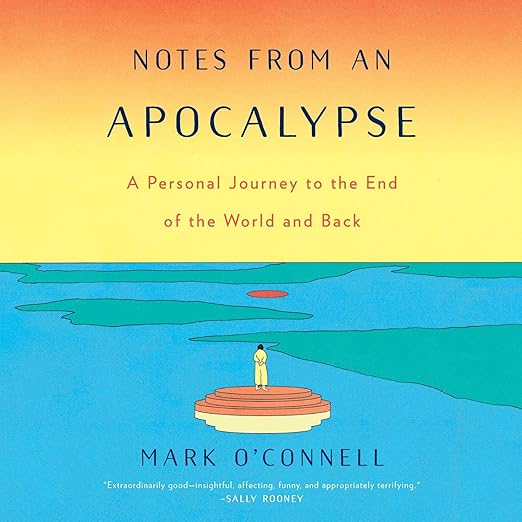
I was three hours into this one on a Friday afternoon when it started raining outside and I made no effort to move away from the window. That kind of arrested listening is a reliable signal for me, the writing is doing something real when I stop tracking time. Mark O’Connell has a gift for making his own anxiety feel like good company, and Notes from an Apocalypse works precisely because it never pretends to be more certain than it actually is.
O’Connell is a Dublin-based writer who won the Wellcome Book Prize for To Be a Machine, his investigation of transhumanism. That book was also concerned with what humans do with their fear of death and their desire to escape biological limitation. This one is the domestic, earthbound version of the same preoccupation: what does it mean to have children, to love specific people in specific places, when the available evidence suggests civilization may not hold?
Survival Bunkers and the Theology of Retreat
The book’s most vivid material comes from O’Connell’s field reporting. He tours luxury survival bunkers in South Dakota, converted missile silos marketed to the extremely wealthy as insurance against collapse. He travels to New Zealand, which has become a kind of ideological safe haven for Silicon Valley billionaires who believe, or at least hedge against the belief, that something will go terribly wrong. He visits Chernobyl as a tourist, watching the exclusion zone transformed into a peculiar destination for people who want to see what the aftermath of catastrophe actually looks like.
What O’Connell does well in all of these encounters is resist the easy satirical distance. He finds the bunker sellers strange and their customers stranger, but he also recognizes something of himself in the underlying fear. A reviewer noted that the book gives him hope and inspires belief that things will be better, which is an interesting response to writing that is, by O’Connell’s own admission, saturated with dread. The hope is not argued for; it accumulates through honesty.
The Prepper Worldview, Examined Without Contempt
O’Connell visits preppers and right-wing conspiracists, and this section of the book is where his credibility as a narrator is most tested. He is clearly not sympathetic to the political valences of much prepper ideology, but he is genuinely curious about what it feels like from the inside, what kind of relationship to the world produces a desire to withdraw from it and build parallel infrastructure. His account of these encounters is more sociologically generous than most mainstream journalism on the subject, without being naive about what he is observing.
One reviewer found the book too loose, describing it as a collection of travel essays rather than a sustained argument. I understand that criticism but disagree with the verdict. The looseness is structural but not accidental. O’Connell is writing about a mood, a pervasive ambient condition of the present, and that subject does not submit to tidy argument. The essay form is appropriate to the material.
Self-Narration and the Question of Tone
O’Connell reading his own work is the best possible choice for this particular book. His voice carries a dry, slightly exhausted quality that the text requires, he sounds like someone who has genuinely thought about these things for too long and has arrived at something provisional rather than resolved. The audiobook format emphasizes the personal dimension of the project in a way that a different narrator could not replicate. When he talks about his children, about why having them in this particular historical moment feels both terrifying and defiant, the intimacy of a self-narrated performance gives those passages their full weight.
Who Should Listen and Who Should Skip
This is the right audiobook for readers who find themselves in a pattern of reading apocalyptic news and wanting to understand their own response to it with more clarity and less reflexive despair. If you want actionable guidance or a structured argument about what to do about climate change or civilizational risk, this is not that book. It is a meditation, and meditations have their own demands. Listeners who prefer O’Connell to reach firmer conclusions may find the open-endedness frustrating. Those who find value in sitting inside a difficult question honestly posed will find the seven hours well spent.
Frequently Asked Questions
Is this primarily a travel book, a cultural criticism book, or a personal essay collection?
It is all three, which is both its strength and the source of occasional criticism that it lacks focus. The travel reporting gives it texture, the cultural analysis gives it weight, and the personal essay framing gives it honesty.
How does O’Connell treat the preppers and bunker builders he visits? Is this a hit piece?
No. He is clearly skeptical of certain ideological premises, but he approaches his subjects with genuine curiosity rather than contempt, and the result is more illuminating than a satirical treatment would be.
Does the book reach any conclusions about how to live with civilizational anxiety?
Provisionally, yes. The ending is described by multiple reviewers as somewhat hopeful, but O’Connell earns that note through honesty rather than argument. Do not expect a self-help resolution.
Is this appropriate for listeners who are already anxious about climate change, pandemics, and political instability?
That is actually the core audience. O’Connell shares those anxieties and the book functions as a kind of companionship in them, not as reassurance that everything will be fine.