Key Details
- Read by: Kitty Hendrix reads the 101-item catalog with clean, even-handed directness that never softens Frankel's bluntest observations.
- At its heart: Career self-sabotage, workplace communication habits, professional image
- Vibe: Direct, coaching-toned, occasionally very funny
- Short version: A genuinely useful, specific catalog for listeners who want nameable fixes, dated in spots but still worth the eleven hours.
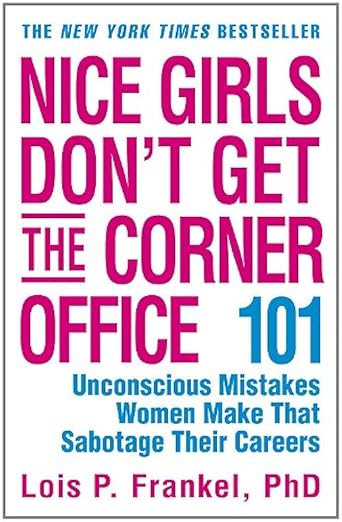
One hundred and one behaviors, according to Dr. Lois Frankel, are quietly working against women's careers without most women ever noticing them happening. Nice Girls Don't Get the Corner Office catalogs those behaviors one at a time, from over-explaining a simple answer to polling colleagues before making a decision that was never really a group decision, and pairs each one with a specific coaching correction. This audiobook runs just under eleven hours, long enough to sit with all 101 entries rather than skimming a highlight reel of the most obvious ones.
Structured Like the Art of War for Women
The book's real strength is specificity. Rather than vague empowerment language, Frankel names concrete, nameable behaviors, working nonstop without breaks, apologizing preemptively, backing down too easily under pushback, and explains exactly why each one reads as junior or tentative in a professional setting. Reviewer S. A. Martin's framing captures how the book actually gets used in practice: identify which of the 101 apply to your specific situation rather than treating the whole list as a uniform diagnosis.
Reviewer danielle's reaction is worth naming directly: a self-help book from a PhD author that she expected to feel dry instead had her laughing throughout, funny enough to become her book club's selection for the month. That combination, real specificity paired with genuine wit, is not the default register for career self-help, and it's a meaningful part of why the book has stayed in circulation as long as it has.
Reviewer S. A. Martin's own comparison, calling it "the Art of War for Women," is worth taking seriously as a description of structure rather than just a catchy line. Like Sun Tzu's strategy text, the book is prescriptive and tactical rather than purely motivational, organized around specific, repeatable moves rather than general encouragement to believe in yourself, which is exactly the register that makes its coaching land as usable rather than aspirational.
Two specific behaviors from the synopsis reward closer attention. "Explaining too much when asked for information" undercuts authority in a very particular way: it signals to a listener that the speaker doesn't trust her own answer to stand on its own, inviting exactly the follow-up scrutiny a confident, brief answer would have avoided. "Polling friends and colleagues before making a decision" reads as collaborative on its face, but Frankel's point is that it often disguises a decision the speaker has already made, diluting her own authorship of it before anyone else even weighs in.
"Working nonstop without a break," the first behavior named in the synopsis, gets a similar close reading elsewhere in the book: in senior leadership perception, constant visible busyness reads less like dedication and more like an inability to prioritize or delegate, the opposite of the calm, strategic presence the corner office actually rewards. That inversion, the behavior that feels like proof of commitment actually undercutting the case for promotion, is the pattern running underneath most of the book's 101 entries.
Hearing a corrected response modeled aloud, in a narrator's actual voice and cadence, does something silent reading can't quite replicate: it gives a listener a template for tone, not just content, to rehearse before trying a more assertive phrasing out loud themselves in an actual meeting. For a book explicitly about changing communication habits, that audio-specific rehearsal value is a real, practical advantage over the print edition.
Built for a Performance Review Cycle
Kitty Hendrix narrates with even-handed directness across the full catalog of 101 behaviors, reading Frankel's blunter observations without softening them into something gentler than intended. That clean, professional delivery serves the coaching register precisely: the book works because it names uncomfortable patterns plainly, and a narrator who hedges or over-warms the delivery would undercut the whole approach.
The catalog structure suits audio better than it might first seem. Each of the 101 behaviors functions almost as a self-contained mini-chapter, which makes the audiobook easy to dip into and return to rather than requiring a single continuous sitting, a real practical advantage for a reference-style book that listeners are likely to revisit rather than finish once and shelve.
That revisiting pattern makes the book a natural fit to pair with something like a performance review cycle or a regular mentoring conversation, returning to specific sections when a relevant situation actually comes up rather than trying to absorb and apply all 101 corrections at once. Coaching material tends to stick better when it's revisited at the moment it's needed, and the audiobook's structure genuinely supports that use.
A Reviewer Writes in From Corfu, Greece
Worth flagging honestly: the book carries a certain dated quality in places, its framing of "girlish" versus professional behavior leans more gender-essentialist than current workplace-advice writing tends toward, a function of when it was written rather than a flaw unique to this edition. Listeners sensitive to that framing should know it going in rather than being surprised by it midway through.
Reviewer lia manesi's response from Corfu, Greece, is worth noting as evidence the coaching content travels well beyond the US corporate context it's ostensibly built around, even though the book's specific examples and scenarios remain fairly US-workplace-centric. That's a real, if partial, answer to anyone wondering whether the advice generalizes outside American office culture. Because audio doesn't offer the same searchable index a print or ebook edition would, listeners hoping to jump straight to one specific behavior later may find themselves scrubbing through timestamps rather than flipping to a page, a real navigation tradeoff worth knowing about for a reference-style book like this one.
The book belongs to an ongoing lineage of women's workplace advice that later, better-known titles like Sheryl Sandberg's Lean In continued in different form, part of a decades-long conversation about why women's career trajectories stall in ways men's don't. Knowing that lineage helps situate this specific book's contribution: it's less about grand structural argument and more about the granular, day-to-day behavioral fixes an individual reader can act on immediately.
A Book Club Pick That Sparks Real Discussion
Women early-to-mid career looking for concrete, nameable behavior corrections rather than motivational abstraction are the clearest audience, and the book club angle is a genuinely real use case too, reviewer danielle's group picked it specifically because it generated actual discussion rather than passive agreement.
Skip it if gendered career-advice framing itself feels like the wrong lens for your particular situation, or if you're specifically looking for the most current, intersectional treatment of workplace bias rather than a behavior-by-behavior catalog written from an earlier moment in that conversation. The coaching content still holds up individually, but the overall frame hasn't been updated to match how the discussion has evolved since, and readers wanting a book built around systemic critique rather than individual behavior change should look elsewhere first.
Common Questions
How does Kitty Hendrix's narration handle Frankel's more blunt observations in this audiobook?
She reads them with clean, even-handed directness rather than softening them, a delivery choice that suits a book built around naming uncomfortable patterns plainly rather than cushioning the coaching.
Is this self-help audiobook outdated for today's workplace conversations?
Some of its framing around "girlish" versus professional behavior reads as more gender-essentialist than current workplace-advice writing, a product of when it was written, though the individual behavioral coaching still holds practical value.