Quick Take
- Voice: Michael Kramer delivers Chris Voss's techniques with authoritative clarity; his no-nonsense pacing suits a book that respects the listener's time and intelligence.
- Big ideas: Tactical empathy, the psychology of agreement, high-stakes communication
- Atmosphere: Sharp, practical, and genuinely surprising
- Worth it?: Chris Voss translates FBI hostage negotiation methodology into everyday applications with enough case study grounding that the principles feel tested rather than theoretical.
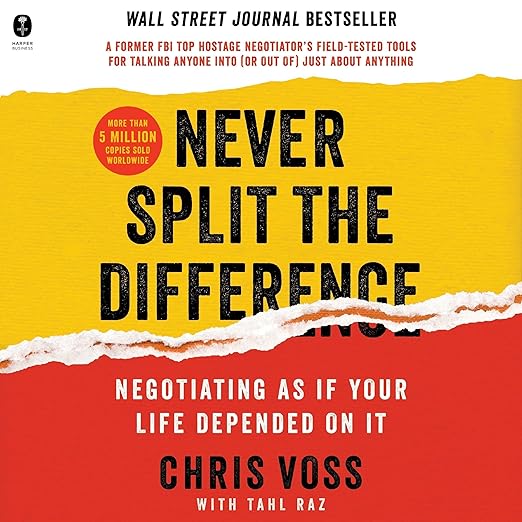
Never Split the Difference opens the audiobook with a claim that most business communication books don't make: that everything we assumed we knew about rational negotiation is wrong. Chris Voss, the FBI's former lead international kidnapping negotiator, is not being provocative for effect. The book's central argument, that humans are not rational decision-makers and that negotiation systems built on the assumption of rationality systematically fail as a result, is grounded in years of life-or-death field experience. Michael Kramer narrates the 8-hour-and-7-minute audiobook with an authority that serves the material's tone: direct, evidence-driven, and impatient with abstractions that don't cash out in practice.
The Voss methodology has accumulated over 5 million copies sold, which is not incidental to the case for reading it. Negotiation books for general audiences tend to cluster around two failure modes: either pure theory with no operational specifics, or tactical checklists with no underlying psychological grounding. Voss threads that needle by rooting his techniques in the brain science of decision-making and then demonstrating them through specific case studies from his FBI career, including bank robbers, terrorists, and kidnapping scenarios where the margin for error was zero. The transfer to salary negotiations and parenting arguments is the book's deliberate extrapolation from that extreme, and it works because the principles don't depend on the size of the stakes to function across different contexts.
Yes Commits, No Creates Space
The tactical empathy framework is the book's most durable contribution to the genre. Voss's argument is that listening is not passive preparation for your next argument but the primary tool itself. Tactical empathy means understanding what the other party feels and making them feel understood, not as manipulation but as the prerequisite for any productive outcome. The counterintuitive move of treating No as a more useful answer than Yes is a representative example of how Voss's framework inverts conventional negotiation wisdom. Yes commits; No creates space. That inversion is disorienting the first time and obvious the third time, which is a reliable sign of genuine insight rather than rhetorical cleverness.
One reviewer, a medical malpractice attorney, described the book as one of the most practical and eye-opening they'd encountered on the subject. The attorney audience is telling: legal negotiation is high-stakes and formally structured, the context furthest from the improvised pressure of a hostage situation, and yet Voss's principles transfer. A reviewer expecting hard-selling tactics instead found practical, human-centered strategies that actually work in everyday situations. That gap between expectation and delivery, from confrontational manipulation to something closer to structured compassion, is where the book's reputation comes from and why it has sustained readership across multiple audience types.
Kramer Delivers the Late-Night FM DJ Voice
The audiobook format is genuinely well-suited to this material. Voss's techniques are about voice, pacing, and the specific words chosen in a conversation. Hearing Kramer deliver the late-night FM DJ voice technique, the calibrated questions, the specific language of tactical empathy, gives the principles a sonic grounding that the page version can only approximate. The chapter on mirroring, where repeating the last few words of what someone said becomes a tool for drawing out further disclosure, is far more useful when you've heard it modeled than when you've only read a description of it on the page.
The 8-hour runtime is structured as a series of skill-focused chapters with clear payoffs. Calibrated questions, the accusation audit, the technique of getting to a genuine commitment rather than a false yes, all receive their own chapter with case study support and explicit how-to instruction. Kramer's clean narration makes the sequential processing feel natural rather than academic. This is a book that listeners tend to revisit, because the techniques are easier to absorb in repeated exposure than in a single pass. The audiobook format accommodates that kind of practice-oriented, recurring relationship with the material.
The Black Swans Chapter Stays Conceptual
The hostage negotiation case studies are compelling but carry an inherent limitation: the power asymmetry in those situations, where one party controls whether people live, is not replicated in most civilian contexts. Voss is honest about the need to calibrate application, and the techniques themselves are genuinely portable, but listeners who apply them without sensitivity to context may find the methods producing friction rather than resolution in lower-stakes situations. The book encourages self-awareness about this; first-time readers occasionally need a second pass before the judgment about when and how to deploy particular techniques fully develops.
The chapter on Black Swans, the unknown unknowns that can change the entire landscape of a negotiation, is the most conceptually ambitious section and the least operationally specific. Voss is describing a category of information you don't know you don't have, which is definitionally difficult to prepare for. The chapter is worth attending to carefully because the principle is real and important, but expecting tactical takeaways from it in the same way as the earlier technique chapters will leave you unsatisfied. It's a conceptual framework, not an instruction set.
Listen if You Negotiate in Any Context
Listen if: you negotiate in any professional context, including sales, management, law, or any situation involving competing interests, and want a psychologically grounded framework that has been tested in extreme conditions. The audiobook format is particularly strong for absorbing the verbal techniques that are central to Voss's method and need to be heard to be internalized.
Skip if: you are looking primarily for a formal negotiation theory text with academic framework. Voss writes for practitioners. The book is empirically grounded but not academically structured, and listeners expecting the latter will find the approach too anecdotal despite the quality of the underlying anecdotes and the credibility of the case studies involved.
Common Questions
How does Michael Kramer's narration serve the Never Split the Difference audiobook?
Kramer narrates with authoritative, no-nonsense clarity that matches Voss's direct writing style. He doesn't over-perform the case studies but keeps the energy consistent across the 8-hour runtime, which makes this a book that sustains focus over multiple listening sessions without becoming monotonous.
Is this audiobook more useful for professional negotiators or general audience listeners who just want better communication skills?
Both audiences report significant value, but the book is genuinely calibrated for general audiences. Voss uses FBI extreme cases as the source material but explicitly transfers principles to salary negotiations, parenting conversations, and business deals throughout. General listeners often find it transformative in ways professional negotiators with existing training may not.