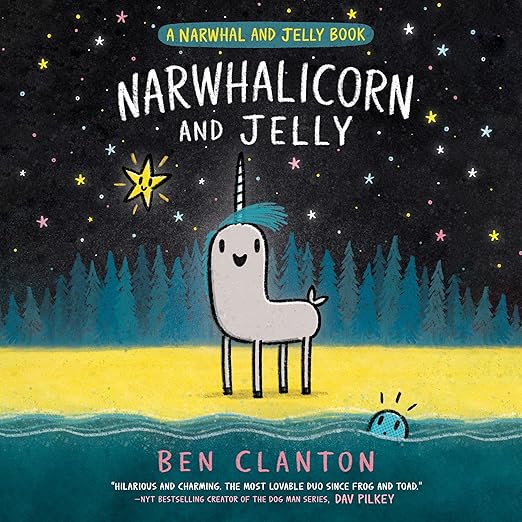
My nephew is seven, and he went through a phase last winter where he refused to try anything new at dinner, at school, or in books. His teacher recommended the Narwhal and Jelly series, and I picked up this seventh installment on a rainy Saturday afternoon. We listened to it together on my laptop while he ate his soup, and by the time Narwhal was wobbling around on land legs, he was giggling so hard he nearly knocked the bowl off the table. That is not a small thing for a child who was, at the time, deeply committed to staying within his comfort zone.
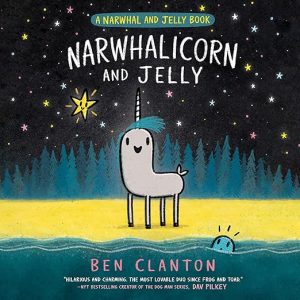
Narwhalicorn and Jelly is a sixteen-minute listen, which sounds brief until you realize Ben Clanton has packed an entire philosophical argument for friendship and adventure into that runtime without it ever feeling rushed or preachy. It is the seventh book in the series, but you do not need any prior knowledge of Narwhal and Jelly to enjoy it. The premise is self-contained: Narwhal wants to see a unicorn, explains to Jelly that unicorns are basically narwhals of the land, and then the whole thing escalates beautifully from a simple wish into a planet-hopping escapade driven by a star named Star. The logic is the logic of childhood imagination, and Clanton commits to it fully.
The Review
Narwhal is one of the more genuinely optimistic characters in children's literature right now, and what makes that optimism work is that it is never saccharine. Narwhal does not lecture Jelly about being braver. Narwhal just gets excited and invites Jelly along, and the story trusts that the companionship itself is the invitation. When Jelly feels out of his element on the unicorn planet, Narwhal notices and responds without making a big production of it. That emotional attentiveness, rendered in a story this short and silly, is quietly impressive.
The detail that a reviewer named Jason Adams shared resonates here: his son started reading back to him using the Narwhal books, taking the Narwhal lines while the father handled the other characters. That kind of co-reading, where a child claims a voice for themselves, says a lot about how Clanton writes Narwhal. The character is accessible, enthusiastic, and distinct enough to inhabit without it feeling like a performance.
Why Narwhalicorn and Jelly (A Narwhal and Jelly Book #7) Works as an Audiobook
Socks Whitmore's narration is a genuine asset here. Short-form children's audiobooks live or die by how quickly a narrator can establish character voice without overplaying it, and Whitmore threads that needle well. Narwhal gets a kind of breathless wonder, Jelly gets a drier, more skeptical cadence, and Star gets something appropriately magical and slightly chaotic. None of the voices feel forced, and Whitmore keeps the pacing brisk without making the story feel rushed. For a sixteen-minute listen, that pacing discipline matters enormously.
Listening Library has produced the audio cleanly, which matters when you are playing something for a young child who will lose interest if the sound quality is muddy or if there are long pauses. There are none here. The whole thing is crisp and immediate.
A Few Reservations
One of the things I appreciate most about this installment is how it handles Jelly's discomfort on the unicorn planet. Jelly wishes he were home, and that is not framed as a failure. Narwhal does not tell Jelly to push through or be less sensitive. Instead, the story finds a way to honor both the adventure and the longing for familiarity. That is a genuinely nuanced message for a picture-book series, and it lands without any heavy-handedness because it is embedded in such absurdist, affectionate comedy.
Multiple reviewers note how easy these books are to read aloud, how appropriate the content is, and how the silliness never tips into meanness. Those qualities carry over fully into the audio format. This is a story where being a little land-sick is understandable, where wanting to go home is valid, and where friendship means cheering someone up even when you are in the middle of a unicorn party.
Who Should Pick Up Narwhalicorn and Jelly (A Narwhal and Jelly Book #7)
This is aimed squarely at children aged four to eight, and it works beautifully in that range. Parents, grandparents, or older siblings looking for something short to share during a car ride, a lunch break, or a bedtime wind-down will find it ideal. If you are new to the series, this installment is accessible on its own, though fans who have followed Narwhal and Jelly through the earlier books will likely get extra pleasure from seeing familiar dynamics play out in such a wild new setting.
If you are hoping for something with plot complexity or longer narrative arcs, this is not that. But if you are looking for sixteen minutes of genuine warmth, well-executed silliness, and a small child laughing so hard they nearly upset their soup bowl, this is exactly what you need. The free audiobook version on Audible makes it easy to try without any commitment, which is all the reason you need to press play.
- Narrator: Socks Whitmore brings exactly the right bouncy energy to Narwhal's enthusiasm and Jelly's reluctant skepticism, keeping the 16-minute runtime fizzing from start to finish.
- Subjects: Friendship and loyalty, stepping outside your comfort zone, imagination run wild
- Tone: Bubbly, goofy, and warmly reassuring
- Bottom line: A short, joyful listen that works brilliantly for early readers and younger children who need a story that celebrates both big adventures and the comfort of home.