At a Glance
- Narrator: Oliver Wyman brings period-appropriate gravitas to Hill's early twentieth-century prose, reading with the deliberate authority the material demands without becoming stiff.
- Subjects: Material success through mental discipline, the rags-to-riches archetype, early law of attraction philosophy
- Tone: Earnest and exhortatory, with the particular energy of someone convinced they have discovered universal laws
- Bottom line: As a historical document of early success philosophy and its rhetorical methods, this audiobook delivers real intellectual interest alongside its practical prescriptions.
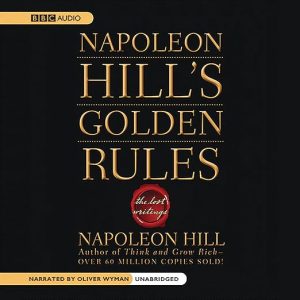
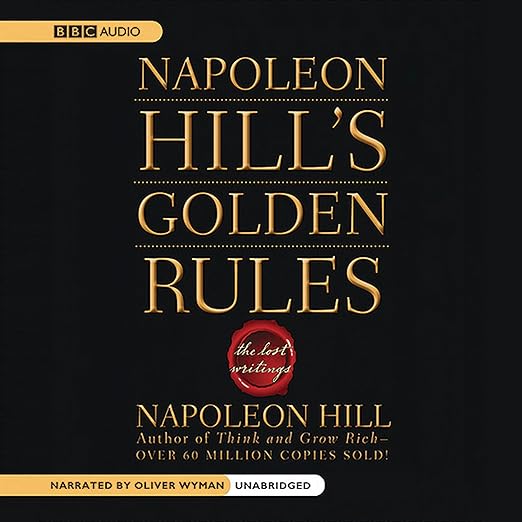
Napoleon Hill's name became synonymous with success literature in the twentieth century, but the articles collected in Napoleon Hill's Golden Rules: The Lost Writings represent an earlier and in some ways more revealing Hill, writing between 1919 and 1923 for Success Magazine before Think and Grow Rich had fully codified the philosophy he would spend the rest of his career elaborating. This audiobook, narrated by Oliver Wyman over six hours and fifty-seven minutes, gives listeners access to the foundational thinking behind the Hill canon in a form that reads, accurately, as the work of a man in the process of working out what he believed.
The Chapter That Later Became The Secret
Hill was a man driven out of the poverty-stricken Appalachian Mountains by an almost obsessive desire to understand how wealth and success were achieved and sustained. The magazine articles collected here represent his sustained engagement with that question during the period when he was most actively studying successful people firsthand, conversations and correspondence with industrialists, politicians, and entrepreneurs that fed directly into his later work. The specific value of these lost writings is that they show Hill's ideas in a less finished state: more speculative, more responsive to the particular tycoons he was studying, and occasionally more direct about the discomfiting implications of his philosophy.
The chapter on the Law of Attraction, which the synopsis notes became the basis for several subsequent bestselling books including The Secret, is the section that most clearly demonstrates how Hill's ideas have both endured and been repackaged across a century. Reading it here in its original context, as a magazine article arguing from the examples of specific rags-to-riches figures rather than as the cosmological principle it would later become, makes it both more grounded and more interesting. One reviewer noted that the book contains "shocking and alarming statements" and hints at content Hill felt could not be released during his lifetime; listeners will encounter material that reflects Hill's era as much as timeless principle, which is part of what makes these writings historically valuable.
The 4.7 rating and 246 reviews for this collection speak to a devoted Hill readership that treats these lost writings as both supplementary scholarship and practical inspiration. The audiobook production allows that dual function to operate simultaneously: you can listen analytically, tracking the development of Hill's philosophical system, or you can listen as a practitioner absorbing the motivational core of his argument. Wyman's delivery serves both orientations without forcing a choice between them.
Wyman Reads With Conviction, Never Irony
Oliver Wyman's narration is a genuine asset for this audiobook. Hill's early prose is formal and rhetorical in the style of early twentieth-century popular journalism, and Wyman navigates its period rhythms with confidence. His delivery has weight without becoming ponderous, and he handles the exhortatory passages, of which there are many, with conviction rather than irony. Listeners who have encountered less careful narrations of Golden Age self-help texts, where the distance between contemporary reader and period author collapses uncomfortably, will appreciate how steadily Wyman holds the tone.
At nearly seven hours, the collection has natural variations in focus and quality, since it gathers articles written across four years for a popular magazine rather than chapters from a single sustained argument. Listeners who approach it expecting the tighter construction of Think and Grow Rich will find a different kind of text. But those who come to it as an opportunity to understand how Hill's philosophy developed, and how the rhetoric of success literature was being shaped in the 1920s, will find the loose structure appropriate to the material. The practical framework Hill offers, built around principles such as definite purpose, the mastermind concept, and controlled attention, appears here in its embryonic form, and following its development is one of the listening experience's genuine pleasures.
Period Artifacts Behind Otherwise Timeless Advice
Listen for the specific examples Hill draws on across these articles. The rags-to-riches tycoons he studied were real figures, and the specificity of his case studies, even when their names have largely faded from common knowledge, gives the philosophical arguments a grounding that later, more abstracted success literature tends to lose. The sections where Hill is most direct about the connection between mental state and material outcome are also the places where the ideology of his era surfaces most clearly, including assumptions about race, gender, and class that will strike contemporary listeners as period artifacts requiring context.
The audio format suits this material well precisely because Hill was writing for the spoken and read-aloud culture of magazine journalism. These are articles designed to be read aloud in family parlors and discussed afterward, and Wyman's narration restores something of that original context. When Hill argues a point, listen for the rhetorical structure underneath it: the anecdote, the principle extracted from it, the challenge issued to the reader to apply it. That three-part pattern runs through almost every piece and is the template on which decades of subsequent success literature would be built.
A Companion for Think and Grow Rich Readers
Listeners who have read Think and Grow Rich and want to understand where Hill's ideas came from will find this audiobook genuinely illuminating as a companion text. Students of self-help history and the cultural mechanics of the success industry will find the early 1920s magazine context as interesting as the philosophy itself. General listeners who simply want a condensed version of Hill's approach delivered with better narration than many public domain productions offer will also be served well by Wyman's performance. Those who expect the same tight organisation as Hill's better-known books should adjust expectations: this is archival material being heard for the first time in audio form, and it reads accordingly.
Before You Listen
Is Napoleon Hill's Golden Rules audiobook a standalone listen, or does it require familiarity with Think and Grow Rich?
The audiobook stands on its own as a collection of Hill's early magazine articles. Prior familiarity with Think and Grow Rich enriches the experience by showing how Hill's ideas developed, but it is not required. The articles are self-contained enough to be followed independently.
How does Oliver Wyman's narration hold up over the nearly seven-hour runtime?
Wyman maintains consistent authority across the full runtime, which is a genuine achievement given the formal and occasionally repetitive nature of Hill's 1920s prose style. His delivery suits the period material without making it feel like a historical artifact rather than a living text.
Does the audiobook include any contextual framing or editorial notes about when the articles were written?
Based on the available information, the audiobook presents the articles directly without substantial editorial framing. Listeners interested in the cultural and publishing context of Hill's Success Magazine work may want to supplement the audio with background reading on the early success movement.
Is this audiobook recommended for listeners new to Napoleon Hill's philosophy?
This collection is interesting for newcomers curious about where the Hill philosophy originated, though Think and Grow Rich remains the more complete and organized entry point into his work. For listeners already familiar with that book, Napoleon Hill's Golden Rules offers valuable historical depth and some genuinely surprising material.