Quick Take
- Narration: Maxwell Glick’s narration is the series constant, comfortable and energetic, perfectly suited to a story that riffs on A Christmas Carol’s structure for a summer audience.
- Themes: Redemption and self-reflection, the mythology of summer freedom, the tension between fun and responsibility
- Mood: Playful and nostalgic, the summer vacation frame gives this special a slightly more reflective quality than the other holiday entries
- Verdict: The most structurally ambitious of the My Weird School holiday specials, borrowing Dickens’ ghost story template and applying it to A.J.’s summer expectations with surprising effectiveness.
My introduction to Bummer in the Summer happened because a second-grade teacher told me it was the book she used at the end of the school year when she needed something funny and cohesive for the last week of class. She read it aloud over three sessions and said the kids talked about it through June. The Dickens parallel did not occur to anyone in second grade. It occurred very clearly to every adult in the room when they heard the setup, which tells you exactly what Gutman is doing here and how well he hides the scaffolding.
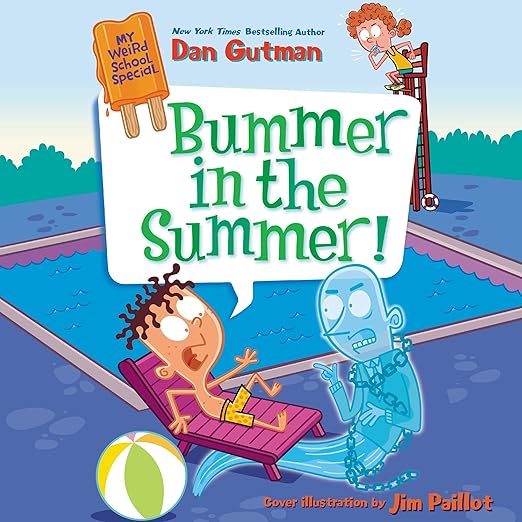
Bummer in the Summer is the My Weird School summer special, and its hook is one of the smartest things Gutman has done in the specials line: A.J. falls into a dream sequence where three spirits, summers past, present, and yet to come, show him what his summer could be and what his choices mean. It is A Christmas Carol with flip flops and Popsicles, and it works because Gutman trusts the structure enough to lean into it while keeping the register completely, unambiguously My Weird School.
The Dickens Template in Ella Mentry Clothes
Children’s literature has a long tradition of repurposing classic narrative architectures for young audiences without acknowledging the source material, the journey narrative, the three-task quest, the before-and-after redemption arc. Gutman uses the ghost story template here as a pure delivery vehicle, and the result is a book with more structural coherence than most of the holiday specials. The three-spirits framework gives the story natural sections, each with its own emotional register: past-summers nostalgia, present-summer possibility, future-summer warning. These are satisfying narrative moves even when the comedy around them is light.
What Gutman does cleverly is make A.J.’s bad ways specifically summer-bad rather than generally bad. This is not a story about a cruel child who learns kindness. It is a story about a child who has built up such an idealized vision of summer vacation that the real thing can only disappoint. The spirits are there to calibrate expectations, not to frighten, and that recalibration gives the story emotional honesty that the purely pranks-and-chaos specials do not need to attempt.
Maxwell Glick and the Dream Sequence Challenge
The dream sequence structure creates a minor narration challenge that Glick handles well: the shifts between A.J.’s present consciousness and the spirit-guided journeys need tonal markers that distinguish the register without being heavy-handed about it. Glick has enough practice with this character that he can modulate A.J.’s baseline voice, slightly surprised, perpetually narrating his own life, into a dreamier, more uncertain key for the spirit sections without losing character consistency.
At one hour and seventeen minutes, this is mid-length for the specials and the runtime earns its ground. The three-act structure means each section has room to develop before the resolution, and the pacing is more deliberate than the prank-war or leprechaun entries. The 585 rating count is significantly higher than most of the other specials reviewed here, suggesting this is one of the more read and listened-to entries in the line.
Summer Reading and the Listening Habit
Bummer in the Summer serves a double function that Gutman is clearly aware of: it is a summer special that also implicitly argues for the value of books during summer vacation. A.J.’s vision of the perfect summer involves not reading, and the spirits gently but firmly complicate that vision. For parents and teachers trying to maintain reading habits over the summer months, this is a book that does their work for them without feeling like a public service announcement.
The summer-break timing also makes this one of the My Weird School specials most likely to be encountered outside of school contexts. It is a car trip listen, a vacation listen, a rainy summer afternoon listen. The Dickens-without-Dickens structure means children who encounter A Christmas Carol in later years will have a frame of reference already installed, which is a gift they will not know they received until they need it.
Who Should Listen and Who Should Skip
For children ages seven to eleven who are transitioning into summer break mode and need something that meets them there. Also the My Weird School special most likely to land for adult listeners accompanying young children, because the structural elegance is visible without effort once you recognize what Gutman is doing. Skip it if you want straightforward school-setting comedy, the dream structure gives this a slightly different quality than the other specials, and some readers who want pure Gutman chaos may find the reflective premise less satisfying.
Frequently Asked Questions
Is Bummer in the Summer a retelling of A Christmas Carol?
Not officially, and Gutman does not name the source, but the three-spirits structure, the protagonist’s bad ways, and the past-present-future framework are unmistakably drawn from Dickens. It functions as an homage in My Weird School clothing, and the structure gives the story more coherence than most of the holiday specials.
Why does this special have significantly more ratings than the others in the series?
Bummer in the Summer appears to be one of the more frequently read and listened-to entries in the specials line, possibly because the summer premise makes it a natural school-year-end and summer-break title with a longer usage window than holiday-specific specials. Teachers and parents return to it annually.
What are A.J.’s bad ways that the spirits are trying to correct?
The book is careful to keep A.J.’s flaws age-appropriate and relatable, this is not a story about serious wrongdoing. His bad ways involve a passive, self-indulgent vision of summer that excludes effort, consideration for others, and the small acts of care that make good summers actually good. The correction is gentle and earned.
Is this one better or worse as a standalone listen compared to other My Weird School specials?
It works particularly well as a standalone because the dream-sequence structure is self-contained and requires no prior series knowledge. The Dickens framework provides enough narrative architecture that new listeners have clear footing throughout. Fans of the series will find additional enjoyment in the familiar characters and voice, but it does not require them.