Quick Take
- Narration: Eight narrators share the sixty-four interviews, each bringing distinct vocal texture to different subjects, though the switching can occasionally interrupt flow.
- Themes: Habit formation, productivity rituals, personal identity through daily structure
- Mood: Curious and energizing, like flipping through a well-curated magazine at 6am
- Verdict: A genuinely varied survey of morning practices that works best as inspiration fodder rather than a prescriptive manual.
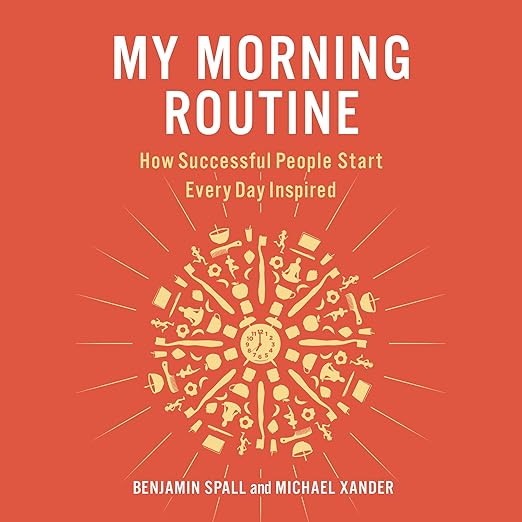
I started listening to this one on a Monday, which felt either perfectly timed or a bit on the nose. I had been wrestling for weeks with a morning that kept dissolving into phone-scrolling and cold coffee, and somewhere in the middle of Ed Catmull’s espresso-and-cocoa ritual, I found myself actually taking notes. That doesn’t happen often. The fact that it happened here says something real about what Benjamin Spall and Michael Xander have built.
The book grew out of the My Morning Routine interview series, and the audiobook format captures that conversational energy well. Eight narrators including Will Damron, Kaleo Griffith, Dominic Hoffman, and Hillary Huber rotate through sixty-four profiles of people ranging from Olympic medalist Rebecca Soni to General Stanley McChrystal to Marie Kondo, who apparently tidies her own mind before leaving the house each day. Jillian Michaels doesn’t set an alarm because her five-year-old handles that task for her. The variety is the point, and it’s genuinely refreshing.
The Range That Makes This Work
What Spall and Xander understood when designing this book is that no single morning routine can be universally prescriptive. The spartan 4am cold-shower crowd lives here alongside people who insist the first hour belongs to leisure and nothing else. Twitter co-founder Biz Stone’s approach looks nothing like Rebecca Soni’s, and that contrast is where the value lives. Rather than declaring one method correct, the authors let the subjects speak, and the audiobook’s multi-narrator casting mirrors that democratic editorial philosophy. You get a different voice for each world, which reinforces the sense that there is no singular template.
One reviewer who works as a teacher mentioned she wasn’t sure she’d relate to CEO routines, then found herself surprised by how many echoes there were. That’s the book’s most quietly effective move: even the most extreme routines contain recognizable impulses. Everyone is trying to start their day with intention rather than reaction. The Jenga metaphor the authors return to, about foundational blocks determining the stability of everything above, is slightly overworked by the end, but it’s not wrong.
Eight Voices, Sixty-Four People
The multi-narrator format is worth addressing directly. It’s an ambitious production choice and it mostly earns itself. Will Damron and Kaleo Griffith in particular have the kind of grounded delivery that suits interview-based nonfiction. The rotation can feel choppy when profiles are short and the narrators cycle quickly, but for longer entries where a subject gets space to develop their thinking, the distinct voices add genuine texture. You register shifts in personality more clearly when the delivery changes than you might with a single narrator reading everything in a uniform register.
The book’s structure moves from the interview profiles into actionable guidance, which is where some listeners may find it loses momentum. The second half reads more like a conventional self-help manual, covering how to survive missed alarms, how to build consistency, how to adapt when life interrupts. It’s useful, but it doesn’t have the same readability as the profiles. That drop-off is common in books built on interview research, and it’s a structural limitation rather than a quality failure.
What the Routine Obsession Is Actually About
Reading this book critically, there’s a case to be made that the morning routine genre is less about productivity and more about identity management. The routines profiled here all say something about how these sixty-four people want to see themselves. Catmull’s precise espresso ritual suggests a person who values controlled complexity. Kondo’s pre-departure tidying ritual reflects her entire philosophical framework applied to time. McChrystal’s military discipline maps onto civilian mornings in ways that feel almost theatrical. The book doesn’t explicitly make this argument, but it’s present beneath the surface for anyone reading with that lens.
That subtext is what elevates this slightly above the standard productivity compilation. Spall and Xander seem genuinely curious about the people they interviewed, not just the tips they can extract, and that curiosity transmits through even the shorter profiles. The audiobook is particularly well suited to this because you encounter these routines while doing your own morning thing, which creates an unusual feedback loop: someone else’s ritual playing in your ears while you navigate your own.
Who Gets the Most from This
If you’re already deeply committed to a morning routine that works, this book will offer limited new information. If you’re looking for a rigid system with specific steps, the second half gestures in that direction but doesn’t deliver the kind of granular protocol that books like Hal Elrod’s Miracle Morning provide. Where My Morning Routine excels is as a wide-angle survey of how people across radically different lives have chosen to start their days. It’s the conversation starter version of morning habits, not the deep-dive implementation guide.
The audiobook length at just under seven hours feels right for the format. Long enough to cover the ground thoroughly, short enough that it doesn’t outstay its welcome. The teacher reviewer who found herself surprised by the relevance of CEO routines named exactly the audience who will benefit most: people who feel skeptical about productivity culture but are curious enough to listen anyway.
Frequently Asked Questions
Does the eight-narrator format make the audiobook feel disjointed?
Occasionally, particularly when short profiles switch narrators quickly. But for the longer, more developed interviews, the different voices reinforce the sense that these are distinct people with distinct worlds. Will Damron and Kaleo Griffith anchor the production steadily.
Is this book more interview collection or practical guide?
Primarily interview collection. The sixty-four profiles from subjects like Marie Kondo, General McChrystal, and Rebecca Soni take up the larger portion. The second half shifts toward general morning routine advice, but that section is less distinctive than the profiles.
How does this compare to other morning routine or habit books like The Miracle Morning?
Very different in approach. Spall and Xander don’t prescribe a single system. They present a wide range of practices and let listeners draw their own conclusions. Think survey journalism rather than coaching manual.
Is the audiobook notably better or worse than the print version of this book?
Several reviewers note that the multi-narrator production adds real value over reading. The conversational origin of the material translates naturally to audio, and listening while navigating your own morning creates an oddly fitting contextual overlap.