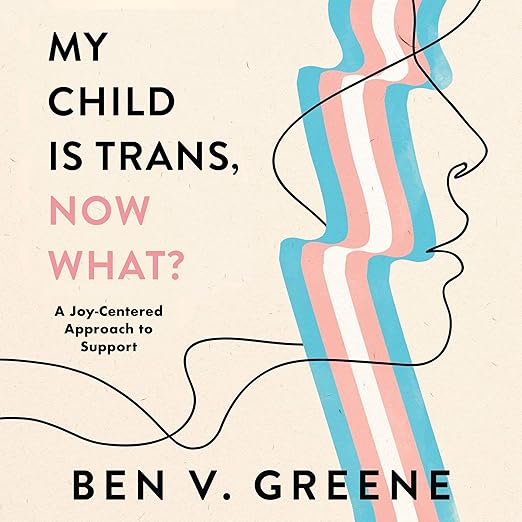
- Performance: Ben V. Greene narrates his own book, and his public-speaker fluency and personal warmth make the listening experience feel like direct conversation rather than instruction.
- What it covers: Supporting trans youth, overcoming fear of saying the wrong thing, practical family navigation, and building genuine allyship across generations.
- Feel: Warm, practical, and consistently encouraging without minimising the genuine complexity of the subject.
- Our call: An essential resource for parents of trans youth that also serves teachers, counsellors, and anyone in a supporting role. Greene's personal narration elevates an already strong guide.
Ben V. Greene's My Child Is Trans, Now What? is one of the clearest and most practically useful audiobooks available to parents navigating their child's gender identity, and the fact that Greene narrates it himself makes the experience distinctly more powerful. Greene, a full-time public speaker who specialises in trans awareness and education, brings exactly the tone you want for this material: informed, warm, direct, and utterly free of the condescension that can make parenting guides feel patronising.
Paralyzed by Fear of Saying It Wrong
The book begins from a painfully honest observation about the current cultural moment. Parents who want to support their trans children often find themselves paralysed by fear of saying the wrong thing. The combination of exhaustion among trans people who have become default educators in their own communities and the social penalty attached to public missteps has produced a culture where well-meaning people opt out of asking questions rather than risk getting something wrong. Greene's response to this dynamic is to offer a genuinely judgement-free space, one where confusion and uncertainty are treated as starting points rather than failures.
The book delivers on two explicit promises: information and emotional support. Greene provides clear definitions, explains what families can realistically expect as they navigate school systems, healthcare, and social environments, and outlines the practical resources available to support trans youth. But the emotional support dimension is equally important. Greene does not treat this as a crisis manual for parents in shock. He treats it as an invitation to build understanding, and that framing shapes every page.
Booklist called it a 'warm and generous book that will help a wide range of readers,' and Publishers Weekly described it as 'a pragmatic program for parenting beyond the gender binary.' Both assessments are accurate. The book is warm without being saccharine, pragmatic without being cold. A social worker who used it to support a family navigating a child's gender identity noted its practical value in professional contexts, which gives a sense of how broadly applicable the content is beyond the parenting audience Greene primarily addresses.
Greene's Funny, Self-Deprecating Narration of His Own Story
Greene narrating his own work matters enormously here. His voice on the page is documented as well-informed, open, funny, self-deprecating, and unfailingly upbeat, and those qualities translate directly into the listening experience. When he recounts personal stories from his own life and community, the authenticity is unmistakable. When he offers practical advice, the warmth behind it prevents the content from feeling like a checklist. This is a book that could easily have felt clinical, and it never does, because the author's own voice is present throughout in the most literal possible sense.
The personal story dimension of the book is one of its greatest assets. Greene draws on his own experience as a trans person and public speaker to illustrate points that could otherwise remain abstract. He shows what good allyship actually looks like in practice rather than simply defining it in theory. For parents who have just received their child's disclosure and are looking for something to listen to during a commute or while processing what they are feeling, this audiobook offers exactly the right combination of grounded information and genuine reassurance.
The book also explicitly addresses the generational dimension of this conversation. Different family members, from grandparents to siblings, have different frames of reference and different entry points to understanding. Greene navigates this complexity without losing the thread or becoming reductive, which is a genuine achievement in a guide that must serve a very wide range of readers simultaneously.
One parent who listened after their daughter came out noted wishing they had found the book before that moment, wanting to have had 'all this wisdom in mind' in advance. That reaction captures something important: this book works as both a reactive guide for parents already in the situation and as a proactive orientation for families who want to be prepared before their children need them to be.
Introductory by Design, Light on Regional Detail
This is a guide written primarily for parents and loved ones who are coming to these questions without prior knowledge or framework. Readers who are already deeply embedded in trans advocacy or who have extensive prior education on the subject may find some sections introductory. That is by design. The book is explicitly trying to meet people where they are rather than assume a baseline that many parents will not have.
Some listeners may also wish for more detail on specific regional resources, since support systems vary significantly by country and local context. The book's practical resource sections tend toward the general, which is a sensible choice for a guide aiming at broad applicability but may leave some readers wanting more granular guidance for their specific situation.
Written for Parents, Useful for Teachers and Coaches Too
The primary audience is parents who have just learned that their child is trans and are not sure where to begin. But as one reviewer noted, Greene's message is not just for parents of trans youth; it is for everyone, and that is genuinely true. Teachers, counsellors, social workers, grandparents, siblings, and coaches will all find material here that is immediately applicable to their relationships with trans young people. The audiobook format is particularly suited to family members who prefer to listen rather than read, and Greene's personal narration makes it feel like a conversation rather than a lecture.
Good to Know
Is this audiobook only for parents, or is it useful for other family members too?
It is explicitly aimed at a broad range of family members and loved ones. Greene addresses grandparents, siblings, and extended family throughout, and several listeners have noted its value in professional contexts like counselling and social work.
Does the audiobook assume any prior knowledge about trans issues?
No. Greene starts from first principles and provides clear definitions throughout. The book is explicitly designed for readers and listeners who are coming to this subject without an existing framework, which makes it particularly valuable as a starting point.