Quick Take
- Narration: Eric Michael Summerer reads Robinson’s communication exercises with measured, unhurried pacing that suits the structured, practice-oriented format well.
- Themes: Couples communication, conflict de-escalation, trigger awareness and active listening
- Mood: Practical and warm, like a productive session with a couples counselor
- Verdict: A concrete, structured communication guide for couples that earns strong reader enthusiasm through specificity rather than inspiration, though its brevity means it covers ground quickly.
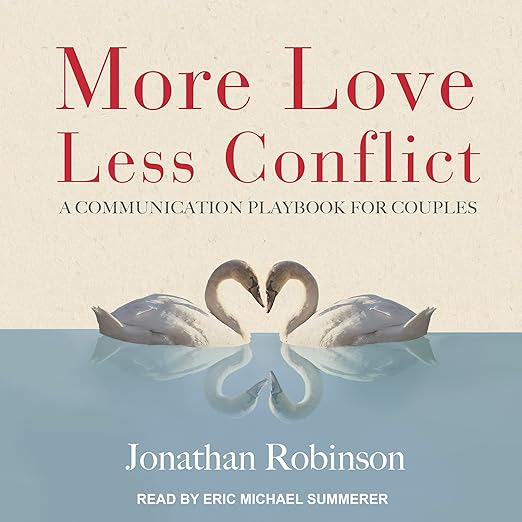
A marriage counselor recommending a book to his clients is one of the more reliable endorsements in the relationship genre. Not an influencer, not an algorithm, not a publicist with a list. An actual therapist who has been sitting across from struggling couples long enough to know what actually helps, handing someone a title and saying: read this. One reviewer of More Love, Less Conflict mentions exactly that scenario, and adds that the counselor admitted if he had read it earlier, his own first marriage might have survived. That is a specific, human thing to say, and it landed for me in a way that aggregate star ratings rarely do.
I came to Jonathan Robinson’s book without high expectations for the relationship communication genre, which tends toward the obvious. What I found instead was a book that has internalized the lesson most advice books ignore: telling people what to do is almost never sufficient. You have to show them how to practice it.
Structured Practice Over General Advice
The core of More Love, Less Conflict is a series of structured practices for couples: specific exercises designed to build communication capacity in a deliberate, low-stakes way before applying those skills in charged moments. Robinson describes this as building a communication muscle, and the metaphor is apt. You do not wait until a marathon to discover whether you can run. Similarly, couples who practice these techniques in calm moments are far better equipped when things get genuinely tense.
The content covers listening techniques, trigger recognition and avoidance, and conflict resolution frameworks. Eric Michael Summerer narrates with a pace that does not rush the exercises, which matters for a book that is genuinely asking you to stop and try something rather than just absorb an idea. He reads clearly without editorializing, and the material works well in audio because it does not rely on visual worksheets or fill-in exercises that lose their function in this format.
Why Therapists Recommend It
Multiple reviewers mention therapists or counselors recommending this book, which is worth noting as a particular kind of signal. Books that therapists recommend tend to share certain qualities: specific enough to be usable, modest enough not to oversell transformation, and grounded in techniques that hold up in actual practice rather than just in theory. Robinson, who has written extensively on communication and happiness, is not making grand claims. He is offering methods that, if practiced, should produce observable improvements in how couples handle specific kinds of difficult moments. That modesty is part of why the book has earned the trust of practitioners across counseling contexts.
One reviewer notes being able to use some techniques immediately on their own, without a partner’s participation. That is a practical point worth flagging: some of the communication habits Robinson describes are things one person can implement unilaterally, which matters for couples where engagement with the process is uneven.
The Runtime and What It Implies
At just under five hours, More Love, Less Conflict is short for the territory it covers. It moves through communication principles and techniques at a pace that assumes a motivated listener rather than one who needs extensive background explanation. For someone coming to relationship communication literature for the first time, this efficiency is an asset. For someone hoping for deeper clinical grounding or more extensive case studies, the brevity will feel like a limitation. This is better understood as a structured toolkit than as a comprehensive exploration of couples psychology, and works best when treated accordingly.
Who Should Listen and Who Should Skip
Listen if you and your partner want a practical set of communication exercises with clear structure rather than general philosophical guidance. Particularly well-suited to couples already in counseling who want at-home practice material, or to couples who recognize a recurring conflict pattern but lack the techniques to interrupt it.
Skip if you are in crisis and need intensive support beyond self-help tools, or if you want a book that explores the psychology of conflict in depth before offering strategies. This is a practice-first book, and it rewards being treated as one.
Frequently Asked Questions
Can one partner benefit from this book if the other is not willing to participate?
Yes, in part. Some of the listening techniques and trigger-management strategies are things one person can practice independently. However, the structured couple exercises Robinson builds toward are designed for two engaged participants. The solo benefit is real but partial.
How does More Love, Less Conflict compare to John Gottman’s work on couples communication?
Robinson’s approach is more immediately practical and exercise-focused, whereas Gottman’s books tend to offer more extensive research grounding and longitudinal data. They complement each other well. Gottman explains why couples communicate the way they do; Robinson focuses on specific techniques for changing those patterns.
Is Eric Michael Summerer’s narration a good fit for structured communication content like this?
Summerer reads with an unhurried, measured pacing that suits instructional material well. He does not editorialize or dramatize, which is the right call for a book asking the listener to absorb techniques rather than be entertained by them.
Is this book grounded in research, or is it primarily anecdotal advice?
Robinson draws on both research and clinical experience. The book is not as heavily cited as academic-adjacent relationship texts, but it is not purely anecdotal either. Its credibility rests primarily on the specificity and practical testability of its techniques rather than extensive footnoting.