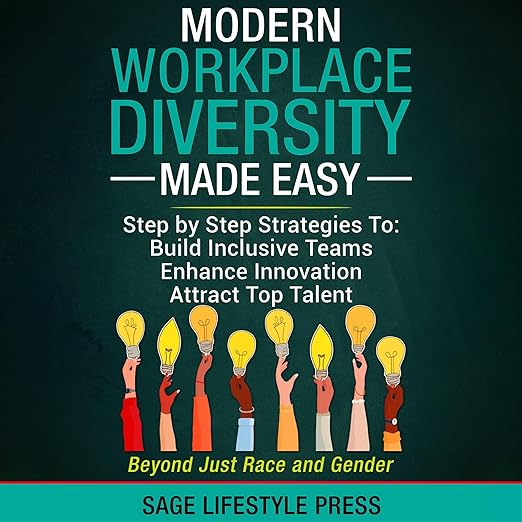
- Read by: Chris Kiefer delivers the material in a professional, unhurried register that suits this audiobook's workshop-style structure.
- At its heart: DEI implementation strategy, multigenerational team dynamics, neurodiversity in the workplace
- Vibe: Practical and measured, with an earnest emphasis on actionability
- Short version: A useful listening companion for managers and HR professionals navigating DEI initiatives without a large budget or dedicated team.
Most diversity and inclusion audiobooks fall into one of two camps: the academic overview that leaves practitioners without a usable framework, or the motivational title that offers inspiration without operational detail. Modern Workplace Diversity Made Easy makes a deliberate attempt to occupy the middle ground, and for the most part it earns that positioning. Published by Sage Lifestyle Press and narrated by Chris Kiefer, this audiobook runs three hours and forty-nine minutes and is built for the manager who has been handed a DEI mandate and needs a practical starting point rather than a philosophy seminar. The PDF companion included with the Audible purchase extends the material with frameworks and templates that the narration references throughout.
I listened to it in two sessions, once while cooking and once at my desk with the companion document open, and found that the chapter structure rewards both modes. The material is organized around distinct challenges rather than around abstract principles, which means you can engage with the section on neurodiverse employees or the section on multigenerational collaboration as a standalone module if that is what your current situation calls for. That modularity is a real design advantage in audio.
The Gap Closes Somewhere Around Monday Morning
The audiobook opens with a problem statement that most managers in complex organizations will recognize immediately: you understand that diversity matters, but the gap between that understanding and knowing what to do on Monday morning is enormous. Sage Lifestyle Press structures the content as a series of bridging strategies, each grounded in the kinds of challenges that actually stall DEI work in real organizations. Resistance from leadership. Cultural pushback from teams. Limited resources. The difficulty of communicating the business case to skeptics without reducing human dignity to a performance metric.
These are not abstract problems, and the audiobook does not treat them abstractly. Each section pairs a challenge with a practical approach, and Chris Kiefer's narration keeps the material moving without rushing through the operational detail. He reads with the tone of a competent facilitator rather than a motivational speaker, which is exactly right for content that asks listeners to apply frameworks rather than simply feel inspired by them. The overall 5.0 rating across 51 reviews suggests the material lands for its intended audience, even without the verification of named or detailed published reviews.
Neurodiversity Gets More Than a Checklist Treatment
The coverage of neurodiverse employees is one of the stronger sections of the audiobook and one that is underrepresented in most DEI resources, which tend to focus almost exclusively on race, gender, and sexuality. The material here addresses how organizations can identify and remove structural barriers that disadvantage employees with ADHD, autism spectrum conditions, dyslexia, and related differences, and it does so without reducing neurodiversity to a checklist exercise. For managers who have begun to encounter this dimension of inclusive practice but lack a working framework, this section alone justifies the listening time.
The hiring process integration section is similarly useful. Rather than presenting DEI hiring as a separate program bolted onto existing workflows, the audiobook frames it as a series of design decisions embedded in job descriptions, interview structures, panel composition, and onboarding architecture. For practitioners who have struggled to get leadership buy-in, the communication frameworks offered here, specifically how to present DEI as an innovation and retention driver rather than a compliance exercise, are among the most immediately applicable material in the audiobook.
The Generation Gap Becomes a Design Challenge
The PDF companion is the most important practical caveat for this audiobook. Some of the frameworks and tools referenced in the narration will be more accessible in print form, particularly any templates or assessment matrices. Downloading it alongside the audio is worth the extra step, and the listening experience will be more complete for it. The runtime of under four hours is well-suited to this kind of practitioner guide, but it does mean the material trades depth for breadth across its topic areas. Any single dimension of DEI, whether that is intersectionality, pay equity auditing, or psychological safety frameworks, is covered at an introductory rather than expert level.
The book carries no named or verified reviews at the time of this writing beyond the aggregate rating, which makes it harder to triangulate independent listener experience across different organizational contexts. The material itself is coherent and well-organized, and the practical orientation is consistent throughout, but claims about specific outcome data should be treated as illustrative rather than empirically validated.
The audiobook's treatment of multigenerational team dynamics is also worth highlighting. Organizations are increasingly managing teams that span Baby Boomers, Gen X, Millennials, and Gen Z, each cohort bringing different assumptions about authority, communication style, and institutional loyalty. The frameworks here address those differences as a structural design challenge rather than a generational conflict to arbitrate, which is the more useful framing for practitioners trying to build functioning teams rather than referee between demographics.
Structural and Operational, Built for Under Four Hours
This audiobook earns a targeted recommendation for managers at mid-size organizations, HR professionals building out DEI programs with limited resources, and team leaders who have been asked to handle DEI as part of a broader role rather than a dedicated function. It is not a deep-cut academic text and does not claim to be. Its value is structural and operational: a working framework for common DEI challenges, delivered in under four hours. Listeners who want a comprehensive historical or sociological grounding in workplace equity issues will need to supplement with other reading. For practitioners who need a practical framework fast, this is a well-structured starting point.
Frequently Asked Questions
Does the Modern Workplace Diversity Made Easy audiobook include a PDF companion?
Yes. The listing notes that when you purchase this title on Audible, the accompanying PDF becomes available in your library alongside the audio. The PDF includes additional frameworks and tools that complement the narrated content and are worth downloading before you begin.
Is this audiobook suitable for someone with no prior DEI training or formal background?
Yes. The material is written for practitioners rather than academics, and Kiefer's narration is accessible without being simplistic. You do not need prior DEI coursework or specialized training to follow the frameworks presented throughout the audiobook.