The Short Version
- Narration: Nicole Lapin narrates her own book, and the confessional, coaching tone depends on that choice working as well as it does.
- Themes: Beginner investing, financial independence, compound interest
- Mood: Encouraging and practical, occasionally dense
- Verdict: A strong first investing audiobook for listeners starting from zero, less useful for anyone who already has a portfolio.
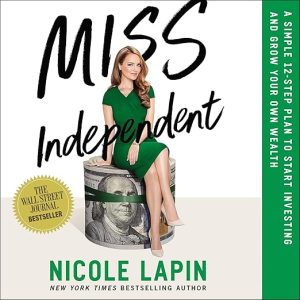
Einstein's line about compound interest being the eighth wonder of the world shows up early in the Miss Independent audiobook, and Nicole Lapin uses it exactly the way a good teacher uses a familiar quote, as a hook before the harder material. This is her third money book after Rich Bitch and Boss Bitch, and by now she has a formula that works: her own financial mistakes mixed with plain-language explanations of stocks, bonds, REITs, and the vaguer, scarier stuff like mortgages and life insurance. At nine hours and twelve minutes, narrated by Lapin herself, the audiobook moves briskly through material that could easily turn dry in someone else's hands.
Reviewer Gabrielle Platt's Two-Thousand-Dollar Tax Save
What Miss Independent gets right is sequencing. Lapin does not open with spreadsheets, she opens with the emotional case for financial independence, the ability to leave a bad job or a worse relationship, before working down into the mechanics of how to actually build savings that compound. Reviewer Gabrielle Platt says the book saved her almost two thousand dollars in taxes, which is the kind of concrete payoff that separates a motivational money book from one that changes a listener's actual bank balance. Another listener, who holds an MBA, admits she never figured out how to personally invest until this book connected the theory she already knew to a plan she could execute.
The audiobook-exclusive interview with Jesse Draper, founder of the investment firm Halogen, is a smart structural choice, since it gives Lapin's own advice a second voice to bounce against instead of ending on another chapter of her narration alone. The companion PDF, with its graphs, tables, and a financial dictionary, matters more here than in most business audiobooks, since terms like REITs and compound interest genuinely benefit from a visual anchor. Listeners who skip the PDF will still follow the audio explanations fine, Lapin defines every term before she uses it, but the download adds real reference value for anyone planning to revisit specific sections later.
The Reviewer Who Gave Her Grandson a Copy
Self-narration is the right call for a book built on vulnerability, and Lapin's own financial mistakes are the spine of her argument rather than a footnote to it. A ghost-read version of this material would flatten the confessional tone that makes the advice land as coaching instead of lecture. Her delivery has the rhythm of someone who has explained these concepts on television and podcasts for years, comfortable slowing down for a genuinely confusing term like REITs and speeding back up once the point is made. That pacing instinct is not something every author-narrator has, and it is a meaningful part of why this book works better heard than skimmed.
The reviewer who gave a copy to her grandson points at something real about the book's actual audience: this is not written only for women already comfortable with financial vocabulary, it works as a first investing book for anyone starting from zero. Lapin's central argument, that meaningful wealth does not require starting with a lot of money, only smart risk and time, gets repeated often enough across the nine hours that a listener could skip around by topic and still absorb the thesis. For a genre that often either condescends to beginners or assumes too much prior knowledge, that balance is harder to hit than it sounds.
Lapin's career before writing books included years as an on-air financial journalist and news anchor, and that broadcast background shows up constantly in how she paces an explanation, she has spent years translating market jargon for a general audience under a ticking clock, and Miss Independent reads like the long-form version of that same skill. It is a genuinely useful credential for an audiobook specifically, since the skills that make someone good at explaining compound interest in a ninety-second segment translate directly into knowing how to keep a nine-hour narration from ever feeling like a lecture.
Finding Your Number Rewards a Second Pass
Nine hours is a real commitment for a personal finance book, and the middle stretch on mortgages, investment properties, and life insurance moves more slowly than the opening chapters on the psychology of wealth. Listeners hoping for a quick primer should know this is closer to a full course than a weekend refresher. The rating of 4.6 across 276 reviews suggests the pacing works for most listeners who commit to the whole thing, but anyone shopping for a ninety-minute crash course on investing basics should look elsewhere in Lapin's catalog or treat this as a multi-session listen rather than a single commute.
The book's reliance on a companion PDF is worth naming honestly as a genre-wide audio limitation rather than a flaw unique to Lapin. Graphs and tables do not translate to sound, and a listener who never opens the download will miss the visual reinforcement the print or ebook edition builds in natively. This is not a reason to skip the audiobook, Lapin's verbal explanations are clear enough to stand alone, but anyone who learns best by seeing a compound interest curve drawn out should plan to have the PDF open at least for the investing-terms chapter.
Lapin spends real time on what she calls finding your number, the total amount of wealth someone wants before retiring, and treats it as a personal calculation rather than a generic formula. That is a smarter framing than the flat percentage-of-income advice common to the genre, since it forces a listener to define what financial independence actually means for their own life before chasing a savings target. The one drawback is that puzzling out a real number takes more active listening than most personal finance chapters ask for, which means this material rewards a second pass more than a single drive-time listen.
Self-Narration and the Draper Interview Favor Audio
Miss Independent is built for listeners at the actual beginning of an investing journey, someone who has never opened a brokerage account, does not know what a REIT is, and wants a teacher who assumes nothing while still respecting their intelligence. It also works well for anyone who has read Lapin's earlier books and wants the more advanced installment, since this one leans harder into portfolio-building than her earlier titles' broader financial literacy focus. The self-narration and the Jesse Draper interview both add reasons to choose audio over print specifically, not just as a convenient alternative format.
Listeners who already have an investment portfolio, a financial advisor, and a working knowledge of mortgages, life insurance, and portfolio basics will find long stretches of this covering ground they have already mastered. The book's target reader is explicitly someone starting close to zero, and its patience with fundamentals, a genuine strength for beginners, will read as padding to anyone further along. For that more advanced audience, Lapin's own later work or a more technical investing text will be a better use of the same nine hours.