Quick Take
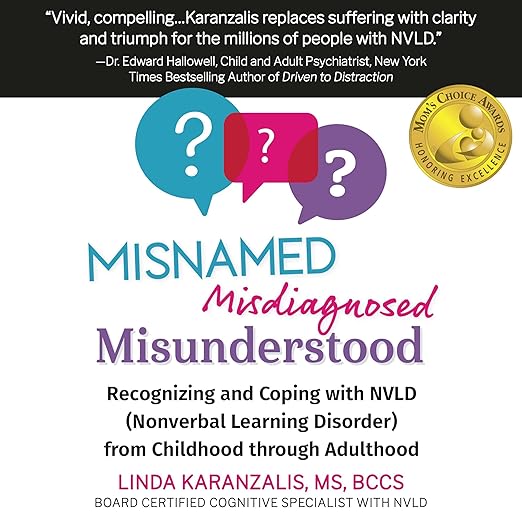
- Narration: Maggie Ross brings a warm, measured quality to Linda Karanzalis’s deeply personal account, keeping the emotional weight without tipping into melodrama.
- Themes: Nonverbal learning disorder, invisible disability, lifelong misdiagnosis and self-discovery
- Mood: Frank and quietly cathartic, with a persistent undercurrent of hard-won hope
- Verdict: An essential listen for anyone who suspects NVLD in themselves or someone they love, and equally useful for educators and clinicians encountering the diagnosis for the first time.
I finished this one on a Tuesday afternoon, and I sat with it for a while before I could write anything useful about it. There’s a specific quality to memoirs written by people who have spent decades not having words for their own experience, a particular texture of relief in the telling that you can feel even through a narrator’s voice. Linda Karanzalis spent years navigating a world that kept handing her explanations that didn’t quite fit, and the book she’s written out of that experience has that texture throughout.
Nonverbal learning disorder occupies a strange place in the public consciousness. ADHD is now widely known; dyslexia has decades of cultural recognition; autism spectrum disorder is increasingly part of mainstream conversation. NVLD remains poorly understood even among professionals, and Karanzalis’s central argument is embedded in the title itself: she was misnamed, misdiagnosed, and misunderstood because the condition she was living with didn’t have a clear name or profile for most of her early life.
The Weight of an Invisible Diagnosis
What Karanzalis does well is refuse to make NVLD abstract. She is a learning disorders specialist who has spent her career understanding the condition professionally, but the heart of this book is the personal account: a child who struggled socially and academically in ways that didn’t fit neatly into any existing category, a teenager navigating friendships and classroom dynamics with a neurological profile that made the unspoken rules of both nearly impossible to decode, and an adult who had to rebuild her understanding of her own history once the diagnosis finally arrived.
NVLD is characterized by relative strengths in verbal ability alongside significant difficulties with nonverbal processing, spatial reasoning, visual-motor integration, reading social cues, and understanding the gestalt of situations rather than their component parts. For Karanzalis, this meant she could speak and write fluently while simultaneously struggling with the things that don’t come with instructions: how to read a room, how to gauge a relationship’s status, how to navigate the gap between what someone says and what they mean. One reviewer described reading the book and finding many similarities to experiences with her own children, pointing to how much of NVLD is lived before it’s understood.
The Dual Register: Memoir and Resource
The book operates on two levels simultaneously, and it mostly manages both without losing coherence. The memoir sections are honest and specific, not sanitized into an inspirational arc, but genuinely grappling with how an undiagnosed learning disorder affects relationships, employment, and self-perception across decades. The educational sections provide a clear-eyed account of what NVLD is, how it differs from ADHD and autism, and what practical accommodations and strategies actually help.
One reviewer who identified as having undiagnosed NVLD herself described the experience as crying while reading, noting that Karanzalis’s account captures something true about living with this particular profile. That emotional resonance is the book’s strongest quality. Another review from an educator framed it as an invaluable resource for educators and mental health professionals navigating the complex landscape of invisible disabilities. Both framings are accurate, and the book earns them.
Maggie Ross and the Voice of Personal Testimony
Maggie Ross narrates with a quality that suits memoir: present without being intrusive, emotionally engaged without performing emotion. The challenge with first-person disability memoir in audio is maintaining the author’s voice rather than smoothing it into neutral accessibility. Ross does this reasonably well. The book never sounds clinical in her hands, which is the right call for material this personal.
At five hours and forty-two minutes, it’s a manageable listen in terms of length. The pacing is deliberate in the early chapters as Karanzalis establishes both her personal history and the diagnostic context, and it picks up once the memoir and the practical framework begin to work together more fluidly. If you come in primarily for the personal story, stay for the practical sections, they give the memoir’s harder passages somewhere to land.
Who Will Get the Most From This Listen
Adults who have always felt that existing diagnoses came close but never fully explained their experience will likely find this book deeply clarifying. Parents who suspect something in their child’s profile that isn’t captured by current assessments will find it equally useful. The professional audience, speech therapists, educational psychologists, counselors, will gain a patient-centered view of what NVLD looks like from the inside, which no clinical framework fully provides.
The one note of limitation worth flagging: a reviewer mentioned that the book’s perspective on religion may not resonate with all readers, though they found everything else in it essential. The faith dimension appears in the context of Karanzalis’s personal experience rather than as a prescriptive framework, but it’s worth knowing it’s present if that context matters to you.
Frequently Asked Questions
Is NVLD a formally recognized diagnosis, and does the book address the ongoing debate around that?
NVLD occupies uncertain diagnostic territory, it is not currently listed as a standalone disorder in the DSM-5, though it is recognized by many neuropsychologists. Karanzalis addresses this ambiguity directly, explaining both the clinical profile and the challenges created by its lack of formal classification, which affects insurance coverage, educational accommodations, and professional recognition.
How does NVLD differ from autism, and does the book clarify the distinction?
Yes. There is significant overlap in social communication difficulties between NVLD and high-functioning autism, and the book engages with how the two conditions are differentiated, where they diverge, and why the distinction matters for treatment approaches. Karanzalis draws on her professional background as a learning disorders specialist to address this clearly.
Is this book primarily a memoir or primarily a guide, and which audience does it serve better?
It operates as both, with the memoir framing doing the heavier lifting emotionally and the educational sections providing practical context. Adults with NVLD and parents seeking understanding will likely respond most strongly to the personal account; educators and clinicians may find the professional framework more immediately useful. Both audiences will get substantial value from the full listen.
Does the book provide actionable strategies for NVLDers, or is it primarily about awareness?
Both. The awareness-building is thorough and necessary given how underrecognized NVLD is, but Karanzalis does not stop at diagnosis. She addresses practical accommodations, strategies for navigating workplace and social settings, and tools for the educators and practitioners who work with NVLD individuals. It is more accessible than academic, but it is not without practical application.