Quick Take
- Narration: Rob Shapiro keeps pace with Rosen’s enthusiastic narrative voice, bringing energy to the discovery sequences without losing the structural clarity the history requires.
- Themes: Scientific progress and its institutions, the birth of the pharmaceutical industry, the evolutionary arms race between humans and bacteria
- Mood: Expansive and propulsive, with the intellectual excitement of a well-researched origin story
- Verdict: An unexpectedly gripping account of how antibiotics changed everything, told with the range and ambition the subject demands.
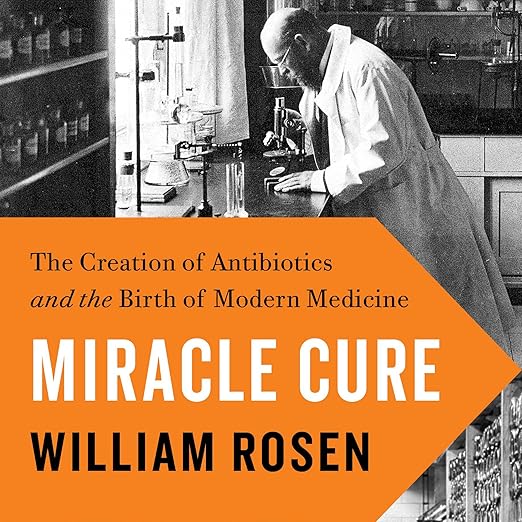
I picked up Miracle Cure during a stretch when I was reading heavily about the history of medicine, specifically trying to understand how the world got from a state where a cut could kill you to a state where a cut was, mostly, fine. William Rosen’s book answered that question better than anything else I read that year. I was on a train from Paris to Lyon, two hours each way, and I did not want to stop either time. That is a useful data point about how this audiobook moves.
The core premise is one of those historical facts that becomes stranger the longer you hold it. As recently as the 1930s, virtually no drug intended to treat infectious disease did anything. Not ineffective in the way we might mean now, where a treatment works only sometimes or for some patients. Nothing. Doctors who made house calls in the pre-antibiotic era were skilled at diagnosis, prognosis, comfort, the setting of bones, the delivery of babies. They were, in Rosen’s framing, largely unable to alter the course of most infections. Then, in less than a generation, that changed entirely. Rosen’s subject is how that change happened, who drove it, and what structures it created that we are still living inside.
Eccentric Characters and Lucky Accidents
One reviewer called this informative and thrilling, and the word thrilling earns itself in the early chapters. The discovery of sulfa drugs and then penicillin and then the systematic search for streptomycin involved a cast of researchers whose personalities are vivid enough to sustain genuine narrative interest. Fleming’s famous contaminated Petri dish is here, but Rosen handles it with appropriate skepticism about the neat origin-story version of events. The discovery was real; the legend around it is tidier than the actual science. What Rosen is more interested in is how the lucky accidents of discovery get converted into reproducible, scalable medicine, and that question turns out to be far more interesting than the accidents themselves.
Why the Pharmaceutical Industry Had to Be Invented
This is where Miracle Cure distinguishes itself from other popular accounts of antibiotic history. Rosen is a historian with a clear argument: the discovery of antibiotics required not just scientific genius but also the creation of an entirely new kind of institution. The only way to identify potential antibiotic compounds in the systematic, large-scale fashion the problem demanded was through industrial organization. You could not do it in a university laboratory with a handful of researchers. You needed funding, facilities, coordination, and the commercial incentive to keep it going. The pharmaceutical company, as we understand it today, was the answer to that problem. Rosen traces this institutional history with the same engagement he brings to the individual scientists, and the result is a book that operates simultaneously as scientific biography, economic history, and cautionary tale about what happens when the incentives of medicine and commerce fully merge.
The Evolutionary Arms Race and Its Consequences
The book’s closing argument, about the bacterial capacity to evolve resistance and what that means for the long-term viability of antibiotics, reads differently in 2026 than it might have at original publication. Rosen explains, with clarity and without alarm, why the same trial-and-error experimental approach that found the original antibiotics is the only method likely to find the next generation. He is honest about how poorly resourced that search has been. One reviewer who used this as a college seminar text noted that reading it in different lights gives you a new perspective on emerging issues in medicine. The book’s final chapters read like a policy document written in narrative form.
Rob Shapiro and the Twelve-Hour Investment
At twelve hours and ten minutes, Miracle Cure asks for a real commitment. Rob Shapiro rewards it. He brings a tone of engaged curiosity to the narration that matches Rosen’s own evident enthusiasm for the material. The science sections are paced slightly slower than the biographical passages, which is the right call for listeners following complex microbiology while doing other things. The history portions have more momentum. The balance holds across the full runtime without the pacing drag that can afflict popular science audiobooks at this length.
Who Should Listen, Who Should Skip
Listen if popular science history is a genre you already enjoy and you want a genuinely excellent example of it. Listen if you work in healthcare, pharmaceutical, or policy contexts and want the deep backstory of the industry you operate within.
Skip if the combination of scientific process, economic history, and biology is more than you want in a single book. This is not a narrow subject. Rosen covers a lot of ground and expects you to stay with him across all of it.
Frequently Asked Questions
Does Miracle Cure require a scientific background to follow?
No. Rosen is a historian and writer, not a scientist, and he writes for a general audience throughout. The biological concepts are explained clearly enough that a curious non-specialist can follow the argument without difficulty.
Does the book cover antibiotic resistance?
Yes, and this is one of its most prescient sections. Rosen traces the evolutionary logic of bacterial resistance and explains why the same large-scale experimental infrastructure that produced the original antibiotics would be required to address resistance. These sections read as particularly urgent given where antibiotic resistance stands today.
How does this compare to other popular histories of the pharmaceutical industry?
It sits closer to books like The Immortal Life of Henrietta Lacks in its willingness to follow both the science and the institutional story simultaneously. It is more historically focused than typical pop-science titles and more narratively driven than academic medical history.
Is Rob Shapiro’s narration engaging for a twelve-hour listen?
Yes. Shapiro calibrates his pace to the density of the material, giving scientific passages slightly more room than the narrative sections. The full twelve hours hold together without the pacing problems that often affect long popular science audiobooks.