Quick Take
- Narration: Nicole Sachs narrating her own work is non-negotiable here. Her lived experience with the conditions she treats and the method she developed makes this a primary-document narration rather than a professional performance.
- Themes: Mindbody medicine, chronic pain and chronic illness, nervous system regulation, JournalSpeak practice
- Mood: Urgent and hopeful in equal measure, the voice of someone who found the exit from a maze and has come back to draw you the map
- Verdict: One of the most significant audiobooks in the chronic pain and mindbody healing space in recent years, built on a clinical method with a substantial track record and narrated with the authority of personal transformation.
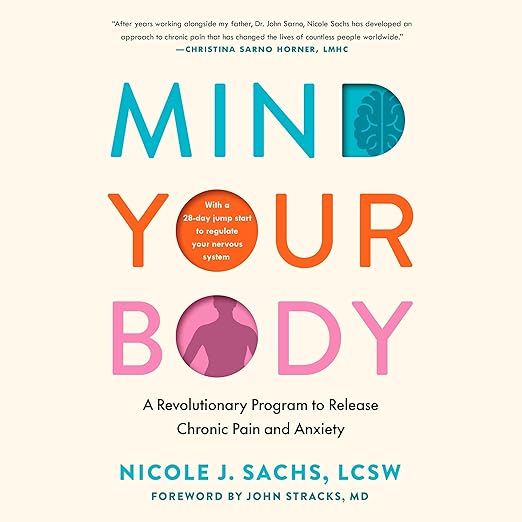
I finished the last hour of this one while making dinner on a Tuesday, and by the end I had stopped pretending to cook and was just standing still and listening. Mind Your Body is a book about chronic pain that reads, at its best, like a clinical thriller: the accumulation of evidence, the methodical dismantling of a dominant framework, and the emergence of a different explanation that accounts for what the old model could not. Nicole Sachs is a psychotherapist who recovered from her own debilitating back pain and prognosis through the work of Dr. John Sarno, and who has since built a clinical practice and a large community around the extension and evolution of that approach.
With 517 listener ratings averaging 4.7 at the time of this writing, the response to this audiobook is not ambiguous. The people it is written for recognize it immediately, and they respond accordingly.
The Premise That Changes Everything
Sachs’s central argument is built on several decades of clinical observation first articulated by Sarno and significantly developed by the practitioners who followed him. Chronic conditions, she argues, including back pain, IBS, fibromyalgia, pelvic pain, long COVID sequelae, and panic disorders, are frequently not primarily structural in origin. They are symptoms of a nervous system that has learned to produce pain and dysfunction as a response to suppressed emotional content, particularly trauma, repressed rage, and the psychological burden of chronic people-pleasing or perfectionism. The brain, in this model, is not broken. It is doing exactly what it learned to do to protect you from something it believes is more dangerous than physical pain.
This is a challenging argument for people who have spent years and significant resources on physical treatments, and Sachs does not minimize that difficulty. She acknowledges that being told your pain may have a psychological component feels invalidating, and she addresses that potential reaction directly and with genuine empathy before making the clinical case.
JournalSpeak as the Therapeutic Core
The method Sachs introduces, which she calls JournalSpeak, is the practical center of the book. It is an uncensored, timed expressive writing practice designed to give the emotional content beneath the pain symptoms a pathway out of the nervous system without requiring the kind of elaborate therapeutic structure that most people cannot access consistently. She is specific about the protocol, the stance you take in the writing, what you are trying to access, and how to process what surfaces without re-traumatizing yourself. Multiple reviewers describe beginning a daily JournalSpeak practice during or immediately after listening, and the specificity of their descriptions suggests the book delivers enough to actually implement it.
One reviewer described themselves as a therapist who had tried everything over years, including becoming a therapist in order to better understand their own symptoms, only to find resolution through this work. That kind of testimonial from someone with both experiential and clinical knowledge carries weight that a layperson’s enthusiasm does not quite match.
Sachs’s Self-Narration and Why It Works
Nicole Sachs narrating her own book produces a specific quality that is extremely hard to replicate with professional narration. She does not perform her own story. She tells it, with the particular flatness and precision that comes from having told it many times in clinical settings. When she describes her prognosis and her recovery, the emotional weight arrives through understatement rather than performance, which is exactly how difficult things sound when someone has fully processed them. The clinical sections benefit equally from her self-narration: she explains her methods the way she explains them to patients, with the layered care of someone who knows which words cause unnecessary alarm and which framing opens the listener rather than closing them.
The Community This Book Speaks To
Sachs runs a large community of people working through this approach, and the book reflects that awareness. She is not writing for the academic or the curious; she is writing for the person who has been told nothing structurally wrong can be found, or who has had the surgery and is still in pain, or who knows something about their emotional history but cannot find the clinical pathway that takes it seriously. That reader will feel recognized here in ways that most medical or wellness audiobooks do not produce.
Who Should Listen, Who Should Skip
This audiobook belongs in the hands of anyone navigating chronic pain, IBS, fibromyalgia, unexplained fatigue, migraines, or related conditions who has exhausted structural explanations and conventional management without resolution. It is also directly relevant for therapists, coaches, and anyone supporting someone through chronic illness who wants a framework that takes both the physical and emotional dimensions seriously. Listeners who find any psychological framing of physical symptoms invalidating will struggle with the premise from the first chapter onward, and the book cannot resolve that resistance from the outside.
Frequently Asked Questions
Is the JournalSpeak method described in enough detail to actually start practicing it after listening?
Yes. Sachs provides specific guidance on how to do JournalSpeak, including the stance to take in the writing, what you are trying to access, the appropriate duration, and how to manage what surfaces. Multiple listeners report beginning the practice during or immediately after listening. The audiobook is a complete enough description to start, though Sachs also has extended resources including a podcast for ongoing support.
Does this book claim that all chronic pain is psychological, and how does it handle the accusation that this framing is invalidating?
Sachs is careful and direct about this. She does not claim chronic pain is imaginary or that structural factors never contribute to symptoms. Her argument is that the nervous system is a primary driver in a larger number of chronic conditions than conventional medicine currently acknowledges, and that treating only the structural component while ignoring the nervous system and emotional component is why so many patients do not fully recover. She addresses the invalidation concern explicitly and with clinical empathy in the early sections.
Is this book connected to the work of Dr. John Sarno, and do I need to read Sarno first?
Sachs credits Sarno as the foundational influence on her clinical approach and describes how his work enabled her own recovery. The book builds on and extends Sarno’s framework, particularly with the JournalSpeak method and the integration of contemporary neuroscience around nervous system regulation. You do not need to have read Sarno first; Sachs provides enough context that the book stands on its own.
Does Nicole Sachs narrating her own work affect the listening experience, and can someone without chronic pain benefit from this audiobook?
Sachs’s self-narration is one of the book’s distinctive strengths. Her clinical experience and lived recovery are present in her voice in a way that professional narration could not reproduce. As for listeners without chronic pain: the nervous system model and emotional suppression framework she describes have relevance to anxiety, burnout, and psychosomatic symptoms more broadly, so the reach of the material extends beyond strictly pain-focused listeners, though the book’s emotional center is clearly the chronic pain experience.