Quick Take
- Narration: Virtual Voice delivers this survey-based study with mechanical evenness, the material is predominantly data and reported experience rather than narrative, so the format limitation is less acute than for memoir or guided practice.
- Themes: Crossdressing identity, survey demographics, social stigma and acceptance
- Mood: Matter-of-fact and informational, with occasional sociological depth
- Verdict: A landmark survey study from the 1990s that retains value as a historical document of crossdressing experience, though the Virtual Voice narration and age of the research are factors worth weighing.
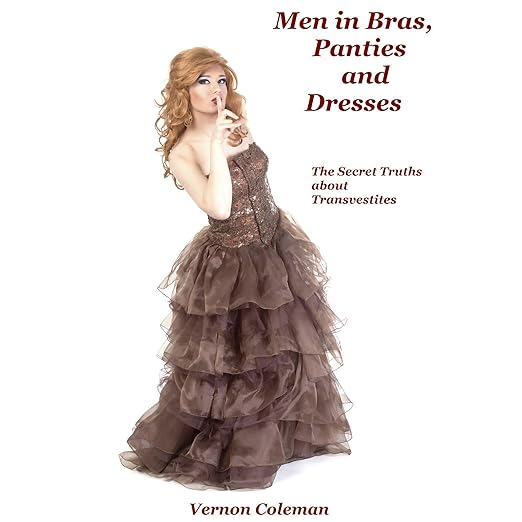
Dr. Vernon Coleman is a contentious figure in contemporary British medical discourse, widely published, widely criticized, and polarizing in ways that have intensified considerably since the COVID-19 period. That context is worth naming upfront, because it is present for any listener who approaches this book with awareness of his more recent work. Men in Bras, Panties and Dresses predates the controversies that now define his public profile by decades, and it is useful to read it as a period document: a medical doctor in the 1990s conducting and publishing a survey of crossdressers at a time when such surveys were rare and the subject was almost entirely absent from mainstream medical or psychological literature.
I spent a quiet Friday evening with this one, two hours and four minutes that move briskly through demographic data, reported experiences, relationship outcomes, and the psychological landscape of men who crossdress. The research methodology is not extensively detailed in the audio, which is one of the limitations of receiving this kind of sociological work in audio format, the listener cannot easily scrutinize the survey design, sample size, or methodology that would be visible in a printed appendix.
What the Survey Actually Found
The book draws on responses from a survey of crossdressers to address the questions that Coleman identifies as most commonly asked about crossdressing men: why they crossdress, how they feel about it, how their partners respond, what their professional and social lives look like, and how the behavior intersects with sexual orientation. The consistent finding is that crossdressing is far more widespread, far more varied in its expression, and far less pathological than popular assumption held in the decade in which the survey was conducted.
Coleman’s explicit argument, that crossdressing is a healthy life choice, was genuinely countercultural in the 1990s context, and the specialist press of that era responded to it accordingly. The quotes from Skin Two, GEMS News, Transformation, and Wildside Toronto that make up the synopsis are all publications connected to the crossdressing and transgender community, which tells you something about the book’s primary audience and the context in which it was received: this was a book that gave a clinical voice to an experience that had been almost entirely pathologized in mainstream medicine.
Reading a 1990s Text in 2026
The language and conceptual framing here require some calibration. Coleman uses “transvestite” and “crossdresser” interchangeably, which reflects the terminology of the period rather than the contemporary distinctions between crossdressing as a practice and transgender identity as an identity. The book does not address gender dysphoria or transgender identity in any contemporary sense, and listeners expecting alignment with current gender studies frameworks will find the text operating within the significantly different conceptual vocabulary of 1990s sexology.
That limitation is real, but it does not make the book valueless. The demographic portrait of crossdressing men that Coleman assembled, across professions, relationship structures, age ranges, and motivations, remains a relatively rare primary document, and one reviewer’s observation that it covers the hows and whys with genuine comprehensiveness is accurate for its period. A listener who encountered it as a young crossdresser in the 1990s described it as potentially life-changing in terms of validation, which speaks to its historical function even as the field has moved considerably beyond it.
Virtual Voice and Sociological Data
The Virtual Voice narration is less devastating here than it would be for memoir or guided practice, for a simple reason: this is essentially a survey report with interpretive commentary. The material does not depend on emotional warmth to function, it depends on clarity and organization, which Virtual Voice can deliver adequately even without human nuance. The two-hour runtime is also a factor; shorter books are more survivable in this format than longer ones, because the cumulative effect of synthetic narration has less time to accumulate.
Who Should Listen and Who Should Skip
Listeners interested in the history of how crossdressing has been understood in medical and psychological contexts will find this a useful primary document. Crossdressers looking for community validation in the tradition of what this book offered in the 1990s may still find it meaningful, with the understanding that the terminology and framework are dated. Listeners expecting contemporary gender studies sophistication, clinical research standards, or any engagement with the broader transgender identity landscape will find the book limited. Those who have followed Coleman’s post-2020 controversies and find that context disqualifying should note that this predates those positions by approximately thirty years.
Frequently Asked Questions
Does the book address the distinction between crossdressing and transgender identity?
No, not in any contemporary sense. The book uses 1990s terminology and conceptual frameworks, the distinction between crossdressing as a practice and transgender identity as an identity is not drawn in the way that current gender studies would approach it. This is a product of when it was written rather than an oversight.
Is this book affirming of crossdressing, or does it treat it as a disorder to be addressed?
Explicitly affirming. Coleman’s thesis is that crossdressing is a healthy, normal variation of human behavior, and the book is written to challenge the pathologizing framework that dominated medical and psychological literature at the time. This was its primary cultural function in the crossdressing community when it was published.
Given Dr. Coleman’s controversial recent public positions, is this book ideologically consistent with those views?
This book predates Coleman’s more controversial post-2020 positions by decades and operates in a completely different domain, sexual health and sociological research. Listeners concerned about his recent views should note that this is an earlier, entirely separate body of work.
Does the book discuss partners and families, or focus exclusively on the crossdressers themselves?
Partners and family relationships are addressed as part of the survey findings. Coleman dedicates sections to how partners typically respond, the variety of relationship outcomes among survey respondents, and the social context in which crossdressing is navigated within marriages and families.