Quick Take
- Narration: Victoria Villarreal brings a bilingual cultural fluency to Paloma’s voice that honors the Mexico City setting and the Frida Kahlo material without reducing either to atmosphere.
- Themes: Heritage and belonging as active recovery, grief accessed through place and art, trust and deception between children who want different things
- Mood: Warm and suspenseful, with a Mexico City setting that feels richly specific rather than generically exotic
- Verdict: Cervantes has written a mystery that uses Frida Kahlo’s legacy honestly and movingly, this is a middle-grade book that earns its emotional depth alongside its plot mechanics.
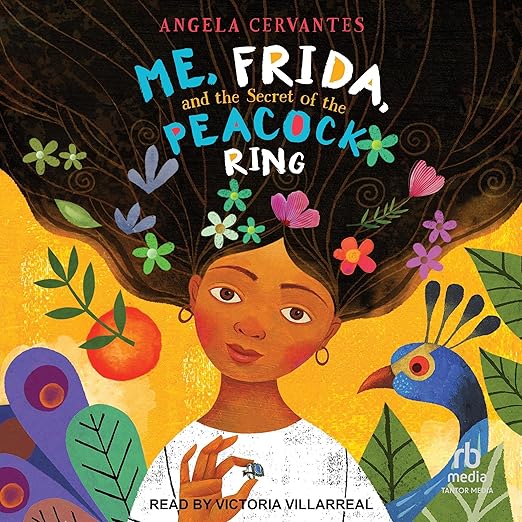
I have a soft spot for mysteries that take their young protagonist’s emotional situation as seriously as their plot situation, and Me, Frida, and the Secret of the Peacock Ring is exactly that kind of book. Paloma Marquez is in Mexico City for the first time, visiting the birthplace of her deceased father, trying to recover something of him through place and memory. When Lizzie and Gael propose their challenge, help find a ring that once belonged to Frida Kahlo, receive a big reward, she accepts partly for the reason she says and partly for a reason she can barely articulate.
Angela Cervantes is the author of Gaby, Lost and Found and Lety Out Loud, both of which demonstrate her particular skill at writing Latina protagonists whose identities are present in the text without being the text’s only subject. In Me, Frida, she works at the intersection of mystery, art history, and family grief in a way that makes Paloma’s journey feel consequential rather than episodic.
What Paloma Is Actually Looking For
The ring is the plot’s object. What Paloma is actually searching for is harder to name, some version of her father, accessed through the city he loved, the artist he loved, the memories that are too sparse and too precious. Cervantes handles this grief thread with real delicacy. Paloma is not performing mourning, and she is not defined by it. It is simply present as the reason Mexico City matters to her in a way that transforms what might otherwise be a standard heist-adventure into something with genuine emotional stakes.
Victoria Villarreal’s narration is well-calibrated to this emotional undercurrent. She navigates the Mexico City setting with a warmth and specificity that signals cultural familiarity, the Spanish words and phrases that appear throughout the text land naturally rather than as decoration, which is exactly right for a book about a girl reconnecting with a heritage she was only partially raised in.
Frida Kahlo as More Than a Famous Name
The book uses Frida Kahlo’s biography and art with more care than the premise might suggest. The peacock ring is a specific object with specific provenance, and Kahlo’s presence in the narrative is tied to actual facts about her life rather than deployed purely as recognizable branding. One adult reviewer noted the book as a welcome refresher on Kahlo as an artist, which is a meaningful observation from someone who presumably went into the book knowing who Frida Kahlo was. Cervantes treats Kahlo’s legacy as something worth protecting, which gives the ring its moral weight beyond its monetary value.
The mystery structure itself is well-constructed. Lizzie and Gael are not simply the helpful siblings they present themselves as, and the double-cross the synopsis mentions is set up with enough care that it feels surprising rather than arbitrary. The book’s central location, the Frida Kahlo Museum, the Blue House, is rendered with the kind of specific detail that sends listeners directly to photograph searches once the audiobook is done.
Mexico City as Inheritance Rather Than Backdrop
For American middle-grade listeners who have never spent time in Mexico City, Cervantes provides a richly specific portrait of the city. The food, the neighborhoods, the particular texture of navigating a place that is familiar through stories but strange through direct experience, all of it is handled with the kind of precise observation that signals a writer who knows her setting well. This is not Mexico as backdrop. It is Mexico City as Paloma’s inheritance, which is a different and more demanding relationship between character and place.
A reviewer who identified themselves as an adult reading for fifth-grade suitability called it culturally affirming, artistic, and even educational, a list that would make some children’s books sound dutiful and heavy. What saves Me, Frida from that weight is that all three of those qualities are delivered through plot mechanics rather than announced. The cultural affirmation is in Paloma’s experience, not in authorial commentary. The art education is in what the ring means and what finding it would cost.
The Age Range and What the Book Gets Right
The book is aimed at middle-school readers, and a seventh-grade protagonist puts Paloma at the older end of the middle-grade range. Listeners from roughly ages ten to fourteen will find the most direct resonance, though the adult reviews that appear alongside the children’s reviews suggest the cross-generational pull is real. The mystery is constructed well enough to engage readers who have outgrown the genre’s simpler offerings, and the emotional material around grief and heritage gives it substance that pure puzzle-mysteries lack.
Frequently Asked Questions
Does the book require knowledge of Frida Kahlo’s life and work to be fully enjoyed?
No prior knowledge of Kahlo is required, Cervantes provides enough context within the narrative to make the ring’s significance clear and the museum setting meaningful. That said, the book will reward listeners who go looking for more Kahlo information after finishing, and several reviewers noted it prompted exactly that kind of further research.
How does Victoria Villarreal handle the Spanish language elements throughout the book?
Villarreal treats the Spanish words and phrases as natural code-switching rather than as foreign insertions requiring special performance. Her delivery signals cultural fluency rather than translation, which is exactly right for a book about a girl navigating her own complicated relationship to Mexican heritage. The language elements land as character texture rather than vocabulary lessons.
Is this book part of a series, or is it a standalone?
Me, Frida, and the Secret of the Peacock Ring is a standalone novel. Listeners who enjoy Cervantes’s writing can explore her other middle-grade novels, including Gaby, Lost and Found and Lety Out Loud, which share her characteristic attention to Latina protagonists and family dynamics.
Is the double-cross involving Lizzie and Gael handled in a way that is appropriate for middle-grade readers?
Yes. The betrayal is present and has real emotional consequences for Paloma, but it is handled with the emotional register appropriate to the age group, painful and instructive rather than cynical or traumatic. It serves the book’s themes about trust and about distinguishing between people who want to honor a legacy and those who want to exploit it.