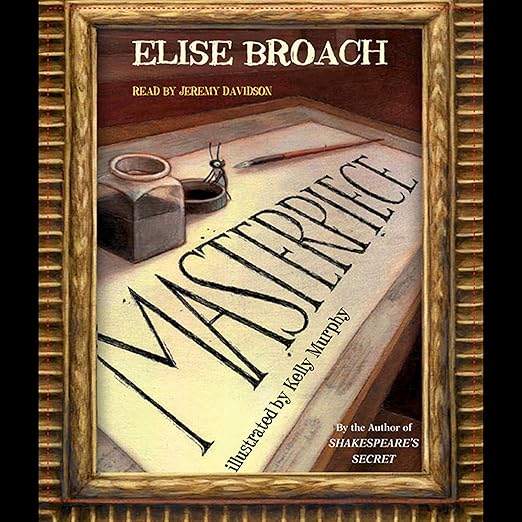
Quick Take
- Narration: Jeremy Davidson navigates the dual-world structure, beetle perspective and boy perspective, with a sure-footedness that makes the unlikely friendship at the book’s center feel emotionally real.
- Themes: Unlikely friendship across profound difference, artistic authenticity and the ethics of stolen credit, art history woven directly into heist mechanics
- Mood: Clever and warm, with genuine Metropolitan Museum of Art atmosphere and a sustained sense of wonder at miniature things
- Verdict: Elise Broach constructs a heist novel built around a beetle and a boy that works as both mystery and meditation on what it means to make something beautiful, inventive and emotionally generous.
I came to Masterpiece on a gray Sunday morning with coffee and no particular plans, and Elise Broach’s beetle-and-boy heist novel turned out to be exactly what I needed. Jeremy Davidson read me into the Metropolitan Museum of Art via the kitchen sink of a Manhattan apartment, and by the time Marvin the beetle had created his first pen-and-ink drawing for James Pompaday’s birthday, I was entirely on board with the premise. That is a testament to Broach’s craft, this book asks you to invest in a beetle’s inner life and delivers enough specificity and warmth that the investment feels entirely reasonable.
Masterpiece is Broach’s follow-up to Shakespeare’s Secret, which also weaves historical material into a contemporary child’s adventure. The formula is similar: a child protagonist, a mystery rooted in real art history, and supporting characters whose depth exceeds their apparent narrative function. But where Shakespeare’s Secret worked with historical documents, Masterpiece builds its mystery around Albrecht Durer, the Metropolitan Museum of Art, and the particular complications of a friendship that exists across the species barrier and therefore cannot be acknowledged in public.
Marvin’s Secret and the Credit Problem
The central ethical tension of Masterpiece is established early: Marvin draws. James gets the credit. This is not presented as a straightforward injustice, neither Marvin nor James engineered the situation exactly, and the friendship between them is genuine rather than purely transactional. But the credit problem becomes plot-relevant in ways that force both characters to confront what they owe each other and what their friendship actually means when tested by public pressure.
Jeremy Davidson handles this ethical dimension with care. His James has an adolescent’s complicated relationship to the situation, benefiting from Marvin’s art, uncomfortable with the deception, unable to explain the truth without being disbelieved. His Marvin has something quieter and more interior: a beetle’s perspective on what it means to make beautiful things in a world that cannot see you making them. Davidson distinguishes the two registers cleanly without making either character sound theatrical.
Durer, the Met, and the Art History That Drives the Plot
The missing Durer drawing at the center of the heist plot is not a made-up McGuffin. Albrecht Durer was a fifteenth and sixteenth-century German master whose pen-and-ink work was technically extraordinary, and Broach has chosen the reference with care, Durer’s draftsmanship is exactly the tradition that Marvin’s miniature drawings invoke. The Metropolitan Museum of Art is rendered with the specificity of a writer who has spent time there. The heist plan, which requires Marvin’s specific abilities and James’s public presence to work together, is constructed with genuine ingenuity.
For children who have visited the Met, Masterpiece will add a layer of mystery to a familiar institution. For children who have not, it provides one of the more vivid fictional portraits of the museum available at middle-grade level. The teacher reviewer who called it her favorite book to read to her class specifically cited its cleverness alongside its beauty, the book is intellectually engaging in a way that rewards attention rather than just rewarding reading.
The Miniature World and Its Full-Sized Feelings
What lifts Masterpiece above a well-constructed heist story is Broach’s consistent attention to scale. Everything about Marvin’s experience is proportioned to a beetle’s perspective, the kitchen sink is a landscape, the apartment is a country, the museum is a world. But Marvin’s emotional experience is not miniaturized. His attachment to James, his pride in his work, his fear when things go wrong, these are full-sized feelings in a small body, and Broach never lets you forget the asymmetry.
That asymmetry is also the source of the book’s sharpest comic moments. Marvin navigating the Met from a beetle’s vantage point during the heist is genuinely funny. But the humor never comes at Marvin’s expense. He is as competent and as present as James in the partnership that makes the heist possible, and Davidson’s narration preserves that equality of standing even while communicating the physical disparity.
The Readership This Book Has Found and Why
The reviews for Masterpiece include a teacher who uses it as a classroom read-aloud, a reader who encountered it as a child and bought a new copy to pass on, and a second-grader who is almost done with it. That range of engagement, cross-generational, self-perpetuating, sought out again in adulthood, is the signature of a book that has found a place in readers’ affections rather than simply their reading lists. The audio format preserves what those readers responded to: the clever plotting, the genuine warmth of the beetle-boy friendship, and the art history woven through the heist mechanics without ever becoming a lecture.
Frequently Asked Questions
Does Masterpiece require any knowledge of Albrecht Durer or Renaissance art to follow the plot?
No prior art history knowledge is required. Broach provides the context necessary to understand Durer’s significance and what the missing drawing represents within the museum world. The art history is embedded in the plot rather than front-loaded as information, so it arrives when the story needs it. Listeners may want to look up Durer’s actual pen-and-ink work after finishing, which is a natural impulse the book encourages.
How does Jeremy Davidson handle Marvin’s interior perspective as a beetle narrator?
Davidson gives Marvin a distinct interior register, quieter and more observational than James’s more reactive voice. He navigates the physical scale difference with care, letting Marvin’s perspective be genuinely beetle-like in its spatial orientation without making him seem less intelligent or less emotionally present than his human counterpart. The friendship between them feels real in his reading because Davidson treats both characters as full participants.
Is the heist plot in Masterpiece genuinely suspenseful, or is it resolved too easily for the middle-grade format?
The heist is constructed with real ingenuity and has genuine tension, the plan requires both Marvin and James to operate successfully in very different contexts simultaneously, and the stakes involve both the recovery of the Durer and the survival of the friendship. The resolution is earned rather than simply provided. Adult readers who pick this up as a heist novel will find the plotting satisfying, not just age-appropriate.
At what age does Masterpiece work best, and is it appropriate for classroom use?
The book targets readers roughly ages eight to twelve, with the upper end of that range getting the most from the ethical complexity and the art history material. Multiple teachers have used it as a classroom read-aloud, citing its combination of mystery, emotional depth, and educational content about the Met. The audiobook format works well for classroom or family listening situations where Davidson’s performance can carry the story.