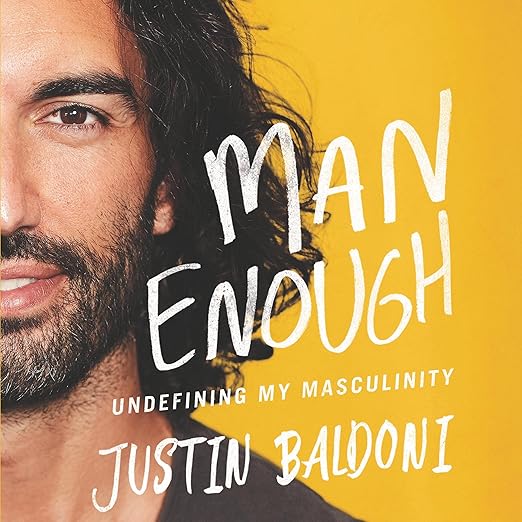
How honest can a memoir about masculinity afford to be when the person confessing is also the person at the microphone? That is the question I kept returning to across twelve hours and thirty-six minutes of this audiobook, because Justin Baldoni wrote it and Baldoni reads it, and no third party stands between the admission and the delivery. HarperOne published the recording in April 2021. The description sells a personal and societal reckoning with what it means to be a man, ranging across strength and vulnerability, marriage, body image, sex and sexuality, racial justice, gender equality, and fatherhood. That is an enormous amount of ground for one book, and the ground it covers best is the smallest of it.
Baldoni takes the microphone for his own confession, which changes what the book is. Read by a hired professional, the passages about his failures would land as material. In his own voice they land as an ongoing negotiation, and the difference is audible in how the sentences are weighted rather than in anything the text does. The synopsis frames him as an actor, director, and activist reflecting on his own struggles with masculinity, and the honest answer to whether celebrity undercuts that is: sometimes. The chapters where he is specific about himself work. The chapters where he generalizes about men as a category work less well.
People who posted seem to agree, though they say it obliquely. One writes that the book gave good insight into the male life experience and perspective and, tellingly, that after listening to it, buying a physical copy became necessary. Another describes reading it for personal reflection and then discovering that it applied to a twenty-four-year-old son who had just disclosed months of depression, and writes the review while crying. A third traces the argument about the man box, where boys and later men police one another out of any behavior read as feminine, and notes how compassion and empathy get scored as failures inside it. That third response is the closest thing on the page to an actual summary of the thesis. A fourth describes reconsidering a personal definition of masculinity while reading, and wishing the book had existed during the years of raising a son and a daughter, which is a more useful endorsement than any adjective.
Why It Works in Audio
Self-narration is the whole argument for this edition. A book asking men to be brave enough to be vulnerable would be undermined by a hired performance of vulnerability, and the credit removes that risk by construction. When the writing turns to his marriage, his body, or the version of himself he learned to perform, the person saying the words is the person they are about, and that is the tell a listener uses to decide whether an admission is real. No second reader is credited, no interview supplement, and no bonus material of any kind, so the twelve and a half hours are one man talking and the format is doing what it should.
The audience matters too. This is a book many people buy for someone else, and one response says so directly in its title, that anyone with a son should read it. Handing a reluctant reader a three-hundred-page hardcover about feelings has a low completion rate. Handing over an audio edition in the author's own voice removes at least one barrier, and the review describing a son's disclosure suggests the conversation is what people are actually buying.
Things to Know Before Starting Man Enough
Shelving is the oddity here. This sits under LGBTQ+ studies, and it is worth understanding why that may not be what you expect. The description says nothing about a queer memoir. It describes a straight-presenting actor examining how traditional masculinity shaped his marriage, his body image, and his fatherhood, with sexuality as one topic among nine. If you came to this shelf for queer life writing, the categorization has pointed you at a book about the costs of conventional manhood instead, which is adjacent territory rather than the same territory.
Numerically the page is unusable. A single vote, the tally claims, holding up an average of 4.7, while five signed responses sit right there underneath it, which is not something any rounding convention permits. One of those responses has no handle attached to it at all, filed under a blank name. Read the write-ups, ignore the badge. And note that with the exception of the listener who bought a hardcover after finishing the audio, nobody comments on the reading, which for a self-narrated book is a genuine gap: the one thing this edition uniquely offers goes unassessed by everyone who bought it.
Worth noticing too: the column contains no dissent. Four responses give full marks and the fifth, which withholds a star, still calls the book deeply true and thoughtful while describing it as an intimate autobiography that teaches mindfulness. That is a somewhat different book than the description advertises, and it is the only place on the page where a reader's account diverges from the marketing at all. Nobody argues with the thesis. Nobody finds the celebrity framing tiresome. Nobody says a chapter ran long. A column with no floor under it tells you the people who disliked this book did not bother to write, and you should assume they exist.
Who Will Get the Most From It
This is for men who suspect the scripts they learned in childhood are costing them something and want a starting point rather than a scholarly treatment. It is also for the parents, partners, and friends of such men, which by the evidence of the review column is who is actually buying it. And it works for listeners who value hearing an admission in the voice of the person making it, since that is the one thing this edition adds that no other format can, and the reason to choose it over the hardcover one reviewer went out and bought afterward.
Approach it differently if you want research rather than reflection, because the method here is personal narrative supported by conviction and not by citation. Approach it differently again if celebrity memoir irritates you as a form, since the opening line of the description is a directing credit and the book never entirely stops being written by a famous person. Listeners looking for a rigorous account of masculinity studies should look elsewhere and come back to this one for the parts a study cannot do.
- Narration: Justin Baldoni reads a book Justin Baldoni wrote, and the confessional passages gain from having no professional standing between the admission and the delivery.
- Themes: traditional masculinity and its costs, vulnerability, marriage and fatherhood, body image, the man box
- Mood: earnest, confessional, occasionally sermonlike
- Verdict: strongest when specific about one life and weakest when speaking for men in general, but the self-narration earns the audio edition.
Before You Listen
Is the Man Enough audiobook narrated by Justin Baldoni himself?
Yes. Author and narrator are the same person on this listing, which matters for a book built on personal admission. The recording runs twelve hours and thirty-six minutes from HarperOne, with nothing on the page indicating a second reader, an interview supplement, or additional bonus material of any kind.
Why is this audiobook filed under LGBTQ+ studies?
The listing places it there, though the description presents a straight-presenting actor examining conventional masculinity, with sexuality one topic among many including marriage, body image, racial justice, and fatherhood. Treat the shelving as approximate. The subject is the cost of traditional manhood rather than queer life writing.
Is this a good book to give to a man who does not read?
The review column suggests that is exactly how people use it. One response is titled around giving it to a son, another describes a parent reading it and then recognizing a twenty-four-year-old son in it. Twelve and a half hours in the author's own voice lowers the barrier considerably.