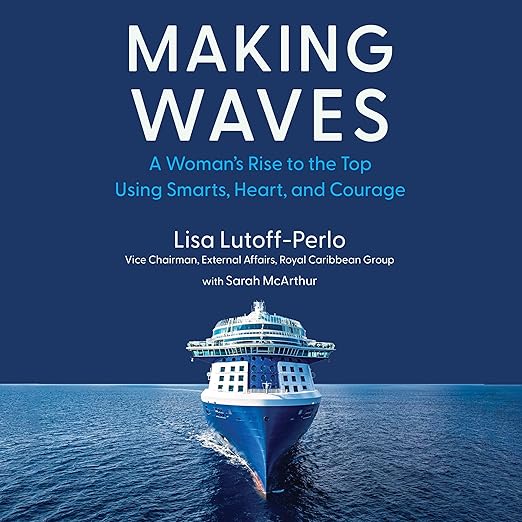
Forty years separate the entry-level roles Lisa Lutoff-Perlo describes early in this audiobook from the Vice Chairman title she holds today at Royal Caribbean Group, and that span is really the whole pitch of Making Waves. Lutoff-Perlo narrates her own rise through a male-dominated cruise industry, culminating in a run as CEO of Celebrity Cruises and the 2018 launch of the Edge Series ships that reportedly reshaped the brand's fortunes. At under five hours, this audiobook moves briskly through four decades, favoring highlight-reel career turning points over granular blow-by-blow detail, which will suit some listeners better than others depending on what they came looking for.
Betting the Edge Series on Relaxed Luxury
As a narrator, Lutoff-Perlo reads like someone used to being in a room and holding it: measured, unhurried, comfortable pausing for effect the way an experienced public speaker does rather than a trained voice actor performing warmth on cue. That authenticity is the audiobook's biggest asset; you believe this is genuinely her account rather than a ghostwriter's polished approximation of an executive memoir voice. The tradeoff is that her delivery occasionally reads flatter on emotionally difficult passages, the setbacks and obstacles she references mostly in general terms, than it does on passages where she is clearly in her element describing a leadership decision or a specific moment of vindication.
The book's organizing idea is that Lutoff-Perlo's leadership style, built on caring for people first, functioned as a genuine competitive advantage rather than a soft skill layered on top of harder business strategy. She walks through specific moments where that approach paid off with both guests and employees, though the audiobook stays light on the kind of granular operational detail, budgets, org charts, specific negotiations, that career-strategy listeners sometimes want from an executive memoir. This reads closer to an extended keynote address than a business-school case study, which is either exactly what a listener wants or a mismatch with their expectations, and it is worth knowing which one you are before pressing play.
The Edge Series launch gets more attention than most single moments elsewhere in the book, and deservedly so. Lutoff-Perlo walks through the specific bet involved in redesigning an entire ship class around what she calls relaxed luxury, a wager that could easily have gone the other way given how conservative the cruise industry traditionally is about major design departures from a proven formula. Hearing her describe the internal skepticism she had to overcome just to get the ships greenlit, let alone built, adds a level of specific professional risk-taking that the more general leadership passages elsewhere in the book do not quite match, and it is the clearest single example of her stated philosophy actually being tested under real financial pressure.
John Plans to Listen Before Boarding Her Ship
The 4.6 rating across a modest 82 reviews suggests a small but genuinely enthusiastic audience, several of whom identify themselves as industry insiders rather than casual business-book browsers. One reviewer, identifying as an aviation industry leader, calls Lutoff-Perlo one of the most transformative leaders of her era; another, a self-described executive, frames the book as a blend of personal insight and professional wisdom rather than a straightforward memoir. A third reviewer, John, mentions planning to listen to it before boarding a Celebrity ship himself, which says something about how tightly this book's appeal is tied to Lutoff-Perlo's specific industry and brand rather than functioning as a general leadership title that merely happens to be set at sea.
Beyond the cruise-industry specifics, the throughline about refusing to compromise personal integrity while still climbing to the very top of a male-dominated field gives the book a wider relevance than its niche setting might suggest at first glance. Lutoff-Perlo is candid about starting at the very bottom of the corporate ladder, and the audiobook spends real time on that early period rather than rushing straight to the executive years, which grounds the later leadership lessons in something more concrete than abstract principle. For listeners specifically interested in tourism, hospitality, or travel-industry careers, the Royal Caribbean and Celebrity Cruises detail alone justifies the listen regardless of how the broader leadership philosophy happens to land for you.
A recurring thread throughout is Lutoff-Perlo's insistence on bringing other people along with her rather than climbing alone, and she names specific instances of mentoring or advocating for other women within the organization as her own career advanced. For readers drawn to succession planning and mentorship within corporate leadership specifically, rather than just the arc of one person's individual rise, that thread adds a dimension the marketing framing around her personal journey does not fully capture on its own.
A Read Told Entirely From the Inside
Under five hours is a genuinely short runtime for a career spanning four decades, and it shows in pacing that sometimes skips whole years between major milestones. Listeners wanting the texture of daily working life, the frustrations, the small wins, the internal politics, will find those given less room than marquee moments like the Edge Series launch. This is a highlight-reel memoir by design, not a slow-burn character study, and knowing that going in will set expectations correctly rather than leaving a listener wishing for more depth partway through the final chapter.
With only 82 ratings on record, this has not accumulated the kind of broad critical conversation that surrounds bigger-name business memoirs, so listeners are largely relying on Lutoff-Perlo's own framing of her career rather than independent journalistic accounts of the same events. That is not unusual for a niche-audience business title, but it is worth naming plainly: nothing here gets checked against outside reporting within the audiobook itself, and the read on her own tenure running Celebrity Cruises is entirely her read, told from the inside, with all the warmth and selective memory that vantage point usually carries.
This Plays Like an Extended Acceptance Speech
Women navigating male-dominated industries, cruise and hospitality professionals specifically, and anyone who enjoys the genre of first-person executive memoir will get the most out of this one. It pairs naturally with other self-narrated business leadership titles where hearing the author's actual voice matters as much as the content itself, since Lutoff-Perlo's delivery carries an authority that a professional narrator reading the same words would have to work harder to fake convincingly. Aspiring hospitality executives in particular will find the Royal Caribbean specifics genuinely useful in a way a more generic leadership title never could be.
Those hunting for a detailed operational playbook, step-by-step tactics for climbing a corporate ladder rather than a broad-strokes account of one particular ascent, should adjust expectations before starting. The inspiration is genuine and the industry specifics are a real selling point, but this stays closer to an extended acceptance speech than a management manual, and four hours and fifty-nine minutes is not really enough runtime to be both at once. Go in for the story and the voice behind it, not for a workbook you can apply chapter by chapter to your own career on Monday morning.
At a Glance
- Read by: Lisa Lutoff-Perlo narrates her own career story with the measured authority of an executive used to holding a room.
- At its heart: Women in leadership, the cruise industry, integrity under pressure
- Vibe: Brisk, motivational, and highlight-reel in pace
- Short version: A strong pick for hospitality and leadership listeners, though its five-hour runtime favors breadth over depth.
Does Lisa Lutoff-Perlo narrate her own audiobook?
Yes, and her self-narration is a real asset here; the measured, unhurried delivery reads like an executive genuinely recounting her own career rather than a professional voice actor performing warmth.
Is this audiobook heavy on cruise industry specifics or broader leadership lessons?
Both, though industry specifics, Celebrity Cruises, the Edge Series launch, Royal Caribbean, ground the broader leadership lessons rather than standing apart from them.
How long is the Making Waves audiobook?
Just under five hours, which covers roughly four decades of career history at a brisk, highlight-reel pace rather than a slow, detailed chronicle.
Do you need a business background to follow this audiobook?
No. It reads more like an extended personal account than a technical business text, so no specialized background is required to follow along.