Quick Take
- Narration: Alan Steinfeld narrates his own compilation, and his 30 years of subject familiarity produces an intimate, invested delivery. The self-narration is appropriate given his role as curator and contributor, though his cadence will test listeners who prefer more neutral presentational styles.
- Themes: UFO and UAP disclosure, contact experience as transformational event, consciousness and the extraterrestrial hypothesis
- Mood: Wide-eyed and urgent, intellectually varied, runs from rigorous to esoteric without apology
- Verdict: The most comprehensive multi-perspective anthology on the UFO contact experience available in audio form, with a companion PDF for diagrams and contributor biographies.
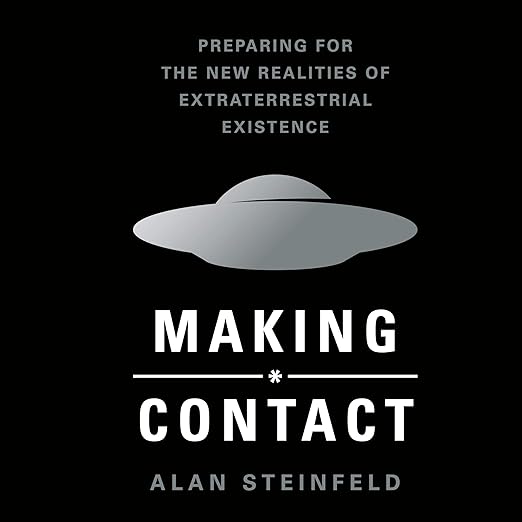
I will be honest about where I sit with this material before going further, because it matters. I am not a true believer and I am not a reflexive skeptic. I have spent enough time around credible people who have reported inexplicable experiences to know that dismissal is as intellectually lazy as credulity. Making Contact by Alan Steinfeld does not ask you to land on one side of that line. It asks you to engage with the full range of what serious investigators and experiencers have been saying for decades, and to consider what that collective record means at a moment when the Pentagon has begun making official disclosures that would have been dismissed as fringe speculation fifteen years ago.
I listened to the first three hours of this audiobook on a cross-country flight, which turned out to be an unexpectedly appropriate setting. Something about being above the clouds at altitude made the chapters about perception, consciousness, and the boundary between what we know and what we assume more than usually available to me. By the time I landed, I had a substantially different sense of the shape of this phenomenon than when I boarded.
The Architecture of the Anthology
Making Contact is not a single-author argument. It is a curated collection of original writings by fourteen contributors, assembled by Steinfeld to provide what the synopsis describes as preparation for the greatest challenge to ever face humankind. The range of perspectives is genuinely wide. Linda Moulton Howe brings investigative journalism. Whitley Strieber, whose 1987 book Communion introduced the alien abduction phenomenon to a mass audience, writes from the inside of personal experience. John Mack, the late Harvard psychiatrist who spent years interviewing contact experiencers, contributes the clinical perspective. Nick Pope brings the policy angle from his years at the UK Ministry of Defense. Darryl Anka writes from a channeled communication framework that sits at the further edge of what the more empirically inclined contributors would find credible.
This unevenness is both the book’s greatest strength and its primary limitation. On the strength side: a collection that includes Mack’s clinical rigor alongside Strieber’s phenomenology and Pope’s institutional perspective is more intellectually honest than a single-author account that filters everything through one methodological lens. The diversity mirrors the actual complexity of the phenomenon. On the limitation side: listeners who find channeling epistemologically untenable will hit chapters that strain their tolerance, and the collection does not mediate between its contributors or provide any evaluative framework for deciding whose approach is more warranted.
Steinfeld’s Curatorial Voice and the Pentagon Moment
The foreword by George Noory of Coast to Coast AM sets an appropriately veteran tone, acknowledging that the subject has shifted from fringe to acknowledged reality without fully explaining what that acknowledgement means. Steinfeld’s own contributions and transitions between chapters carry 30 years of engagement with the subject in a way that feels earned rather than promotional. He is not trying to convince you of a specific conclusion. He is trying to establish the conditions under which honest inquiry is possible.
Reviewer Estrella Katarina Castillo’s response to Steinfeld’s description of missing time, the passage she quotes about a film strip being spliced and reinserted, captures something real about what the best writing in this collection does. The language of the contact experience, the phenomenology of what it is like to undergo something that ordinary frameworks cannot accommodate, is rendered here by people who have thought carefully about how to communicate it. That renders the anthology valuable even to readers who remain uncertain about the ontological status of the experiences being described.
The book was written and positioned explicitly against the backdrop of the Pentagon’s recent UAP disclosures, and that framing gives it more contemporary relevance than most books in this space. Reviewer John West’s observation that Steinfeld introduced this compilation at precisely the right time is not just enthusiasm. The official acknowledgement that unidentified phenomena are real and unexplained has created a credibility gap in mainstream discourse: the sightings are now acknowledged, but neither scientists nor politicians have frameworks for what to do with that acknowledgement. Making Contact addresses exactly that gap by presenting perspectives developed over decades of serious inquiry.
The PDF Companion and What It Covers
The downloadable PDF companion containing comparative diagrams and contributor biographies adds genuine value that is easy to underestimate from the listing alone. Given that the anthology spans fourteen distinct voices with widely varying credentials and methodological approaches, having the biographical context available in readable form is more than a bonus feature. I would recommend downloading it before you begin the audio rather than after, so you arrive at each contributor’s chapter with a sense of who they are and from what institutional or experiential background they are writing.
Who Should Listen and Who Should Skip
Listen if you are genuinely curious about the full spectrum of serious UFO and contact research, if you want to understand what investigators from academic psychiatry to investigative journalism to firsthand experience have concluded, or if recent government disclosures have left you wanting more context than mainstream media has provided. Also listen if you find single-perspective accounts on this subject too limited or too advocate-shaped.
Skip if you require empirical proof as a precondition for engagement. Reviewer JJCEO put it directly: this is not a book for evidence-seekers. Some chapters will require more suspension of ordinary epistemological standards than others. Know that going in, and have the PDF companion available to help locate each contributor in their broader work.
Frequently Asked Questions
Does Making Contact take a position on whether extraterrestrials are real, or does it present multiple views?
The anthology deliberately presents multiple perspectives without mediating between them. Contributors include former government investigators, clinical researchers, journalists, and firsthand experiencers. Steinfeld as curator does not resolve the epistemological differences between contributors. The book assumes you are capable of holding uncertainty while engaging with evidence.
What is the PDF companion included with this audiobook, and do I need it?
The downloadable PDF contains comparative diagrams and full contributor biographies from the printed edition. Given that the anthology draws on fourteen contributors with widely varying backgrounds, having the biographical context in readable form is genuinely useful rather than merely supplementary. It is worth downloading before you begin listening so you can contextualize each contributor’s perspective as you encounter it.
Is this suitable for listeners new to UFO research, or does it assume prior knowledge?
The collection is accessible to newcomers, though some contributors assume familiarity with specific events or terminology. George Noory’s foreword provides useful orientation, and Steinfeld’s transitions between contributions are designed to contextualize each perspective. Listeners entirely new to the subject may want to read a brief overview of the Pentagon disclosure timeline before starting to get more from the policy-oriented chapters.
How does Whitley Strieber’s contribution here relate to his book Communion?
Strieber is one of the anthology’s contributors, and his chapter draws on the experiential ground he established in Communion, which introduced the alien abduction phenomenon to a mainstream audience in 1987. Making Contact positions itself as existing after those foundational texts, assembling the accumulated inquiry of multiple investigators rather than presenting a single testimony. Strieber’s contribution here is contextualised by decades of additional engagement with the phenomenon since Communion was published.