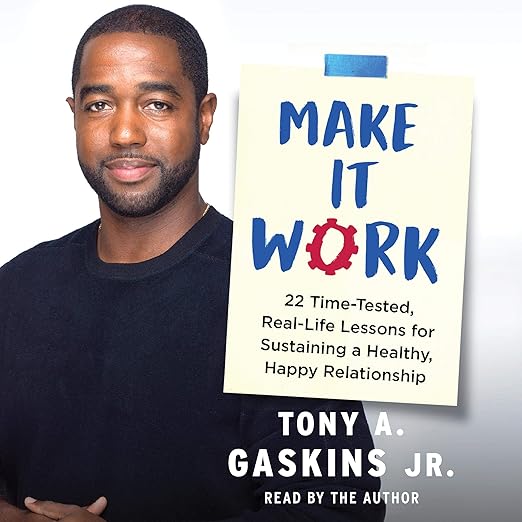
Tony A. Gaskins Jr.'s appearance on The Oprah Winfrey Show to discuss domestic violence launched his career as a public relationship coach, and Make It Work - his full-length audiobook, narrated by himself at seven hours and forty-four minutes - is the extended statement of principles that his millions of online followers had been anticipating. Gaskins is a self-narrator here in the most complete sense: he is not just reading his own words but performing his own framework, and the gap between the book and the man is deliberately closed across the runtime.
Gaskins's central framework is built on a distinction that sounds simple and turns out to be significant: that maintaining a relationship requires different skills than finding one, and that most people invest almost entirely in the pursuit while being unprepared for the maintenance. The book is structured as a series of lessons on identifying the right person, setting standards that produce longevity, and recognizing patterns to avoid - and it draws on both the Bible and Gaskins's own documented failures and more than a decade of faithful marriage. The combination is unusual and, for his audience, credible: he is not positioning himself as someone who has always had it figured out, but as someone whose errors eventually produced a framework worth sharing.
One reviewer described the book as life-changing for helping them "lead with love" rather than with the defensive strategies and unspoken expectations that had damaged earlier relationships. Another, a woman in her early thirties who had struggled to understand why previous relationships failed, described the book as providing both the practical understanding and the clarity to see when someone was wrong for her rather than when she was simply failing to try hard enough. That distinction - between trying harder with the wrong person and setting the standards that attract the right one - is one of the book's most repeated and most practically useful points.
The material drawn from Gaskins's counseling of thousands of couples gives the audiobook a specificity about recurring relationship patterns that distinguishes it from books built only on personal experience. He identifies dynamics that appear again and again regardless of individual personalities - the ways communication breaks down, the ways standards erode under romantic pressure, the ways people confuse compatibility with comfort - and addresses them in the same empowering tone his following has come to trust.
Why Make It Work Works as an Audiobook
The self-narrator format transforms this particular book. Gaskins's coaching background means he naturally modulates between instructional delivery and personal testimony, and hearing the shift in his voice between the framework sections and the confession sections gives the audio version a dimension that the text alone cannot replicate. At seven hours and forty-four minutes, this is a full-length engagement rather than a quick-hit motivational text, and Gaskins sustains the tone - empowering without condescending, spiritually grounded without requiring the listener to share his specific faith - across the full runtime.
The book's practical density rewards sequential listening. Each lesson builds on the previous one, so skipping around costs the listener the cumulative logic of the framework. For listeners who have struggled with previous relationship audiobooks that offered inspiration without structure, the lesson-based architecture here provides something more actionable than affirmation. Gaskins is not asking listeners to feel differently about relationships; he is asking them to behave differently, and he provides specific enough guidance to make that ask practical rather than aspirational. Each lesson builds on the previous one, so skipping around costs the listener the cumulative logic of the framework. For listeners who have struggled with previous relationship audiobooks that offered inspiration without structure, the lesson-based architecture here provides something more actionable than affirmation.
Weak Spots in Make It Work
The section on what Gaskins calls "standards" is the book's most practically applicable material. He distinguishes carefully between standards that reflect values - what you need from a relationship to be whole rather than merely comfortable - and preferences that function as defenses or projections. That distinction matters because it changes the nature of the evaluation process: standards based on values are stable guides, while preferences based on fear are constantly shifting and ultimately unsatisfiable.
The chapters on recognizing what to avoid draw on both his own experience and the patterns he has observed across years of counseling, and they address the dynamics of how men and women tend to approach relationships differently with enough nuance to feel observed rather than prescribed. The book's Christian framing is consistent and sincere but not exclusive; non-religious listeners have found the underlying principles applicable across the boundary of faith, and Gaskins rarely argues from doctrine in ways that require theological agreement to follow the practical reasoning.
The Right Listener for Make It Work
Listeners who are currently in relationships that feel uncertain or who are preparing to enter one will get the most direct application from this audiobook. Single listeners in their twenties and thirties who are trying to understand patterns from previous relationships will find the standards framework particularly useful. The book addresses both men and women directly at different points, though the primary voice is Gaskins speaking across both audiences. Listeners looking for a relationship audiobook grounded in real experience rather than psychology-adjacent self-help will find this more personal and less clinical than most in the genre. Those who are put off by spiritual framing should know it is consistent throughout but does not require agreement to find the practical material useful.
Is this audiobook specifically for people in troubled relationships, or does it work for single listeners too?
Both audiences are addressed directly. The sections on identifying the right person and setting standards are aimed at listeners who are not yet in a relationship or who are evaluating a current one. The sections on sustaining and repairing relationships address those already committed. Gaskins frames the material as relevant at every stage.
How religious is the content in this audiobook?
The book draws explicitly on the Bible and Gaskins's Christian faith as a primary source of his framework. The spiritual framing is consistent and sincere throughout. Non-religious listeners have found the practical principles applicable regardless of faith background, but they should know the religious context is present, not incidental.
What makes this audiobook different from other relationship self-help audiobooks?
Gaskins narrates his own work and draws on documented personal failures as well as successes, which gives the audio version a credibility that third-person delivery cannot replicate. The framework is also more specific about the selection process - identifying the right person before committing to making it work - than most relationship books, which tend to focus on repairs rather than foundations.