Before You Press Play
- Read by: Mary Pope Osborne narrates her own characters with the same low-key, practiced warmth she has offered for decades.
- At its heart: Time-travel adventure, sibling teamwork, history and myth made accessible
- Vibe: Warm, brisk, and endlessly repeatable for car rides
- Short version: A dependable pick for early readers, as long as you confirm this specific listing's actual book range before buying.
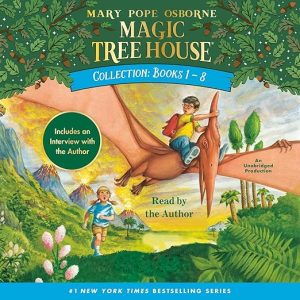
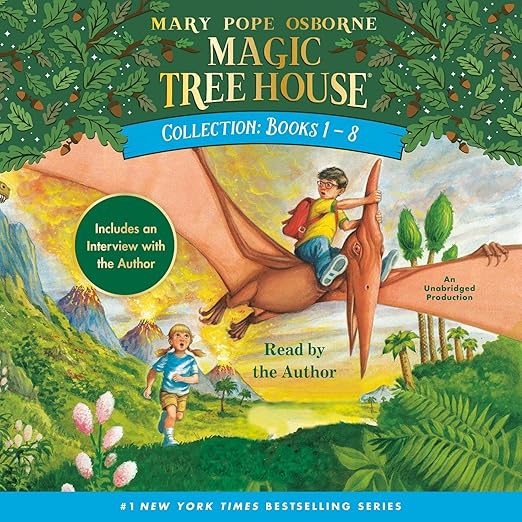
Dinosaurs Before Dark through Midnight on the Moon: whichever numbering appears on this particular collection's cover, the content packaged inside is Mary Pope Osborne's original eight-book launch of Jack and Annie, and it remains the strongest entry point the franchise has ever offered. I want to flag that plainly up front, since the audiobook's own title promises books 33 through 40 while the description attached to it walks through the first eight titles instead, dinosaurs, a medieval knight, Egyptian pyramids, and a pirate crew, followed by a quest to free Morgan le Fay using four magical 'M' objects. Osborne narrates her own characters here, and that self-narration is the real anchor of the whole listening experience regardless of which specific volumes end up in your download.
A Voice AudioFile Calls Beautifully Articulated
Treat the mismatch as a genuine heads-up rather than a minor technicality. If you're specifically hunting for the later-numbered adventures, the ones that send Jack and Annie somewhere entirely different from ancient Egypt or Camelot, the synopsis attached to this listing won't confirm you're getting them. What you can count on, based on the description provided, is Osborne's original run: a time-traveling brother and sister who discover a magic tree house in the woods, then get pulled into the Age of Dinosaurs, a medieval castle under siege, the construction of the pyramids, and a run-in with treasure-seeking pirates across the first four books alone. Kids meeting this franchise for the first time genuinely could not ask for a better starting point than that original sequence, mismatched title notwithstanding.
Chicago Parent called Osborne's own narration 'low-key and well-paced,' adding that it's 'a great way to introduce children who are reluctant readers or can't yet read to this highly entertaining book series and to reading in general,' and that assessment holds up across every one of these eight stories. AudioFile went further, praising her 'soothing, beautifully articulated voice' and her 'knack for characterization,' calling both 'reliably pleasing.' Because Osborne created Jack and Annie herself, decades of familiarity with these two characters comes through in ways a hired narrator, however skilled, would need real effort to replicate from scratch.
It's worth noting, too, why this specific opening quartet works so well as a franchise launchpad. Dinosaurs and pirates rank among the most reliably popular subjects with young children of any era, and pairing those two perennial favorites with a medieval castle and ancient Egypt gives the first four books an unusually wide net, appealing to whichever specific obsession a given child already has, without requiring any of the four to be experienced in order first.
A Franchise That Grew Into a Stage Musical
The books-5-through-8 stretch, the Morgan le Fay rescue quest, gives the collection real momentum beyond the four standalone historical adventures that open it. Jack and Annie need to find four specific 'M' objects to free their friend from a spell, which sends them to meet a ninja master in ancient Japan, dodge a crocodile along the Amazon River, meet cave-dwelling people during the Ice Age, and eventually blast off to the moon in a future setting. That serialized structure rewards listening straight through rather than picking titles at random, since each success builds toward the larger rescue in a way the first four standalone adventures don't require.
At just over six hours for all eight books combined, the format is genuinely built for repeat car-ride and bedtime listening rather than a single marathon sitting, and the reviews attached to this listing confirm that's exactly how families are using it. One reviewer described playing these on even short trips to the grocery store with a four-year-old who now talks constantly about the stories; another's nine-year-old daughter reportedly couldn't put the book down, an odd but telling compliment for an audiobook. A third described 30 to 45 minutes of daily car time as prime Magic Tree House territory, with a toddler benefiting alongside an older sibling.
The Magic Tree House franchise itself has grown well beyond this original eight-book launch, into dozens of subsequent numbered adventures, a parallel line of nonfiction 'Fact Tracker' companion guides for many of the settings Jack and Annie visit, and even a stage musical adaptation, which helps explain why bundle titles and numbering across different retailer listings can get genuinely confusing, this one included. For a franchise operating at that scale, the original eight books described here still function as the foundational text new readers get pointed toward first, regardless of which specific numbered volumes a given household happens to already own.
Individually Titled, None of Them 33 to 40
The book-range mismatch is worth repeating clearly: this listing's title says books 33 through 40, while every plot detail in the description matches the franchise's original eight, individually titled Dinosaurs Before Dark, The Knight at Dawn, Mummies in the Morning, Pirates Past Noon, Night of the Ninjas, Afternoon on the Amazon, Sunset of the Sabertooth, and Midnight on the Moon. Magic Tree House has been repackaged and renumbered across various bundles for years, which likely explains the confusion, but anyone specifically chasing the later volumes should verify the actual audio contents before buying rather than assuming the title accurately describes what's inside.
If you already own the original 1-8 set in any format, this specific listing may not be adding new material to your shelf despite its different title and cover. Genuine value exists in confirming the table of contents against what you already have before purchasing, especially for anyone building out a complete Magic Tree House collection deliberately rather than picking up whatever's convenient.
Hard to Beat, Mismatched Title Aside
Parents of early readers and pre-readers, roughly ages five through nine, are the clear core audience, especially families who already treat car time or bedtime as dedicated listening time. Reluctant readers get particular benefit here, per the Chicago Parent blurb, since the audio format removes the barrier of decoding text while still building the same story comprehension and vocabulary skills. Anyone introducing a child to chapter books for the first time will find this original eight-book run genuinely hard to beat as a starting point, mismatched title aside.
Collectors chasing the specific books 33 through 40, and only those books, should confirm the exact contents before adding this to their cart, since the description provided describes the franchise's original volumes instead. Kids who've already worked through the first eight titles in another format and are specifically looking for new, unfamiliar adventures should also hold off until the actual track listing is confirmed. Neither issue affects families simply looking for a strong, dependable Magic Tree House listening experience regardless of numbering, but it matters enormously for anyone shopping with a specific gap in their collection to fill.
A Few Questions About Magic Tree House Collection: Books 33-40
Does this audiobook collection actually include Magic Tree House books 33 through 40?
The title says so, but the description provided matches the franchise's original books 1 through 8 instead, so confirm the actual contents before buying if the specific numbering matters to you.
Is Mary Pope Osborne's own narration different from the professional voice actors used on some other Magic Tree House audiobooks?
Yes, her self-narration carries a personal familiarity with Jack and Annie that reviewers and critics alike have praised as soothing and well-paced, distinct from a hired performer's interpretation.
What age range gets the most out of this Magic Tree House audiobook?
Roughly five to nine years old, including reluctant readers, based on both the publisher's own blurbs and the family reviews attached to this listing.
Do I need to listen to these Magic Tree House audiobooks in order?
The first four adventures work fine in any order, but the following four form a connected quest to rescue Morgan le Fay and are best heard in sequence.