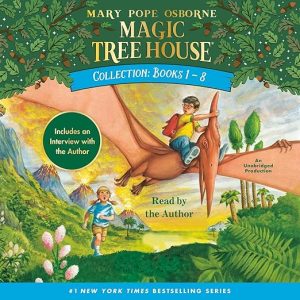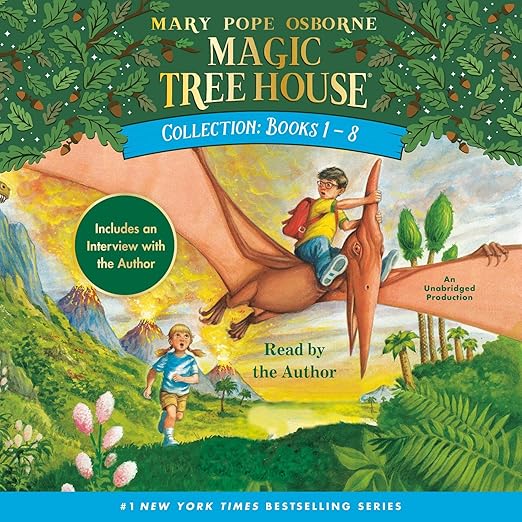
Mary Pope Osborne's Magic Tree House Collection: Books 1-8 brings together the first eight volumes of one of the longest-running children's chapter book series in American publishing history, and the audiobook format - with Osborne narrating her own characters - has become one of the canonical ways families experience this series. Jack and Annie's adventures across the Age of Dinosaurs, medieval castles, ancient Egypt, pirate ships, feudal Japan, the Amazon, the Ice Age, and the moon cover six hours and one minute of listening time, which is enough for multiple long drives or a week of shorter car trips. Chicago Parent called this audiobook collection "a great way to introduce children who are reluctant readers or can't yet read to this highly entertaining series." That framing matters, because one of the collection's most consistent virtues is its accessibility at a range of ages and reading levels.
Book Five Turns Adventures Into a Quest
Osborne built the Magic Tree House series on a deceptively simple structure: two children, a magic tree house stocked with research books, a mission in each adventure, and historical or mythological settings rendered with enough specificity to feel real. The first four books send Jack and Annie on time-traveling adventures where they must solve a problem before returning home. Books five through eight shift the stakes upward - Morgan le Fay, the children's magical benefactor, has been trapped by a spell, and Jack and Annie must retrieve four specific objects, one from each adventure, to free her. That change from episodic adventure to quest-arc gives the second half of the collection more cumulative drive, and listeners who arrive at book five having heard the first four will feel the increased urgency.
The historical settings are genuinely varied and well-chosen. Ancient pyramids in Egypt, pirates in the Caribbean, ninja training in feudal Japan, the Amazon River, Ice Age cave dwellers, and a projected future moon mission - Osborne moves across time periods and geography with the confidence of a writer who has done real research without letting the research slow the pace. Each adventure is short enough to finish in a single sitting, which matters for younger listeners who need narrative resolution before patience runs out. Families who have described the collection as essential for car travel are responding to that quality: these are adventures that begin and end cleanly rather than leaving children suspended mid-story at bedtime or destination.
Jack Sounds Cautious, Annie Sounds Braver
Osborne's narration is the collection's primary asset. She has spoken these characters across a series that now spans over fifty books, and her voice for Jack - cautious, fact-oriented, always checking the research book - is immediately distinct from her voice for Annie, who is braver and more instinctive. That differentiation makes it easy for very young listeners to track who is speaking without needing to see the page, which is exactly what car listening requires. AudioFile's description of her "knack for characterization" reflects the same quality that reviewers who are parents or grandparents notice in the back seat: children lean in, they ask questions, they want to know what Morgan le Fay is trapped by before the chapter ends.
The interview with Osborne included at the end of the collection gives older listeners - and parents who have been co-listening - a brief window into the creative and research process behind the series. It is short, but for families who want to extend the educational dimension of the adventures into conversation, it provides a useful starting point. Several reviewers have noted that the collection works for children as young as four who are not yet reading, which speaks to Osborne's pacing and her handling of the vocabulary - she does not condescend, but she does not outpace young listeners either.
Forty-Five Minutes Fits a Natural Stop
The shift between books four and five is worth noting for families planning their listening. The first four books are fully standalone - each adventure is complete in itself, and children can enter at any point without missing critical setup. Books five through eight are connected by the Morgan le Fay quest and work best heard in sequence. Listeners who begin at book five without the context of the earlier adventures will not be lost, but the quest structure will feel less motivated without understanding who Morgan is and why the children want to help her.
Each individual book in the collection runs approximately forty-five minutes, which makes it easy to plan listening sessions around natural stopping points. Families who listen in the car will find that a single adventure fits comfortably into most trips to school, grocery stores, or short weekend drives. The collection also rewards re-listening for younger children who are working to process the historical settings - a child who has heard the Egypt adventure once will often ask to hear it again, and Osborne's narration sustains the second listen as well as the first.
Narrative Pleasure Before Reading Fluency Arrives
Children from approximately age four through early elementary school are the primary audience, and reviewers across that range describe the collection enthusiastically. Reluctant readers in particular benefit from hearing books narrated by their author - the experience of story without the friction of decoding makes narrative pleasure accessible before reading fluency catches up. Families with mixed-age children in the car will find the collection works for a wide range on both ends: four-year-olds engage with the adventure and the emotional stakes, while older siblings or parents co-listening will appreciate the historical accuracy and the pace. Adults looking for literary complexity in children's content will find Osborne's series more educationally substantive than most comparable audiobooks at this length.
Before You Press Play
- Narration: Mary Pope Osborne narrates her own series, and AudioFile praised her 'soothing, beautifully articulated voice and knack for characterization.' She has built these characters' voices across dozens of books, and the familiarity shows in every chapter.
- Themes: History made tangible through adventure, sibling cooperation and courage, learning as exploration
- Mood: Warm, fast-paced, and safe enough for a four-year-old in the back seat
- Verdict: Eight audiobooks in one collection, narrated by the author herself, offering genuine historical variety and the kind of tidy adventure that children actually finish - this set earns its near-universal praise across every age and listening context reviewers describe.
Good to Know
Is this audiobook appropriate for children who cannot yet read, or does it require some literacy?
This audiobook collection works extremely well for pre-readers. Several reviewers describe four-year-olds listening attentively in the car, fully engaged with the stories. Osborne's narration and the series' fast pacing make it accessible without reading ability, and it is frequently recommended as a way to develop listening comprehension and a relationship with story before independent reading begins.
Do the eight audiobooks in this collection need to be listened to in order?
The first four books are standalone adventures and can be heard in any order. Books five through eight form a connected quest and work best in sequence, since each adventure contributes one item needed to free Morgan le Fay from her spell. Starting from book one and listening straight through gives children the full arc as Osborne intended it.
How does Mary Pope Osborne's narration compare to other children's audiobooks in the same genre?
AudioFile praised her narration specifically for its 'knack for characterization' and 'soothing, beautifully articulated voice.' Having the author narrate her own series is relatively uncommon, and the familiarity she has with Jack and Annie across more than fifty books comes through in voice differentiation that makes the characters immediately distinct even for very young listeners.
Is there any additional content in this audiobook collection beyond the eight books themselves?
Yes - the collection includes a short interview with Mary Pope Osborne appended after the eighth book. It is brief but gives older listeners and co-listening parents some insight into her research process and the creation of the series, which can extend the educational conversation beyond the adventures themselves.