Quick Take
- Narration: Sura Siu brings warmth and authority to a densely researched history, navigating the book’s many individual snapshots with the kind of personal investment the material deserves.
- Themes: Asian American identity and resistance, immigration and exclusion, solidarity across communities of color
- Mood: Urgent and illuminating, with the pacing of a history that keeps insisting it matters right now
- Verdict: One of the most important middle-grade history audiobooks in recent memory, and one that earns every five-star review calling it required reading for everyone.
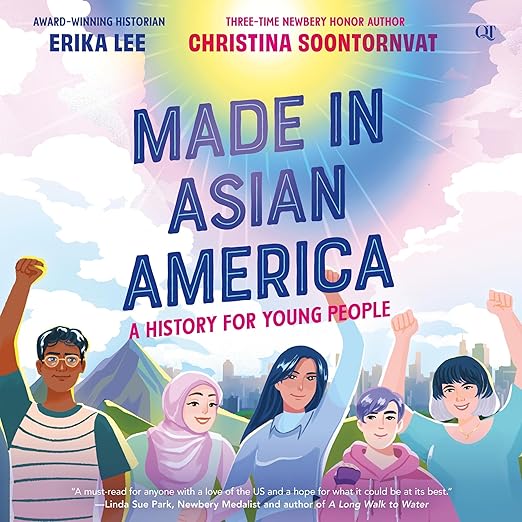
I listened to about forty minutes of this on a Tuesday evening after a long day, and by the time I set my phone down I felt the particular disorientation that only comes from learning something you should have been taught twenty years ago. Erika Lee and Christina Soontornvat have built a history of Asian America that begins, as the text pointedly notes, before the United States even exists as a nation. Hearing Sura Siu read those opening framing lines aloud made the scope of what this book intends land harder than reading them on the page would have.
Lee is an award-winning historian best known for her adult-audience work, including The Making of Asian America. Soontornvat is a three-time Newbery Honor recipient whose middle-grade credentials are impeccable. The collaboration results in something that the genre rarely achieves: serious historical scholarship that reads with the urgency and accessibility of a story written specifically for twelve-year-olds who are already asking the right questions. One reviewer called it the most important book they had ever read about American history. That is a sentence I would typically walk around carefully, but here I find it hard to argue with.
A History Built from Snapshots
The book organizes its chapters as snapshots, a structural choice that works particularly well in audio. Each snapshot is a discrete entry point into a broader pattern: migration, exclusion, resistance, rebuilding. You hear about the 1882 Chinese Exclusion Act not as a legislative footnote but as a lived disruption to specific families and communities. You hear about the incarceration of Japanese Americans during World War II in terms that make the scale of the injustice viscerally clear without numbing the listener with statistics.
Siu handles the emotional register of these shifts with real skill. There are passages in the book that deal with racial violence and dehumanization, and the narration does not soften them, but it also does not lean into theatricality. The material is allowed to carry its own weight, which is the right choice for a young audience that deserves to be treated as capable of sitting with difficult truths.
What the Synopsis Positions Correctly
The book’s framing makes an explicit and important claim: Asian American history is not one single story. That premise shapes every chapter. Filipino farmworkers organizing alongside Cesar Chavez. South Asian activists challenging citizenship laws in the early twentieth century. Korean and Vietnamese refugees remaking communities in cities across the American South and Midwest. The breadth is not scattershot; it is the argument. Lee and Soontornvat are insisting that the category Asian American has always been an umbrella over enormous internal diversity, and that understanding American history requires understanding how those many stories connect.
The audiobook includes a supplemental PDF companion, which functions similarly to visual aids found in other educational titles: useful for classroom use, not strictly necessary to follow the narrative. The history here is primarily told in words and travels well through audio without major loss.
The Updated Scope Since COVID
One reviewer noted that the book updates material from Lee’s earlier adult work to account for the rise in anti-Asian violence that accelerated during the pandemic years. That update is not an afterthought. The final section connects the historical patterns of exclusion and scapegoating to contemporary events with a directness that young readers can recognize and name. The closing material arrives not as a neat resolution but as a continuation, which is the honest thing to do with a history that is still unfolding.
For a middle-grade audiobook, the runtime of just over six hours is appropriate. It does not overstay its welcome, and Siu’s narration maintains enough energy to carry listeners through the denser historical passages without losing momentum. This is the kind of audiobook that works as a family listen, as a classroom companion, and as a solo discovery for a curious ten-to-fourteen-year-old. It rewards attention with understanding, and understanding with a clearer picture of what American actually means.
Who Should Listen and Who Should Skip
This audiobook belongs in the listening queue for middle schoolers, parents, teachers, and anyone who learned American history primarily from a single dominant narrative. It does not shy away from racism, exclusion, or violence, though the treatment is age-appropriate and never gratuitous. Listeners looking for lighter fare will want to know that the book is serious in intent, even when it is warm in tone. That seriousness is its greatest strength.
Frequently Asked Questions
Is this audiobook appropriate for younger children, or is it best suited to middle schoolers?
The target audience is middle grade, roughly ages 10 to 14, and the material is calibrated accordingly. Some chapters deal with racial violence and unjust laws in terms that are frank but not graphic. Younger listeners would benefit from a parent or educator listening alongside them to provide context.
Does Sura Siu’s narration work for a history that covers so many different communities and time periods?
Yes. Siu navigates the book’s snapshot structure with consistent warmth and a clear sense of which moments carry emotional weight. The narration never flattens into rote recitation, which is particularly important given the breadth of the material.
Is this book connected to Erika Lee’s adult history The Making of Asian America?
It draws on the same research base and covers much of the same historical arc, but it is a separate, purpose-built book for younger readers, co-written with Christina Soontornvat. Lee’s adult book is denser and more comprehensive; this one is structured for accessibility and emotional impact with a middle-grade audience in mind.
How necessary is the PDF companion for following the audiobook?
The PDF enhances the experience, particularly in classroom settings where maps and visual timelines would add context. But the history here is primarily narrative rather than diagram-dependent, so the audio stands on its own more fully than some nonfiction audiobooks where visual aids are load-bearing.