The Short Version
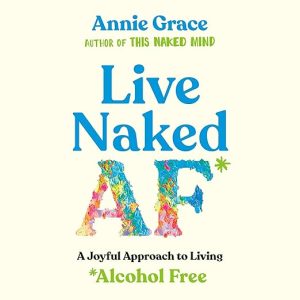
- Performance: Annie Grace reads her own sequel for Penguin Audio, with a companion PDF of visuals sitting outside the recording.
- What it covers: the life that starts after the last drink, subconscious conditioning and emotional habit change, sobriety in social settings
- Feel: Warm, systematic, unsentimental
- Our call: The right book for month six rather than week one, and only worth it with the first one already behind you.
Quit lit has a structural problem: almost all of it ends at the last drink. Annie Grace has already written that book twice, and this audiobook picks up on the far side of it, where the drinking has stopped and the question becomes what the rest of a life is actually for. That subject is harder and a great deal less crowded.
Reprogram the Feeling, Then the Habit Follows
Affective Liminal Psychology is the name given to the method, and the copy never expands the phrase. What does get explained is the mechanism behind it: habits sit in the subconscious and are wired to emotions, so how you feel about a behavior decides whether you can shed it. Reprogram the feeling and the behavior follows. Whether you find that convincing will settle the whole book for you.
Specific promises here are unusually concrete for the shelf. How to handle conversations about your sobriety, how to keep a social life intact, how to turn down a drink without making it an event. Why the drinking, however bad it got, does not mean you were broken. Exercises for processing emotions without numbing or escaping. Practical rather than inspirational, and that distinction matters at three weeks in.
Writing on the day of release itself, one buyer graded it five stars and thanked the author for spreading the message in a relatable and compassionate way. Take the timing for what it is. A response filed the same day a nine-hour recording arrived says a great deal about an existing readership and almost nothing about the recording. Enthusiasm at that speed is loyalty rather than assessment.
Grace Narrates Because the Genre Demands It
Posting at the end of February at five stars, another reader describes the part that seems to land hardest: a deep dive into the personal conflicts that surface once the drinking stops, and a systematic route to working out why other people provoke the reactions they do. That is the material this book adds to the earlier ones. Relationships after sobriety, rather than sobriety itself.
Evidence is where quit lit usually goes thin, and Grace argues from mechanism instead of willpower. The starting question was why she kept drinking despite wanting to stop, and the answer she reached was subconscious programming assembled from personal experience and cultural messaging. None of it requires a disease model, and the copy openly questions the value of the label itself.
Annie Grace reads it herself, which in this genre comes close to a requirement. A recovery book delivered by a hired voice asks a listener to take instruction from somebody with no stake in the outcome, while a book read by the person who did the thing carries its own credential. The text is written in the second person and stuffed with exercises, so the reading has to sound like address rather than recitation.
A Companion PDF You Have to Remember
Repetition is the one substantive complaint on this page. Posting on January 27, 2026 at four stars, the lone four in a column of fives calls it a good read as expected but carrying a lot of repeat from the previous book. Price that in before buying. This is a sequel to a book many buyers already own, and the overlap is real whether or not the new material justifies it.
Visuals are a problem the format cannot solve by itself. The listing states that this edition includes a downloadable PDF of key visuals and other useful resources, which means a framework built partly on diagrams reaches you as a separate file you have to remember to open. Anybody working through the exercises properly needs that document, and the audio alone will not hand it over.
Ratings are strong and worth stating precisely rather than admiringly. A 4.9 across forty-nine ratings requires a total between two hundred and thirty-eight and two hundred and forty-two stars against a ceiling of two hundred and forty-five, so every disappointment on this page combined removes at most seven stars. That is near unanimity. It is also a young pool on a recent release, and unanimity erodes as a book ages.
Terminology is the other thing to settle before starting. One of the book's stated positions is that the word alcoholic may be doing more harm than good in the wider response to addiction, which sets it against recovery traditions built entirely on that identity. If a program you rely on uses the term as a foundation, expect friction rather than reinforcement, and decide in advance whether you want it.
More Useful in Month Six Than Week One
People already past their last drink are exactly who this was built for, and the title states as much more plainly than most subtitles manage. Somebody in week one will take less from it than somebody in month six, because the questions it answers are the ones that surface after the immediate crisis has passed and ordinary life resumes its shape.
Reading it for something other than drinking is a live option. Posting on January 25, 2026 at five stars, one buyer calls it excellent not only for alcohol, which opens the audience considerably. The framework is presented as a general model for habit and behavior change, so anybody trying to shed a compulsion that is emotionally loaded rather than merely inconvenient could take the same route through it.
Save your money if you have not read This Naked Mind, since this is explicitly the book that comes after it and the copy assumes the first argument is already in place. Anybody wanting a clinical treatment plan should look for one elsewhere, because what sits here is a psychological framework and a set of exercises rather than medical guidance. Newcomers to the author are better served starting where the argument starts.
Questions Listeners Ask
Do you need This Naked Mind before starting this audiobook?
It helps considerably. The February 15, 2026 five-star calls this good quit lit and says it landed better than the first book, which assumes familiarity rather than replacing it. The copy positions this as the guide to what comes next, so the earlier argument about subconscious conditioning is taken as read rather than rebuilt.
What is in the audiobook's companion PDF?
The listing calls it a set of visuals and resources drawn from the book, then gives no page count and no contents list, so nothing tells you in advance how much of the framework sits in that file. Download it before you start rather than hunting for it later, especially if you plan to work the exercises.
Is this aimed at people who are still drinking?
No, and the title says as much. The premise is that the drinking has already stopped and the harder work begins afterward, which is why the social chapters deal with refusing an offer rather than with quitting. Somebody still deciding whether to stop is better served by the earlier book.