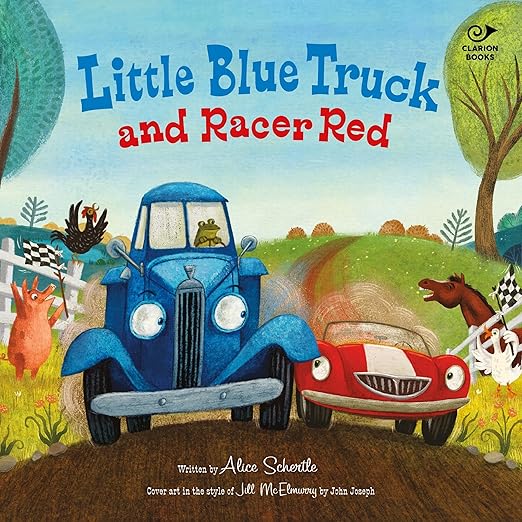
Little Blue Truck and Racer Red is the audiobook version of Alice Schertle's picture book, and at five minutes with Oliver Wyman narrating, it is one of the more compact listening experiences in the children's audiobook catalog. The rating sits at 4.9 across 728 reviews, which, for a children's title with a runtime measured in minutes rather than hours, reflects the specific enthusiasm of families who have discovered this series and returned to it repeatedly. Wyman has the vocal texture for this material: warm without being saccharine, enthusiastic without tipping into the overstimulated performance register that makes some children's narrators exhausting.
The Little Blue Truck series, of which this is a recent entry, has built a readership on consistent character values: Blue is dependable, friendly, and good-natured; the vehicles he meets have distinct personalities and something to learn or share. Racer Red arrives as something genuinely new for the series, a character defined by speed and competitive energy who challenges Blue in a way that the series' usual gentle pace doesn't accommodate. Schertle's solution is clean: Blue accepts the challenge, knows that winning or losing isn't the point, and races anyway. The moral is uncomplicated and exactly appropriate for the target age range of toddlers and preschoolers.
The rhyme scheme in Schertle's text is the engine the book runs on, and Wyman respects it without making the listening experience feel like a meter exercise. His delivery has rhythm without being singsong, which is the technical distinction that separates narrators who understand picture book cadence from those who simply read the words quickly. The Beep! Beep! Zooooom! passages are the kind of repeated sonic event that young children find deeply satisfying, and Wyman pitches those moments with appropriate energy while keeping the quieter beats, the pause before the race begins, the recognition of a new friendship, at a different register.
At five minutes, the audiobook cannot develop its characters the way a longer work might, and it doesn't try to. What it does is establish Racer Red's personality, place her in relationship with Blue and Toad, stage a race, and land the friendship message with enough warmth to justify the journey. One reviewer specifically described it as packed with heart and excitement, which is an accurate summary of what a five-minute audiobook can reasonably accomplish. The book doesn't overextend. That discipline is part of what makes the Little Blue Truck series consistently effective: Schertle knows what each book needs to do and does only that.
Wyman Voices Racer Red's Speed Without Arrogance
The case for the audiobook format specifically, rather than the print edition, rests almost entirely on Wyman's narration. The text was written to be read aloud; its rhyme scheme and its sound effects, the Beep! Beep! and the Zooooom!, exist to be performed rather than silently processed. Wyman gives Racer Red a voice that suggests speed and confidence without making her feel arrogant, which matters for the moral of the piece. Toad's few lines land with appropriate warmth, and Blue's steady, unhurried quality comes through even during the race sequence.
The audiobook format also serves parents who read this book aloud repeatedly at bedtime and want a break from the performance themselves. A five-minute professionally narrated version that children can listen to independently, or that parents can play while doing something else, has practical value beyond the aesthetic. Several reviewers note children returning to the series obsessively, which means the audio version gets significant repeat-play use. Wyman's narration holds up to repetition better than a more stylized performance would.
Racer Red Doesn't Need to Slow Down
For newcomers to the series, this entry works as a standalone but benefits from knowing the established characters. Blue and Toad have an existing friendship that the book assumes rather than establishes, and listeners coming to the series here for the first time will understand the story perfectly but miss some of the warmth that longtime series fans bring to these characters. The original Little Blue Truck is the natural starting point for families new to the series.
The book's central contribution to the series is Racer Red herself, a female character with a competitive, confident personality that is presented as entirely positive rather than something that needs to be tempered or softened. She doesn't need to learn to slow down; she and Blue simply discover that racing can be an act of friendship rather than a test of dominance. For the target age range, that is a subtler lesson than it appears.
Worn-Out Parents Let Kids Listen Independently
The audiobook format for picture books has developed a distinct function in family life: it enables children who have worn out their parents' willingness to perform a favorite text to access it independently, and it introduces children to listening as a mode of engaging with story before they can read. For a five-minute text built on rhyme and sound effects, the audio version is as close to the book's natural form as a recorded version can be. Schertle wrote these books to be read aloud, and Wyman's version is a strong realization of what that intended aloud-reading sounds like at its best.
Families with toddlers and preschoolers already invested in the Little Blue Truck series will find this a natural addition. Children who respond to vehicle characters, racing sequences, and rhyming text will engage fully in five minutes. Parents looking for short audiobook content that works for car rides, pre-nap listening, or independent play will find the runtime ideal. Listeners new to the series should start with the first Little Blue Truck book to get maximum value from the character relationships this entry assumes.
At a Glance
- Narration: Oliver Wyman's narration brings exactly the right energy to Racer Red's zippy competitive personality while keeping Blue's warmth intact; at five minutes, every vocal choice counts and Wyman doesn't waste any.
- Themes: friendship and good sportsmanship, the joy of trying regardless of outcome, introduction to character-based competition
- Mood: Bright, fast-moving, and genuinely joyful
- Verdict: Five minutes of Wyman narrating Alice Schertle's rhyming text is a small, well-executed audiobook that earns its near-perfect 4.9 rating from very young listeners and their caregivers.
Frequently Asked Questions
Is the Little Blue Truck and Racer Red audiobook appropriate for very young children who haven't listened to audiobooks before?
Yes. At five minutes with clear narration and prominent sound effects, it's one of the most accessible audiobook entry points available. The rhyme scheme and repeated sound words give children clear audio anchors to follow even without the picture book in hand.
Does the audiobook work without the physical picture book, since the illustrations are part of the original edition?
The narration carries the story fully, and Oliver Wyman's vocal characterization gives each vehicle a distinct presence that compensates for the absent visuals. Young children who know the book will follow easily; those encountering the story for the first time in audio form will understand the narrative but miss the illustration detail.
Is Oliver Wyman the same narrator across the Little Blue Truck audiobook series?
Wyman has narrated within the series, and his established familiarity with these characters contributes to the consistency of this entry. His voice has become associated with the series' warmth and pacing, which makes repeat listening feel comfortable rather than repetitive.