Quick Take
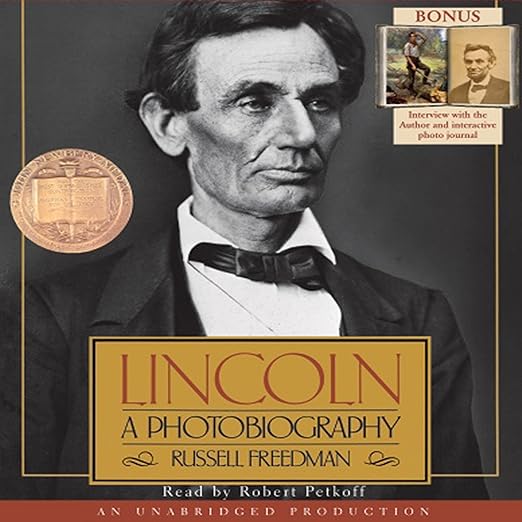
- Narration: Robert Petkoff reads Freedman’s biography with his characteristic warmth and precision, his pacing suits the book’s careful movement from Lincoln’s boyhood through the Civil War presidency to Ford’s Theatre.
- Themes: Leadership through moral crisis, the gap between public reputation and private life, the weight of historical context
- Mood: Measured and authoritative, like a well-lit archive room on a quiet afternoon
- Verdict: A Newbery Medal biography that remains an excellent introduction to Lincoln for children ages 8 through 12, given additional authority by Petkoff’s grounded narration.
I listened to Lincoln: A Photobiography on a morning when I had already been thinking about how we tell children stories about complicated historical figures. Russell Freedman won the Newbery Medal for this biography in 1988, and it remains one of the clearest examples of what narrative nonfiction for children can do when it is done with full attention. It takes Lincoln seriously as a human being rather than a monument, and it trusts children to engage with complexity.
The audiobook begins with Lincoln’s Kentucky and Indiana boyhood, moves through his self-education, his career as a lawyer, his courtship and marriage to Mary Todd, and then focuses its energy on the presidential years from 1861 to 1865. The final chapter covers Ford’s Theatre on April 14, 1865. Freedman’s organization is chronological but his framing is thematic: what kind of person was Lincoln, and how did that person meet the specific demands that history placed on him? The answer the biography constructs is not heroic in a simple sense. Lincoln was funny, sometimes crude, politically careful, emotionally private, and capable of significant growth. Freedman gives the reader all of that.
The Photobiography Format and Its Audio Limitations
The title announces a specific format: this is a biography built around photographs and visual primary sources. In the print edition, the images are structural, breaking up text, providing evidence, and giving young readers a different kind of access to the historical record than prose alone. The audio version by definition cannot reproduce those images, and for a book whose title foregrounds photography as a format element, that is worth noting clearly.
What the audio does preserve is Freedman’s prose, which is excellent. He writes with the kind of clarity and specificity that refuses to condescend. His account of the political complexities Lincoln navigated, the question of slavery, the practical management of a coalition government, the strategic decisions of the war, is rendered at a level appropriate for middle grade readers while being genuinely substantive rather than simplified. An adult listening alongside a child will not feel they are receiving a distorted or oversimplified account.
Robert Petkoff and the Weight of Lincoln’s Voice
Robert Petkoff is one of the best narrators working in the biography space, with a long track record in narrative nonfiction. His reading of Freedman’s text is precise and warm without being reverential. Lincoln emerges from the narration as a person rather than a statue. Petkoff handles the account of Ford’s Theatre in the final chapter with the gravity it requires without performative emotion, which is exactly right for a book whose method is careful observation rather than sentiment.
At two hours and twenty-nine minutes, this is a brief audiobook by adult standards, reflecting the book’s original design for a young audience. The brevity is not a weakness: Freedman packs the runtime with substantive content, and Petkoff’s pacing ensures nothing feels rushed. The concluding author interview, included in the audio, adds useful context about Freedman’s research approach and his decisions about what to include and exclude.
A Newbery Biography That Earns Its Award
Not all Newbery-winning nonfiction ages as well as its fiction counterparts. Lincoln: A Photobiography is one that does. The biography was praised on publication for the specificity of its research and the humanizing quality of its portraiture, and those qualities remain intact. Freedman’s decision to open with Lincoln’s wit and humor before establishing his gravity is still an effective choice: it builds a Lincoln who is immediately interesting rather than imposing.
One reviewer notes that they usually dislike biographies but found this different because of the photographs, direct quotes, and facts that made Lincoln feel real. In audio, the direct quotes carry most of that weight, and Petkoff delivers them with the right balance of historical distance and conversational accessibility.
Who Should Listen, Who Should Skip
Children ages 8 through 12 studying American history or the Civil War will find this an excellent, authoritative starting point. For children who have already done substantial reading about Lincoln, the scope is introductory rather than comprehensive, but the humanizing quality of Freedman’s approach makes it valuable even for more informed readers. Adults who want to understand why this biography remains in circulation nearly forty years after its publication will find the answer in Petkoff’s narration of its final chapter. The audio is most effective when paired with the print edition for the visual primary sources.
Frequently Asked Questions
Does the audio version include the photographs referenced in the title?
The photographs are not included in the audio. This is the most significant limitation of the audio format for this particular title, since the visual primary sources are structural to the print edition’s design. The author interview at the end, however, is included.
How appropriate is this for an 8-year-old just beginning to study American history?
It is well-suited for that age and purpose. Freedman writes with clarity and avoids both condescension and oversimplification. The account of slavery and the Civil War is honest without being graphic, and the human portrait of Lincoln is accessible and engaging for children at that age.
Is the author interview included in the audio version actually useful?
The author interview adds genuine value. Freedman discusses his research approach and his reasons for specific editorial choices, which gives young listeners a sense of how historical biography is constructed. It functions as a brief introduction to research methodology.
How does Robert Petkoff’s narration compare to simply reading this aloud yourself as a parent or teacher?
Petkoff brings professional pacing and authority to the text that reinforces its status as serious nonfiction. For classroom or homework use, his narration models engaged, careful reading. For a parent who enjoys reading aloud, the print edition with your own voice is a legitimate alternative, especially given the photographs.