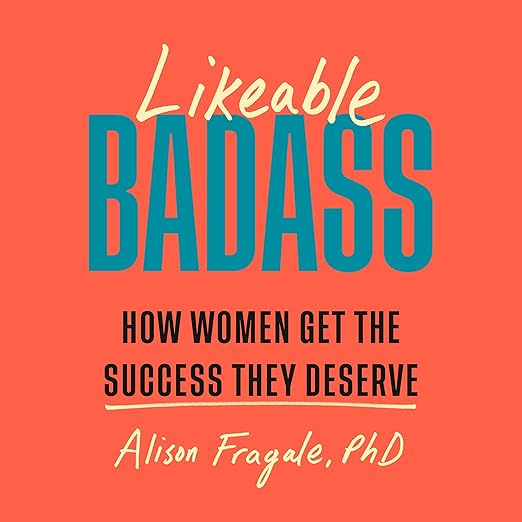
Alison Fragale spent years fielding one specific question from women at every career stage: how do you thread the needle between being liked and being taken seriously at work? That's the animating question behind this audiobook, which she narrates herself. Fragale's answer runs through the concept of status, not power exactly, but the perception other people hold of you, and her core argument is that status can be deliberately built through a specific combination of warmth and assertiveness she calls the 'likeable badass.'
A Response to the Lean In Wave's Gap
What separates Likeable Badass from a purely motivational career book is the research scaffolding underneath the branding. Fragale draws on decades of her own behavioral-science research, speaking engagements, and mentorship to back up what could otherwise read as another feel-good framework; the peer-reviewed grounding is doing real work here, giving the 'likeable badass' concept enough substance to survive past a catchy title.
The book's central insight, that no amount of credential, title, or paycheck raises a woman's actual workplace standing unless it also changes how others perceive her, reframes a familiar problem in genuinely useful terms. Fragale isn't arguing women should simply work harder or negotiate more aggressively; she's arguing the perception problem itself needs a specific, learnable strategy, and she spends the bulk of the book laying that strategy out.
The book's title itself does real branding work, pairing 'likeable,' a word often used to diminish or patronize, with 'badass,' a word that asserts real force, and refusing to treat them as contradictory. That pairing is the entire thesis compressed into two words: the two qualities aren't actually in tension, the perception that they are is the actual obstacle Fragale spends the book dismantling.
One reviewer's framing captures the book's core contribution precisely: Fragale, in that reviewer's words, gives language to something many women in leadership have been navigating for years without ever having a name for it. That's a genuinely useful thing for a business book to do, naming an experience precisely enough that readers recognize it instantly, since vague dissatisfaction is much harder to act on than a clearly labeled dynamic with documented mechanics behind it.
Likeable and Badass Aren't Actually in Tension
Negotiation gets specific, practical attention as one of the concrete skills Fragale ties back to the status framework; she treats negotiating effectively not as a standalone skill to memorize scripts for, but as one of several visible behaviors that either reinforce or undercut the warmth-and-assertiveness balance the whole book is built around. That integration, tying a specific tactical skill back to the larger conceptual framework, is a real structural strength worth noting.
Likeable Badass arrives well after the 'lean in' wave of feminist workplace advice from the early 2010s, and it reads like a response to that earlier moment's central critique, that asking women to simply behave more assertively ignored how differently assertiveness gets perceived depending on who's displaying it. Fragale's status framework directly addresses that gap: the problem was never simply telling women to negotiate harder, it was that identical behavior reads differently depending on the person performing it, and her research explains why.
The synopsis frames the whole project around securing 'that elusive corner office,' old-fashioned corporate shorthand that Fragale herself seems aware sits a little uneasily next to her more contemporary status research; she uses the phrase knowingly, as recognizable shorthand for advancement generally, rather than suggesting every reader's actual career goal is a literal corner office in a traditional hierarchy.
Self-Narration Sent One Reviewer to the Hardcover
Self-narration works to real advantage here. Fragale brings professor-level authority to material she's spent her career researching, paired with a warmth that keeps the science from reading as dry or distant; one reviewer specifically noted buying the hardcover after listening just to underline and annotate the material directly, a strong sign the content itself is doing the heavy lifting regardless of format.
At seven hours and one minute, the audiobook covers real ground without overstaying its welcome. One reviewer, self-described as having read dozens of business and psychology titles, called this 'the most actionable, helpful, and truly life changing of all of them,' a striking claim given the volume of comparison titles that reviewer had apparently already worked through.
A second reviewer specifically credited the book with dismantling what they called 'the false choice many women feel forced to make between being liked and being respected.' Fragale's own research backs that reframing directly: status and likability aren't zero-sum in the way workplace folk wisdom often assumes, and the book spends real time unpacking exactly where that false trade-off assumption comes from and how it gets reinforced in typical office culture.
Office politics gets the same treatment: rather than offering generic advice to simply network more or build alliances, Fragale frames navigating office politics as another arena where the same status-building mechanics apply, giving listeners one coherent mental model to carry across negotiation, day-to-day collegial interaction, and more overtly political workplace situations alike.
Explaining Mechanisms Over Prescribing Quick Tactics
A slight repetition sets in around the midpoint, per the general shape of the reviews, where the core warmth-plus-assertiveness framework gets restated across several chapters before new material picks back up. That's a common enough rhythm in research-grounded business books; it's worth naming so listeners expect it rather than wondering if they missed something new.
This is written specifically for women navigating workplace status dynamics, not a general leadership book applicable to any reader regardless of gender; men reading as allies or managers will find real value in understanding the dynamic Fragale describes, but the book's direct address and its examples are built around women's specific experience of the likeable-versus-competent bind.
As a working professor and researcher rather than a career coach or consultant by trade, Fragale writes from a slightly different vantage than many peer titles in this space; the book leans toward explaining documented mechanisms over prescribing quick tactics, which rewards listeners who want to understand why a strategy works, not just what to do next.
The book draws on decades of Fragale's combined research, speaking engagements, and mentorship experience per her own framing, which gives it real longitudinal weight, but also means some of the underlying studies referenced span a wide range of publication dates. Listeners wanting only the most recent behavioral-science findings should know this synthesizes work across a career rather than reporting on a single new study.
Research-Grounded Strategy Struck in Genuine Balance
Women at any career stage navigating the likeable-versus-respected bind Fragale describes, along with their allies and managers wanting to understand that dynamic better, are the built-for audience. Readers who want research-grounded strategy rather than pure motivational energy will find the balance genuinely well struck here.
Skip it if you've already read extensively in this exact space and want something structurally different rather than another treatment of the warmth-versus-competence framework, or if research-backed behavioral science reads as dry to you regardless of how warmly it's narrated.
- Voice: Alison Fragale self-narrates with professor-level authority and real warmth.
- Big ideas: Workplace status, warmth versus competence, career advancement
- Atmosphere: Research-grounded but genuinely encouraging
- Worth it?: A well-researched, actionable career guide for women navigating the likeable-versus-respected bind.
Common Questions
Does Alison Fragale narrate this audiobook herself?
Yes, and her professor-level authority paired with genuine warmth is a real asset, keeping research-heavy material from reading as dry or distant.
Is this audiobook based on peer-reviewed research or purely motivational advice?
It's grounded in Fragale's own behavioral-science research and years of mentorship, using that scaffolding to support a practical framework rather than relying on motivational energy alone.
Is the Likeable Badass audiobook written for women specifically, or for a general audience?
It's written specifically for women navigating workplace status dynamics, though managers and allies of any gender will find real value in understanding the dynamic it describes.