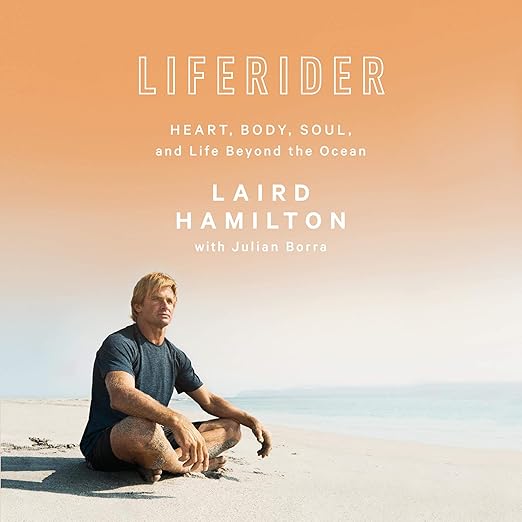
Five pillars hold up this book, and none of them is surfing. Death and Fear, Heart, Body, Soul, and Everything Is Connected are the headings Laird Hamilton organizes his worldview under, which makes Liferider a philosophy audiobook wearing a big-wave rider's clothes. The description is straightforward about how it was made: extensive interviews and conversations between Hamilton and his coauthor Julian Borra, plus additional insights from his wife, the professional volleyball player Gabby Reece. Elijah Allan-Blitz reads all six hours and thirty-two minutes of it for Random House Audio.
What We Made of It
Liferider opens by picking a fight with its own shelf. Millions of us, the description argues, chase happiness through fads and self-help titles while reaching for some enlightened state, and Hamilton would rather look inward and appreciate the creatures we already are. That is an anti-self-help position taken inside a self-help package, and the tension runs through the whole thing. He is not offering a program. He is offering a temperament, which is harder to sell and more interesting to listen to.
Ocean life functions as the lens rather than the subject. The stated range covers resilience, relationships, business, technology, risk-taking, and respect for the natural world, all filtered through a life spent in and beyond the water. Anyone buying this for wave-by-wave accounts of the sport should recalibrate now: the surfing supplies the metaphors and the credibility, while the actual conversation is about fear, mortality, and how to stay physically and mentally alive in ordinary conditions. The description's list rewards a second read, since business and technology sit in it beside heart and soul, and a listener expecting only the ocean-and-spirit register will meet the other half unprepared.
Something worth naming sits in the description's own wording. It promises Hamilton 'raw, honest, and unvarnished' in his own words, then explains two sentences later that the text was built from interviews with a coauthor. Both statements are true, and together they describe a specific genre: spoken thought, transcribed and shaped by a professional writer. That process is standard, and it is also why the prose can feel simultaneously conversational and oddly polished.
The endorsements on the page are unusually specific about the man rather than the book. Josh Brolin describes the Hamilton he knows as 'real, faulty, moody, deeply loving, and communal' and says that person comes through on every page. Eddie Vedder's line is blunter: when Hamilton surfs, you watch, and when he speaks, Vedder listens. Both blurbs are testimonials to a personality, which is a reasonable indicator of what the reading experience actually offers.
Hamilton's framework sticks, which is not nothing for a book of this kind. One five-star response from April 2020 hands the last pillar straight back, praising Hamilton's words of wisdom and then adding that mind, body, soul, and earth are all connected. When a reader paraphrases your framework unprompted a year after publication, the framework is doing its job. Five headings are also easy to carry in the ear, which suits audio better than a run of numbered chapters would. Structure is what keeps books like this from dissolving into quotable fragments, and five named containers give a listener somewhere to file each idea as it lands.
That Vedder line raises the sharpest audio question here. The listing sells the book as Hamilton speaking in his own voice, but the reading credit belongs to Elijah Allan-Blitz, so the speaking that Vedder singles out is not what a listener actually gets. Nothing about that is dishonest, and interview-built memoirs are often read by professionals. It does mean the intimacy the marketing promises arrives at one remove, which is worth knowing before you choose this format over the printed edition.
Things to Know Before Starting Liferider
The dissenting voice on the page is worth reading closely. A two-star response titled 'Poorly edited, I do not think that's Laird's fault' places the blame on construction rather than on Hamilton, then redirects anyone curious about him toward the book Force of Nature or the documentary Take Every Wave. That is a specific complaint about assembly, and it fits a text made from interview transcripts, where repetition and loose sequencing are the usual failure modes.
Read the response pool with its origins in mind. One entry is a five-star note about a parcel arriving quickly and in good condition, which reviews a delivery rather than a book, and several others describe reading a physical copy. This page pools print buyers with listeners, so the 4.3 average across 261 ratings measures the material broadly rather than this particular recording of it.
Enthusiasm here also seems tied to prior affection. One four-star response calls it a nice book 'especially for Hamilton fans' and credits him with a positive outlook, which is faint praise dressed politely. Listeners arriving without a pre-existing interest in the man may find the aphoristic register thin in places, since the authority behind each claim rests substantially on who is making it rather than on evidence offered inside the book.
Best Suited For
Athletes, coaches, and anyone whose work involves calculated physical risk will find the Death and Fear material genuinely useful, since Hamilton treats fear as a practical instrument rather than a problem to eliminate. The book also suits listeners who like their philosophy delivered by practitioners instead of academics, and anyone drawn to the water, whether they surf, swim, dive, or simply organize their year around being near it. It also serves people who want a short book about how to think about danger, a narrower and more useful proposition than the inspirational cover suggests.
The household is part of the appeal, which the credits underplay. A May 2019 response describes the book as worth returning to repeatedly, calls it mind-opening, and thanks both Hamilton and Reece by name for it and for everything else they do. Reece contributes insights to the text and appears nowhere on the byline, as does Borra, so a listener who came specifically for that partnership should know it is present but uncredited.
Hoping for a chronological account of Hamilton's career is the surest route to disappointment, because the book is organized by theme rather than by decade. Listeners who want evidence-backed wellness advice will struggle too, since the claims here are experiential rather than researched, as will anyone with a low tolerance for aphorism delivered with total conviction. If hearing the man himself was the entire point of the purchase, that is precisely what this edition cannot supply.
- Narration: Elijah Allan-Blitz is the credited reader, so a book marketed as Hamilton in his own words reaches the listener through someone else's voice.
- Themes: Fear and mortality, physical resilience, relationships and partnership, risk as a practice, connection to the natural world.
- Mood: Grounded, aphoristic, salt-air earnest.
- Verdict: Rewarding for listeners who want a practitioner's philosophy of risk, frustrating for anyone expecting a surfing life story.
Common Questions
Is Liferider a surfing memoir or a philosophy audiobook?
Much closer to the second. The organizing structure is five pillars covering mortality, heart, physical life, soul, and connection, rather than a career timeline. Big-wave surfing supplies the credibility and most of the imagery, while the actual subjects are fear, health, relationships, work, technology, and the natural world.
How practical is the audiobook, in terms of things to actually do?
Not very, and that is deliberate. The pillars work as an orientation rather than a routine to follow, so expect reflection on fear, physical maintenance, and connection instead of protocols, sets, or schedules. Listeners wanting a training program or a structured wellness plan will need to look elsewhere.