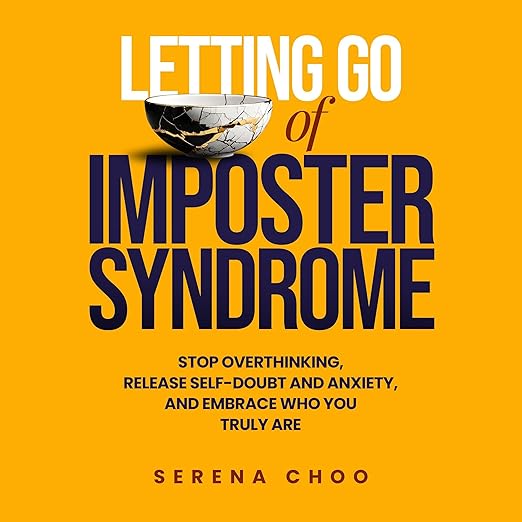
A promotion that still feels like a clerical error, or a compliment that gets replayed on a loop until it starts sounding fake, is the specific, familiar territory Serena Choo built this audiobook to address. Narrated by D'ella Rayne across six hours and forty-two minutes, Letting Go of Imposter Syndrome draws on Choo's twenty-five-plus years as a personal leadership coach to offer twenty-three specific, actionable tools rather than the usual stock of generic confidence-building advice. Part of the Practical Clarity Books line, the audiobook positions itself less as a lecture and more as a structured, one-on-one coaching session, working backward from self-doubt to its actual root causes instead of just papering over the symptoms.
Self-Doubt as a Story You Were Taught
Imposter syndrome is a crowded category at this point, and what separates Choo's approach from a lot of the competition is the insistence on root-cause work over quick reframes. Rather than offering a single mindset trick to silence the inner critic, the book works from the premise that the feeling isn't really about the listener's actual competence at all; it's about a story they were taught to believe about themselves, and that story has to be examined and dismantled rather than just argued with in the moment. That's a slower, more demanding process than most imposter-syndrome content promises, and the twenty-three tools exist to support that longer arc rather than deliver instant relief.
Choo builds the book around relatable stories drawn from her coaching practice rather than abstract theory, which keeps the material grounded even when it's asking listeners to do real internal work. The explicit rejection of fake-it-till-you-make-it posturing, in favor of practical steps aimed at actually quieting the inner critic, gives the book a specific personality distinct from the more performance-focused confidence literature that dominates the business shelf. It reads less like a manifesto and more like the actual structure of a coaching relationship, session by session.
That reframing, self-doubt as an inherited narrative rather than an accurate self-assessment, has real grounding in how self-doubt actually tends to form, usually through early comparison, unclear feedback, or environments that reward constant self-monitoring. Choo doesn't spend much time on that developmental backstory herself, focusing instead on practical tools for the present, but the root-cause framing implicitly acknowledges it, which gives the twenty-three tools more credibility than a book that treated self-doubt as something to simply argue yourself out of.
Roughly Seventeen Minutes per Tool, Twenty-Three Times
D'ella Rayne's narration brings a measured warmth that suits coaching content specifically well, positioning the listener as someone being guided through a process rather than lectured at from a stage. That register matters for a book explicitly designed to feel like sitting down with a wise friend rather than working through a dry self-help lecture; a colder or more clinical narrator would have undercut exactly what the book is trying to do.
Reviewer William Wyres praises Choo's 'refreshing and insightful approach to tackling the pervasive feelings of self-doubt and inadequacy that plague so many individuals,' and a reviewer identified only as Amazon Reviewer adds that the book 'really spoke to me,' specifically flagging how heartbreaking it is to watch how often people doubt themselves. S. Will's review keeps things brief but pointed, describing an excellent book with 'clear and useful resources,' a description that lines up with the twenty-three concrete tools structure rather than a vaguer set of affirmations.
That validate-first instinct is worth calling out beyond just one reader's reaction: the book acknowledges the emotional reality of self-doubt before trying to dismantle it, rather than rushing past the feeling toward the fix. That sequencing, acknowledge first, then equip, is a big part of why the coaching-session framing works better here than a more clinical, checklist-driven approach would.
Rayne's pacing also avoids the rushed, list-checking cadence that can creep into audiobooks built around a numbered framework; each of the twenty-three tools gets room to land as its own idea rather than blurring into the next item on a checklist, which matters for content designed to be revisited rather than consumed once and filed away.
Divided evenly across all twenty-three tools, the six-hour-and-forty-two-minute runtime works out to roughly seventeen minutes per tool, which tracks with a book built for steady, one-tool-at-a-time engagement rather than a single unbroken sitting.
A Slightly Awkward Fit for Passive Listening
The imposter syndrome category is genuinely oversaturated at this point, and listeners who've already worked through several other titles covering similar ground may find some of the foundational material here familiar even where Choo's specific tools and root-cause framing add something real. This works best treated as an active workbook experience rather than passive listening, a slightly awkward fit for audio specifically, since the twenty-three tools are clearly meant to be practiced and revisited rather than simply heard once and absorbed.
A companion PDF is available alongside the audio in the Audible library, and given how much the book leans on structured tools and exercises rather than pure narrative, treating that PDF as optional would likely shortchange the material. Listeners planning to actually apply the twenty-three tools, rather than just absorb the book's general philosophy, should plan on pairing the audio with that written companion for reference.
Choo's coaching background is the credential doing most of the persuasive work here, since the book doesn't lean heavily on academic psychology citations or clinical research the way some competing titles do. Listeners who want their self-help grounded explicitly in published research rather than practitioner experience should know that distinction going in, even though the coaching-derived tools themselves read as practical and specific rather than vague.
A Public Win as the Actual Trigger
Professionals experiencing the specific, familiar loop of achievement followed immediately by self-doubt (particularly those who've already tried more surface-level confidence advice without lasting results) are the clear audience Choo is writing for. The coaching-session structure also suits listeners who respond better to guided, personal-feeling instruction than to more academic or research-heavy treatments of the same psychological territory.
Anyone currently in a season of visible achievement, a promotion, a public win, a new level of responsibility, rather than a quiet stretch, may find the book's timing counterintuitively perfect, since Choo's central argument is that imposter syndrome often intensifies right after success rather than fading with it. That specific insight, success itself as a trigger rather than a cure, is easy to miss when scanning the self-help shelf for a title and worth calling out directly.
Readers hunting for a quick, single-listen fix should adjust expectations going in, since the book's entire premise is that lasting change requires the slower work of root-cause examination rather than a fast mindset hack. Anyone unwilling to engage with the twenty-three tools as active practice, rather than simply nodding along, will get considerably less out of this than a listener ready to treat it as an ongoing coaching relationship rather than a single sitting.