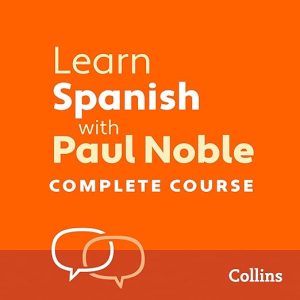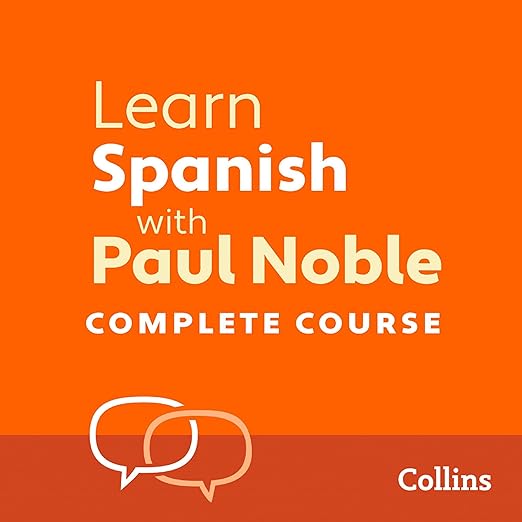
Almost a million learners have gone through some version of Paul Noble's method, and this audiobook course earns that reputation more than the marketing copy suggests it might. Learn Spanish with Paul Noble for Beginners bundles all three parts of his beginner curriculum into one thirteen-hour-and-twenty-one-minute download, and the pitch is refreshingly narrow: no grammar tables, no memory drills, no vocabulary lists to cram before bed. Instead Noble walks new speakers through a chain of everyday situations, ordering coffee, asking directions, describing themselves, and lets repetition inside real context do the work grammar charts usually try to do. It is a bold promise for an audio-only format, and for the most part it holds up.
Thirteen Hours Where Present Perfect Comes Before Simple
The structural decision that defines this course is unusual enough to deserve its own paragraph. Noble introduces the present perfect tense before the simple present, inverting the order almost every classroom textbook uses. Reviewer Walter E Campagna flagged this immediately, noting that Noble leans on what is technically the present perfect from the very first disc and does not fully explain the pedagogical logic until disc ten. That is a deliberate design choice, not an oversight, and it rewards patience over the instant-gratification structure most language apps are built around. Listeners who stick with it get a method built on cumulative recall rather than isolated fact memorization, which happens to be exactly the kind of thing that works better heard in sequence than skimmed on a page.
Two native Spanish speakers, one male and one female, model pronunciation throughout the course, a production choice reviewer Kindle Customer specifically praised for making the earliest lessons, like ordering a coffee, land fast and feel usable within the first CD. What that same reviewer could not pin down was which Spanish-speaking country or region the pronunciation was modeling, a fair concern given how much accent and vocabulary shift between Madrid and Mexico City. The synopsis states the course covers both European and Latin American Spanish but never specifies how the two are blended or separated across the thirteen hours, so listeners with one specific dialect target in mind should treat that gap as a real planning consideration.
This listing's tag data hints at a broader use case than pure travel chatter. Alongside travel-tourism, it is filed under business-careers, and the synopsis's own scenario list, asking for directions, eating out, talking about yourself, is deliberately generic enough to serve a business traveler building rapport in Spanish just as well as a vacationer ordering tapas. Noble never markets the course as professional Spanish specifically, but the conversational foundation it builds is the same one a business traveler would need before a client dinner in Madrid or Mexico City.
The Forgetting-Then-Recovering Cycle Plays to Audio's Strengths
The method's real engine is repetition inside context rather than rote drilling, and reviewer DK's account of working through the course at roughly one disc every three to seven days captures how it is meant to function: you forget a word, Noble reintroduces it a few lessons later without fanfare, and the forgetting-then-recovering cycle is what makes vocabulary stick for good. That is a genuinely different mechanism than flashcard-style apps rely on, and one that plays directly to audio's strengths, since the course can loop a phrase back into a fresh scenario without the listener needing to flip back through pages to find it.
This particular listing is also the complete course, all three parts bundled into a single purchase rather than the opening segment some retailers sell on its own, and that matters because Noble's sequencing genuinely depends on momentum across all three parts. A downloadable companion booklet rounds out the package as a reference and revision tool, giving listeners a real print backstop for anything that does not fully land by ear alone. For anyone who has bounced off grammar-heavy courses before, this is a structurally different approach worth taking seriously rather than one more app with a new coat of paint.
The synopsis also points listeners toward what comes next: Next Steps in Spanish with Paul Noble for Intermediate Learners, a follow-up course designed to pick up exactly where this one leaves off. That continuation matters for anyone deciding whether thirteen hours is enough to reach genuine fluency; it is not meant to be, and Noble's own catalog treats this beginner course as the first stage of a longer runway rather than a single finish line. Framed that way, the honest pitch here is confidence and a real working foundation, not full fluency in one download, and listeners should set expectations accordingly before diving in.
A Children's Tag That Undersells Adult Content
The genre tags attached to this listing include a children's category, which badly undersells what is actually a dense, adult-paced instructional course. Nothing about the content, the pacing, or the scenarios, booking meetings, navigating logistics, holding adult conversations, is built for a young audience, and any listener browsing by that tag should ignore it entirely. At over thirteen hours this is also a real time commitment, not a casual weekend project, and Noble's unhurried, conversational delivery style asks for patience rather than speed. Listeners hoping to cram survival Spanish before a trip next week should look elsewhere.
The dialect ambiguity raised above is worth a second mention for anyone traveling to one country specifically. General, neutral Spanish serves most beginners well, but a listener headed to Argentina, or conducting business in Spain, will eventually need supplementary, region-specific material this course never claims to provide on its own. Framed correctly, as a broad foundation rather than one destination's dialect guide, that limitation stops reading as a flaw and becomes simply an honest description of what the product is trying to do.
Nervous Learners Who Freeze at a Vocabulary Quiz
This suits absolute beginners who have tried and abandoned grammar-first courses before, and it equally suits nervous learners who freeze at the idea of a vocabulary quiz. Noble's format asks you to listen, respond out loud, and let mistakes pass without consequence, a genuinely lower-anxiety way into a new language than most classroom-style audio courses attempt. Frequent travelers building general conversational confidence, rather than chasing one specific accent, are squarely the intended audience here, and the almost-million-strong track record the synopsis cites suggests the format holds up across a lot of different learning styles.
Skip this one if intermediate Spanish is the starting point and structured grammar review is the goal, since the entire design philosophy here avoids the kind of tables intermediate learners often want back. Skip it too if a single specific national dialect needs to be modeled consistently from lesson one, since this course is built for broad usability rather than precision. For everyone else starting closer to zero, it remains a thoughtfully sequenced audiobook course, worth the full thirteen hours if the method is allowed to work the way it was actually designed to.
A Few Questions About Learn Spanish with Paul Noble for Beginners
Does this audiobook cover Spanish from Spain, Latin America, or both?
The synopsis states it covers both European and Latin American Spanish, but it does not specify exactly how the two are separated across the thirteen hours. Listeners with a single destination in mind, Argentina versus Spain, for instance, should expect to supplement with region-specific material later.
Is this audiobook appropriate for children, since it appears under a children's category?
No. Despite that genre tag, the pacing, vocabulary, and scenarios (booking appointments, navigating adult logistics) are built for adult learners. Treat the tag as a metadata quirk rather than a content signal.
Do I need the companion booklet to get full value from this audiobook?
It helps. A downloadable booklet is included as a reference and revision tool, and having it on hand makes it easier to revisit specific vocabulary after a listening session rather than relying on memory alone.
Why does the course teach the present perfect tense before the simple present?
It is a deliberate sequencing choice by Paul Noble rather than an error. One reviewer notes the logic behind teaching that tense first is not fully explained until disc ten, so early confusion about the order is expected and resolves itself with patience.