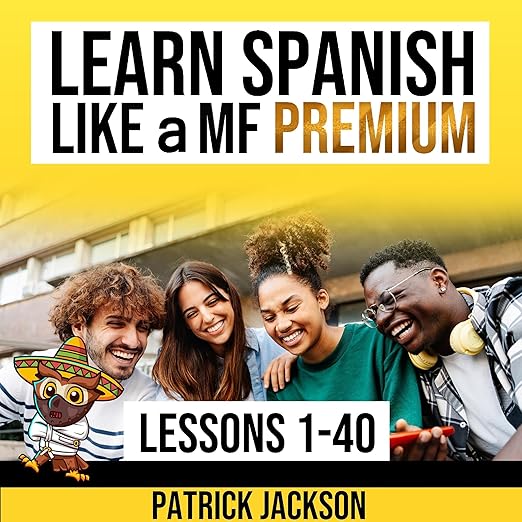
Patrick Jackson built the Learning Spanish Like Crazy system around a specific and pointed critique of mainstream language learning: gamified apps and vocabulary drill software produce learners who can maintain impressive streaks but cannot hold a real conversation when they actually need to. Learn Spanish like a MF Premium is Jackson's audiobook answer to that problem, narrated by Felipe Gonzalez across forty-one hours and twenty-three minutes, oriented specifically toward conversational Latin American Spanish as it is actually spoken rather than as textbooks typically present it. Gonzalez narrates with the relaxed authority of a native speaker who has worked extensively with language learners, and the program includes a companion PDF and live weekly conversation club access with an instructor based in Medellín, Colombia.
The program's design philosophy consistently puts authentic voice and real-world phrase structure above the grammatical scaffolding that most structured language courses make their organizing principle. Jackson is explicit about this throughout: the goal is to produce learners who can understand and be understood by native speakers in actual conversation, not learners who can correctly parse grammar explanations on a test. Every example in the program is voiced by Latin American Spanish speakers across a range of accents, and the vocabulary selection prioritizes high-frequency conversational phrases over the formal register that most textbooks default to as their baseline. That orientation toward practical conversational applicability is the core of what the premium format promises and, for the most part, delivers.
Practical Vocabulary Over Comprehensive Grammar Coverage
The reviewer who commented on this specific title praised it as "clearly an improvement over the author's other books and audiobooks" specifically for its focus on "practical, useful Spanish vocabulary" that would actually apply during travel or real conversation rather than only in structured exercises. That endorsement comes from someone already familiar with the broader Learning Spanish Like Crazy catalog, which makes it meaningful context: it points to what the premium format does differently by narrowing the vocabulary scope to what high-frequency conversational use actually demands rather than attempting comprehensive grammatical coverage. Jackson understands that breadth is the enemy of automaticity at the production level, and the program reflects that understanding throughout its structure.
The program is best understood and used as a complement to some structured grammar study rather than as a complete standalone replacement. Jackson's immersive approach works well because it does not ask learners to understand grammatical rules fully before beginning to produce language; it asks them to produce first and trust that patterns will consolidate through sustained exposure and repetition. That approach works efficiently for some learners and produces significant frustration in others who feel disoriented without explicit rule explanation before exposure. Those listeners will find the intuitive format difficult to work with despite the genuine quality of the audio content throughout.
Gonzalez's Prosody Bridges Comprehension and Production
Gonzalez's narration is the program's most immediate and consistent asset. His voice carries the prosody and rhythm of natural Latin American Spanish speech, which is different enough from Castilian and from the neutral accent used in many mainstream programs that learners develop genuinely applicable listening comprehension from the very first sessions. The forty-one hours of native-speaker audio provide the kind of repeated and varied input that the research literature consistently identifies as foundational for pronunciation and intonation acquisition. Learners who shadow Gonzalez's pronunciation actively during listening rather than simply receiving passively will notice measurable improvement in their own production across the program's length.
The weekly conversation club with a Medellín-based instructor is the program's most distinctive structural feature and the one most likely to determine whether learners actually achieve the conversational outcomes the title promises. Listening practice alone builds receptive competence, which is valuable, but it does not directly produce productive speaking fluency. The live interactive component is where the transfer from comprehension to production happens, and Jackson's inclusion of it reflects a realistic understanding of what audio-only programs can and cannot accomplish on their own.
Knowing When to Use the Right Word
The cultural insights sections distributed throughout the program are worth specific attention. Jackson includes observations about Latin American social norms, conversational conventions, and contextual differences in language use across different countries and registers that are genuinely useful for travel or professional contexts. These sections do what most grammar-focused programs cannot do: they prepare listeners for the moment when knowing the right word matters less than knowing when and how to use it in a culturally appropriate context. Also notice how Gonzalez models the pronunciation sections, where he approaches phonological distinctions between Spanish and English with the precision of someone who has worked with learners long enough to know which contrasts cause the most persistent difficulty in production.
Low-Intermediate Learners Ready to Start Talking
This audiobook is best suited to low-intermediate learners who have established basic vocabulary but have limited actual conversational experience, and to travelers or professionals who specifically need practical Latin American Spanish rather than formal or Castilian patterns. The premium format's considerable length demands genuine and sustained commitment, and listeners who approach it as background audio rather than as active deliberate practice will find the return on their time investment modest. Those willing to engage actively, pausing to produce responses before the audio confirms them and to participate consistently in the conversation club, will find it a genuinely effective element of a broader learning strategy. Listeners who need explicit grammatical structure before they can begin to internalize patterns through practice should pair this program with a parallel grammar reference from the start.
Before You Press Play
- Narrator: Felipe Gonzalez narrates with the natural fluency and conversational warmth of a native Latin American speaker, and the contrast between his voice and the drill audio recorded by other native speakers gives the program genuine sonic variety across its forty-one hours.
- Subjects: Conversational fluency, authentic pronunciation, practical Latin American Spanish
- Tone: Energetic and practical, with the slightly irreverent self-awareness built into the title carrying through the program's attitude toward traditional language learning
- Bottom line: Learn Spanish like a MF Premium is a well-structured immersion program for learners willing to commit to its lengthy runtime, though its title-level ambitions occasionally outpace its execution.
A Few Questions About Learn Spanish like a MF Premium
How does this audiobook differ from the standard Learn Spanish Like Crazy program by Patrick Jackson?
The premium format focuses more narrowly on practical conversational vocabulary and includes access to a live weekly conversation club with a native instructor from Medellín, Colombia. One reviewer specifically noted it teaches vocabulary more applicable to real travel conversations than earlier versions.
Is this audiobook suitable for complete beginners, or does it require prior Spanish knowledge?
The program is most effective for low-intermediate learners with basic vocabulary already in place. True beginners may find the pace and assumption of some familiarity difficult to navigate without supplementary foundational study.
Does Felipe Gonzalez narrate the entire audiobook, or are multiple voices used?
Gonzalez narrates the instructional content, while the example sentences and drills are voiced by multiple native Latin American Spanish speakers. That variety is a deliberate feature of the program, exposing learners to the natural range of Latin American accents and speech patterns.