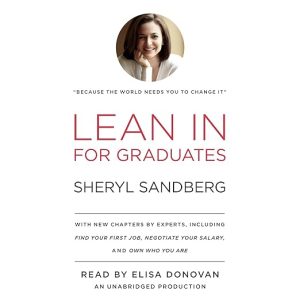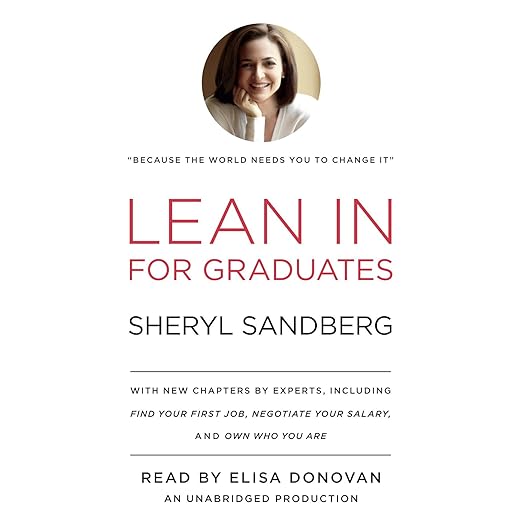
The original Lean In turned into such a cultural phenomenon in 2013 that its title became shorthand on its own, which raises a real question for this specific edition: what does a book already absorbed into everyday language have left to offer a graduate holding a diploma and no job yet? This audiobook is the Graduates Edition of Sheryl Sandberg's best seller, narrated by Elisa Donovan, and it answers that question with six entirely new chapters aimed at the reader Sandberg didn't have specifically in mind the first time around.
The Foundation Named for Sandberg's Late Husband
The added material is substantial rather than cosmetic: a personal letter to graduates from Sandberg, now identified in the synopsis as Meta's COO from 2008 to 2022; a chapter on finding a first job from Mindy Levy, drawing on Wharton and Penn credentials; salary negotiation guidance from Kim Keating; a chapter aimed specifically at millennial men from McKinsey consultant Kunal Modi; and further contributions from Rachel Thomas, Mellody Hobson, and Rachel Simmons, plus twelve short reader stories woven through the whole.
That range of contributors matters because it answers one of the most common critiques of the original book directly: that Sandberg's own experience as a Harvard-and-Google-and-Facebook executive doesn't automatically generalize. Bringing in voices like Mellody Hobson, president of Ariel Investments, or Rachel Simmons, cofounder of the Girls Leadership Institute, widens the perspective beyond Sandberg's own career path without diluting the book's central argument.
The foundation behind one of the new contributors, Rachel Thomas's Sheryl Sandberg and Dave Goldberg Family Foundation, carries its own quiet context: Goldberg, Sandberg's husband, died suddenly in 2015, and the foundation's ongoing work threading through this graduate-focused expansion connects Lean In's original ambition-and-confidence argument to Sandberg's later, more public writing about resilience and loss.
A TED Talk Tested the Argument First
Kunal Modi's chapter on millennial men deserves particular note as a genuine structural addition rather than a token gesture: the original book focused almost entirely on women's individual choices and workplace dynamics, and explicitly addressing men's role in gender equality, from a McKinsey consultant with Harvard Business and Kennedy School credentials, extends the book's argument to an audience the first edition mostly left to infer its own responsibility.
The book grew out of a TED talk Sandberg gave several years before publication, on why so few women reach leadership roles, which means the central argument had already been tested and refined in front of a live audience before it became several hundred pages; that origin explains some of the book's directness, it reads like an expanded, more evidenced version of a talk built to persuade in under twenty minutes.
Mellody Hobson Broadens the Book's Definition of Ambition
The original Lean In reshaped how an entire decade of professional women talked about ambition, ambition itself became a less loaded word partly because of this book, and reviewer jennyc. captures the regret many readers describe: wishing she'd 'read this book before graduating college' instead of learning the same lessons 'the hard way' over eight years in the workforce.
Reviewer Amazon Customer describes it as required reading for internship and leadership courses, and specifically credits it with helping her 'understand how to use my strengths to get uncomfortable in corporate settings,' a phrase worth sitting with; the book's real value, per this account, isn't comfort or reassurance but a kind of productive discomfort.
The twelve reader stories woven through the book function differently than the expert contributor chapters: rather than offering more advice, they show the original book's ideas already tested in real careers, a structural choice that shifts the book, briefly, from instruction into evidence, letting listeners hear how Sandberg's framework actually played out for people who read the first edition years earlier.
Reviewer jennyc.'s specific detail, having been out of college for eight years and learning Lean In's lessons the hard way in real time, is a useful data point for how the book's shelf life actually works: its core arguments about confidence and negotiation don't expire quickly, part of the case for reading it earlier rather than catching up to it nearly a decade later.
Mellody Hobson's specific chapter, Own Who You Are, carries particular weight given her own public profile as one of the most prominent Black women in American finance; her inclusion broadens the book's implicit definition of ambition beyond the mostly white, Ivy-League-adjacent world Sandberg's own career largely took place in.
One Narrator Voicing Six Distinct Professional Contributors
A single narrator, Elisa Donovan, reads both Sandberg's original text and all six new contributor chapters, meaning the distinct professional voices of Levy, Keating, Modi, Thomas, Hobson, and Simmons all get filtered through one performer rather than each author reading their own material the way some multi-contributor business audiobooks do. That's a real structural choice worth knowing going in, not a flaw exactly, but a different listening experience than a fully multi-voice production.
Reviewer Krystan offers the most pointed honest critique available: 'one author cannot touch on every marginalized group of women but there isn't even a mention of women with disabilities.' That's a fair limitation to flag directly rather than smooth over, especially for listeners specifically hoping this graduate-focused expansion would broaden the book's intersectional coverage rather than just its career-stage coverage.
The original Lean In also drew a specific, recurring critique worth naming alongside Krystan's disability-coverage point: some readers and critics argued the book put too much weight on individual women changing their own behavior, confidence, negotiation, ambition, relative to how much weight it put on employers and systems changing theirs. The Graduates Edition doesn't fundamentally resolve that tension, though the added contributor chapters do broaden whose individual experience gets centered.
Listeners who found the original book's tone overly corporate or Silicon-Valley-specific should know the graduate-focused material broadens that register somewhat, several contributors write from law, finance, and nonprofit backgrounds rather than exclusively from tech, though the core voice remains recognizably Sandberg's throughout.
The Synopsis Names This the Perfect Graduation Gift
Recommended above all for actual new graduates, the synopsis calls this explicitly 'the perfect graduation gift,' and the new material is genuinely built for that specific moment: resume writing, interviewing, and salary negotiation are all first-job problems, not mid-career ones.
It's a natural fit for listeners already familiar with the Lean In Circles peer-support model Sandberg's organization built around the original book, since the graduate-focused material extends that same community-oriented, practical-action approach to an audience just starting out.
Skip it if you already own and finished the original Lean In and specifically want only the six new graduate-focused chapters without re-listening to the full original text, this edition doesn't appear to offer that material as a standalone add-on, or if intersectional coverage of disability specifically is a priority, per Krystan's critique, that gap remains unaddressed here.
Before You Listen
Is this audiobook the original Lean In or the updated Graduates Edition?
The Graduates Edition, which includes the complete original text plus six new chapters and a letter aimed specifically at graduates.
Does one narrator read all the guest-contributor chapters in this audiobook?
Yes. Elisa Donovan narrates the entire edition, including the new material from contributors like Mindy Levy, Kim Keating, and Mellody Hobson, rather than each writer reading their own section.
Is the Lean In audiobook a good graduation gift?
The publisher frames it explicitly that way, and the new material, first jobs, salary negotiation, interviewing, is built specifically for that life stage.
How long is the Lean In audiobook?
Nine hours and thirty-four minutes for the full Graduates Edition, original text plus all new material.