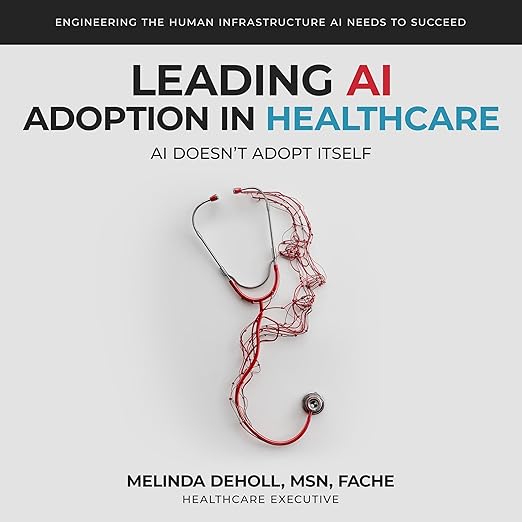
The statistics that open Melinda deHoll's Leading AI Adoption in Healthcare audiobook are designed to stop you cold. Organizations globally have invested somewhere between thirty and forty billion dollars in artificial intelligence. According to MIT research from 2025, ninety-five percent of that investment produced no measurable return. Only five percent made it into daily workflows. DeHoll opens with those numbers not to shame anyone but to establish the specific problem this book is built to solve: the gap between AI that looks successful in a pilot and AI that actually works when it enters clinical operations under real pressure from real staff making real decisions about real patients.
DeHoll is a healthcare leadership and operational science practitioner, and that background shows in how precisely she locates the failure modes. This is not a book about whether AI is good or bad for healthcare. It takes as given that AI will become part of clinical operations, and then asks the harder question: what does it take for that to go right? The 2-hour-and-26-minute runtime is compact by design. DeHoll writes for executives with real accountability and finite time, and she never loses sight of that audience for a single paragraph.
DeHoll Asks What Organizations Need to Become
What distinguishes deHoll's framework from the wave of AI-in-healthcare books that arrived in the early 2020s is her insistence on locating the risk in the right place. Most governance approaches focus on piloting, metrics, and oversight committees. DeHoll's argument is that these tools create a false sense of control. The problems accumulate downstream, in moments where AI-assisted decisions go unchallenged, where front-line concerns stop surfacing because the system has trained people to defer to the algorithm, and where accountability gaps widen invisibly until they manifest as a patient safety event, a lawsuit, or a wave of workforce turnover. That is a specific and somewhat alarming diagnosis, and she earns it through operational detail rather than vague warning.
The book introduces practical frameworks for governing AI where consequences actually land: in workflows, in team decisions, in the specific moments when human judgment needs to override automation. One reviewer noted that the book confronted the deeper issue of whether governance and operating models are genuinely ready for clinical AI embedded directly into care delivery, and that framing captures what makes deHoll's contribution different from the technology-capability literature. She is not describing what AI can do; she is describing what organizations need to become before they scale AI responsibly.
Reviewers Call It Confronting, Not Reassuring
Self-narrated audiobooks in the business and leadership genre are a gamble. The author knows the material better than any voice actor could, but that expertise does not automatically translate into engaging audio delivery. DeHoll reads with clear, measured authority, which suits the material well. This is not a performance that will sweep you up emotionally, but it is easy to follow, and the concision of the prose means the listening experience never drags. At just over two and a half hours, this audiobook is short enough to complete on a long flight or across a few commutes, which seems entirely intentional. DeHoll is not trying to become ambient background listening; she wants focused attention from people who will actually implement something afterward.
Reviewers have emphasized the book's practical orientation, with one healthcare professional noting that it changed their assumption that their organization was prepared for AI deployment. Another described it as confronting rather than reassuring, which is the highest compliment a governance framework book can receive. The tendency in this genre is to offer checklists that produce the feeling of preparation without the substance of it. DeHoll resists that tendency consistently, and the result is a short book that does more than much longer ones on adjacent topics.
Discounted Judgment Makes Staff Leave or Go Silent
The central tension deHoll surfaces is between the visible metrics of AI performance and the invisible accumulation of risk. Dashboards show what they are designed to show; they do not capture the front-line concern that was never raised because accepting the AI recommendation was easier than questioning it. She is particularly precise about how pilot environments create false confidence by filtering out the pressures that real clinical workflows apply. That gap, between what AI looks like in controlled conditions and what it does under operational stress, is the book's animating insight, and it is one that many technology-forward healthcare organizations have not yet confronted honestly.
The book also addresses workforce dynamics in a way that feels underrepresented in competing titles. Staff retention and trust, deHoll argues, are directly affected by how AI adoption is managed. When front-line workers feel that their judgment is being systematically discounted in favor of algorithmic output, they either leave or they go silent, and both outcomes are costly in ways that do not appear on the ROI analysis that justified the AI investment in the first place. That connection between governance quality and workforce behavior is one of the book's more original contributions.
This Skips Anyone Still Beginning to Think About AI
This audiobook is written explicitly for healthcare executives with accountability for AI outcomes: CMOs, CNOs, CIOs, and clinical operations leaders who are past the question of whether to adopt AI and squarely into the question of how to do it without creating new categories of harm. It is also useful for anyone in a governance, risk, or patient safety role who needs a concise framework for the conversations they are already having. Listeners looking for a technology-capability overview or an introduction to healthcare AI concepts will find this too operationally specific for their needs. This is not a book for those beginning to think about AI; it is for those already deploying it who sense that something in their approach is not quite right.
Quick Take
- Narration: Melinda deHoll self-narrates with the authority of someone who has actually sat in those governance meetings, though the delivery is measured rather than dynamic.
- Themes: AI governance failure points, clinical workflow risk, human judgment under automation
- Mood: Urgent and precise, with no patience for optimism theater
- Verdict: Short enough to listen to in a single session, substantive enough to change how a healthcare executive thinks about their next AI deployment.
A Few Questions About Leading AI Adoption in Healthcare
Is the Leading AI Adoption in Healthcare audiobook dense enough to justify the investment compared to a longer book on the same topic?
Yes. DeHoll writes with deliberate concision, and at just over two and a half hours the book covers a specific and actionable argument rather than broad survey territory. The density is a feature rather than a limitation.
Does Melinda deHoll self-narrating the audiobook help or hurt the listening experience?
It helps. The material requires the kind of operational precision deHoll brings naturally, and a voice actor might smooth out the specificity that makes the governance frameworks feel grounded. Her delivery is measured and clear throughout.
Does this audiobook address AI tools in specific clinical settings, or does it stay at a strategic level?
Primarily strategic, with operational specificity. DeHoll focuses on governance frameworks, workflow risk, and leadership accountability rather than evaluating particular AI products or clinical specialties.
Is this audiobook relevant for non-US healthcare systems given that the investment statistics reference US-focused research?
The governance principles and failure-mode analysis apply broadly. The investment figures and regulatory context lean toward the US system, but the operational science underlying the frameworks is not jurisdiction-specific.