Quick Take
- Narration: Jacqueline Wilson and Vanessa Kirby share the reading duties, and that pairing, a beloved British children’s author and an acclaimed screen actor, gives this anthology a credibility and warmth that no anonymous recording could match.
- Themes: Female courage and ingenuity, cultural breadth in heroism, wit over brute force
- Mood: Empowering and intimate, with the gentle authority of a skilled storyteller
- Verdict: Six short tales of resourceful girls from around the world, read by two excellent performers, a purposeful anthology that does exactly what it sets out to do without overreaching.
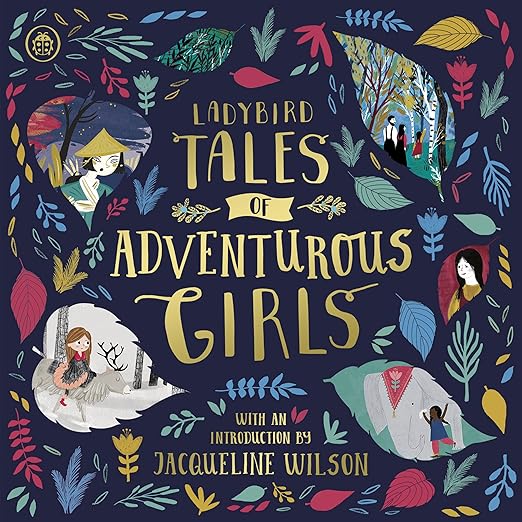
I was reading with a seven-year-old niece last summer when she asked me, with the directness that children manage before they learn to soften their questions, why the heroes in so many of the stories she knew were boys. I did not have a great answer. Ladybird Tales of Adventurous Girls exists, in part, as an answer to exactly that question. It is a 52-minute collection of six tales from around the world, Japanese, Indian, European, Chinese, featuring girls who use intelligence, courage, and strategy rather than waiting to be rescued. The concept is not new; there have been many such collections over the past decade. This one distinguishes itself through its casting and its geographic scope.
Jacqueline Wilson’s introduction, which opens the audiobook, sets the tone immediately. Wilson is one of the most significant British children’s authors of the past thirty years, known for writing female protagonists who are tough, complicated, and real. Having her introduce an anthology of empowering tales for girls is not merely celebrity casting: it is a structural choice that signals to the listener what kind of stories these are. Vanessa Kirby, sharing the reading with Wilson, brings a different quality: her background as a stage and screen actor gives her a precision and physicality in vocal delivery that complements Wilson’s warmer, more author-inflected style.
Six Stories from Six Corners of the World
The anthology’s selection is its strongest argument. Gretel and Hansel, retold with Gretel as the active intelligence rather than her brother, is the expected European fairy tale recasting. Tokoyo and the Sea Serpent draws from Japanese legend; Chandra and the Elephants from Indian folk tradition. Sea Girl and the Golden Key and Tamasha and the Troll extend the geographic range further. The Snow Queen closes the collection. This is not a Western fairy tale anthology that has added diversity as an afterthought. The international range is the point, and the selection demonstrates that every culture has stories of girls who find a way through. Reviewer Samantha notes that Chandra and the Elephants is a particular standout, which aligns with the ambition of the Indian folklore entry among the more familiar European material.
The Divided Reviews and What They Tell Us
The collection’s reviews span from two stars to five, and the two-star review from Samantha is worth taking seriously. She notes that she bought the print version based on its beautiful cover and a strong foreword, but wished she had skimmed the stories first. This is a print review attached to the audio listing, but the underlying concern about uneven story quality across the six entries is likely real. For the audiobook, Jacqueline Wilson and Vanessa Kirby’s narration provides a consistent quality floor that the print experience cannot match, but the variation in story quality across the six tales is probably genuine. Some of the lesser-known tales are simply better stories than the familiar ones.
What 52 Minutes Actually Gets You
At 52 minutes, this is a complete evening’s listening for a child in the five-to-eight range, or a useful car-journey companion. The individual stories run roughly eight minutes each, which is the right length for maintaining young attention without exhausting it. The format works particularly well for the pre-reader or early reader who cannot yet sustain the concentration for a full chapter book but is ready for more narrative substance than a picture book. Reviewer Vincent’s observation that his seven-year-old and nine-year-old were competing over reading the most paragraphs suggests the material works across that age span as both a read-along and a listen.
Who Should Listen / Who Should Skip
Children between five and ten are the primary audience, with girls in particular likely to find this validating and exciting. Boys with a strong story appetite and no resistance to female protagonists will enjoy it equally. Parents and grandparents looking for a purposeful gift that is also genuinely enjoyable rather than merely instructive will find this hits both targets. Adults who find explicitly gender-reframed fairy tales too programmatic will not get much from it. This is a collection with an argument to make, and it makes it clearly.
Frequently Asked Questions
Is Jacqueline Wilson narrating the whole collection, or only the introduction?
According to the synopsis, the anthology is read by both Jacqueline Wilson and Vanessa Kirby, with Wilson providing the introduction. The reading duties across the six stories appear to be shared between them, though the exact division per story is not specified in the metadata.
How closely does the Gretel and Hansel retelling follow the Grimm original?
Retelling the story as Gretel and Hansel with the girl first signals an intentional reframing of who has agency. The Ladybird anthology approach tends toward empowering retellings rather than strict preservation, so Gretel’s role as problem-solver is foregrounded, though the essential story structure remains.
Is this appropriate for children who may find fairy tale antagonists, a sea serpent, a troll, frightening?
The Ladybird anthology tradition typically maintains age-appropriate rather than Grimm-original darkness. The monsters in these stories function as obstacles to be overcome rather than sources of sustained menace. Sensitive children around five or six should be fine. Below that age, some parental preview is recommended.
The two-star review mentions the book not being ideal for small kids, what age floor would you suggest for the audiobook specifically?
The reviewer’s concern appears to be that some stories are more complex than a simple picture book. For audio, where Wilson and Kirby handle the performance quality, the floor is probably around five. Below that, the story length and vocabulary may stretch very young listeners. The sweet spot is five to nine.