Quick Take
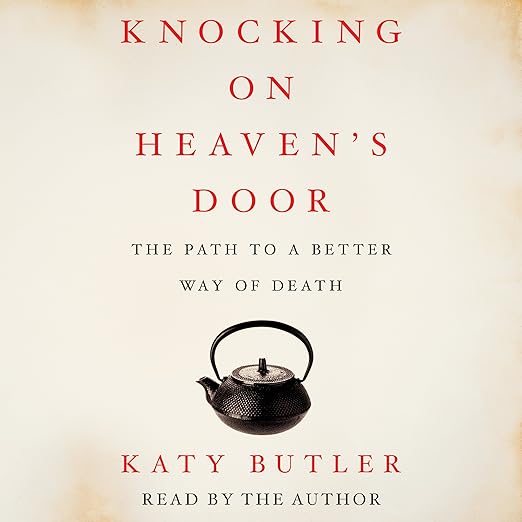
- Narration: Katy Butler narrates her own work with the journalist’s ear for precision and the daughter’s register of grief, the combination is as close to irreplaceable as self-narration gets.
- Themes: The Good Death, medical technology and its limits, the ethics of end-of-life care
- Mood: Lyrical, unflinching, and quietly furious at a medical system that confuses prolongation with care
- Verdict: The definitive audiobook on end-of-life care and the forces within medicine that obstruct it, a book that has genuinely changed conversations in hospitals and living rooms alike.
I listened to the final hours of this book on a Sunday afternoon, knowing it was coming to its end the way you know a long walk is nearly finished, a particular quality of attention, because you understand you won’t be in this company much longer. Katy Butler writes with the precision of an award-winning journalist and the grief of a daughter who watched her father live too long in exactly the wrong ways, and the combination produces something that transcends both categories.
The facts at the center of the book are these: Butler’s father suffered a crippling stroke at seventy-nine. Doctors outfitted him with a pacemaker, which kept his heart beating reliably while doing nothing to prevent his slide into dementia, near-blindness, and misery. When he said “I’m living too long,” that was not metaphor or despair. It was a factual assessment of a situation that medicine had helped create and then refused to address. When the family sought to have the pacemaker disabled, a straightforward request that would simply allow him to die as his body was otherwise prepared to do, doctors refused.
The Pacemaker at the Center of Everything
That refusal, and Butler’s efforts to understand it, drives the book’s investigative spine. What she discovers is not individual malice but systemic dysfunction: a medical culture that has made maximum intervention the default and comfort the afterthought, supported by reimbursement structures that reward procedure and cannot price the conversation that might make procedure unnecessary. The rise of the pacemaker as a routine intervention, with its profound secondary effects on patients who have multiple serious conditions and no realistic path to recovery, is the specific vehicle through which Butler makes her larger argument about what aggressive longevity medicine does to dying people.
The contrast Butler draws is with her mother’s death. Faced with her own grave illness, Butler’s mother rebelled against her doctors, refused open-heart surgery, and met death, as Butler puts it, the old-fashioned way: head-on. The description of that death, present and prepared and on her own terms, is among the most moving passages in contemporary American health writing. It is not romanticized; Butler is too honest for that. But it is held up as evidence that the Good Death is not merely a historical artifact, that it remains possible when the people involved are willing to fight for it against a system not designed to provide it.
The Slow Medicine Movement as Constructive Counterpoint
The second half of the book moves from personal narrative to a broader account of the Slow Medicine movement, physicians and advocates working within the healthcare system to restore the primacy of patient-centered care, advance care planning, and the recognition that the highest-technology intervention is not always the most ethical one. Butler chronicles this movement with the same reportorial rigor she brings to her family’s story, and the effect is to locate the personal grief in a larger history. This is not just what happened to one family. It is what is happening, and will happen, to millions of families navigating a system optimized for something other than dying well.
The New York Times Book Review called this a “mix of personal narrative and hard-nosed reporting,” which is accurate but misses what makes the book singular: the way Butler’s grief infuses the investigative reporting with stakes that pure journalism cannot achieve. At nearly ten and a half hours in audio, the book rewards the full investment.
Why This Specific Audiobook Format
Katy Butler’s narration is not the most technically polished self-narration you’ll encounter. There are moments where the author’s voice strains against the material. But these moments are part of what makes listening to this particular book in this particular format different from reading it. The catch in the voice when Butler describes her father’s final months is not performance, it is the sound of a journalist who cannot fully separate herself from her subject because her subject is her own family. That quality is present on the page, but in the ear it becomes something more immediate. This is one of those cases where the narration’s imperfection is not a flaw but an asset.
Frequently Asked Questions
Is Knocking on Heaven’s Door specifically about cancer patients, or does it address end-of-life care more broadly?
The book’s focus is end-of-life care in general, not cancer specifically. Butler’s father’s experience is centered on stroke, dementia, and cardiac disease managed through a pacemaker, common situations for aging adults, not unusual oncological cases. The systemic critique Butler develops applies to any situation where aggressive technological intervention in the final years of life conflicts with patient-expressed wishes and quality of life.
Is this book primarily a personal memoir or a policy critique?
It is a sustained hybrid of both, and the combination is what makes it distinctive. The personal memoir establishes the emotional stakes; the investigative journalism establishes the systemic causes; the sections on Slow Medicine provide a constructive alternative framework. Readers who want pure memoir will find the policy sections demanding; readers who want pure journalism will find the personal sections emotionally intense. Both are essential to what the book achieves.
Has the medical system changed since this book was published in a way that makes its critique outdated?
The book was originally published in 2013, and while specific policy details have evolved, the underlying systemic critique, that medical reimbursement structures incentivize intervention over conversation, that advance care planning remains inadequate, and that patients and families frequently lack the tools to navigate end-of-life decisions, remains substantially accurate. The cultural shift the book contributed to has been real but partial.
How does Knocking on Heaven’s Door compare to Atul Gawande’s Being Mortal as audiobooks?
The two books address overlapping territory from different angles. Gawande’s book is more comprehensive as a medical and policy survey. Butler’s book is more specifically personal and more journalistically driven, the pacemaker story and the investigation of why it could not be disabled give Knocking on Heaven’s Door a narrative propulsion that Being Mortal, for all its virtues, doesn’t quite match. Both are essential reads; together they provide the most complete available picture of end-of-life care in America.