Quick Take
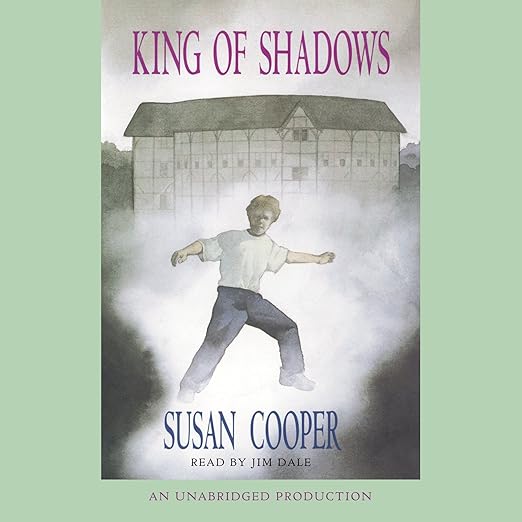
- Narration: Jim Dale is the ideal voice for this material, his theatrical instincts and command of period register make Elizabethan London feel inhabited rather than costumed.
- Themes: Theater as sanctuary, grief and the search for surrogate family, the ethics of time
- Mood: Intimate and literary, a slow burn that rewards patience with something genuinely moving
- Verdict: Susan Cooper’s time-travel Shakespeare novel is one of the smartest middle-grade audiobooks in existence, and Jim Dale’s performance makes it definitive.
I was on a bus heading out of London the first time I read King of Shadows, the print edition, back when I was doing a semester abroad and feeling the full disorientation of living somewhere with too much history. The novel made an impression I could not quite explain at the time. Going back to it as an audiobook years later, with Jim Dale narrating, the experience clicked into something I understand better now. Cooper is writing about grief finding relief in theater. Dale is the right voice for that.
Nat Field is a boy with tragedies behind him, the details are revealed gradually, which is part of how Cooper keeps the reader emotionally unguarded. When he is chosen to join an American drama troupe traveling to London for a production of A Midsummer Night’s Dream at the new Globe, the theater is already his emotional shelter. The displacement of time travel, when it comes, feels less like a fantasy device and more like a logical extension of what theater already does to people who need it most.
Shakespeare as Father Figure
The central relationship in King of Shadows is between Nat and William Shakespeare himself, the warm, nurturing presence Nat has been missing since losing his own father. This is where Cooper takes her most interesting risk, and where the novel either wins or loses readers. She makes Shakespeare human without diminishing him: a working playwright, an employer, a man who sees something in a grieving boy from the future and responds with straightforward care.
There is no mystification here, no reverential fog around the figure. Cooper’s Shakespeare is pragmatic about the theater, demanding about performance, and unexpectedly gentle in private moments. That specificity is what makes the relationship credible. Nat is not starstruck by history, he is grateful for kindness at the moment he needs it most.
Jim Dale handles this dynamic beautifully. His Shakespeare has authority without coldness, and the scenes between Dale’s Shakespeare and his Nat land with a tenderness that a lesser narrator might oversell or underplay. Dale finds exactly the right register.
The Globe Reconstructed in Sound
Cooper is meticulous about the differences between the original Globe of 1599 and the replica Nat first rehearses in. Those details, the smell of the timber, the behavior of the groundlings, the mechanics of the trapdoor and the heavens, are not decoration. They are the evidence of a writer who understands that theater is always also architecture, always a physical space that shapes the people inside it.
For young listeners who have studied Shakespeare or visited a theater, this material is genuinely educational in the best sense: it does not feel like a lesson. For those who have not, it opens a window without making them feel ignorant. The audiobook format suits this particularly well, Dale’s theatrical background means he understands the technical vocabulary intuitively, and he explains it through performance rather than exposition.
The Time Travel Question
Cooper is less interested in the mechanics of how Nat ends up in 1599 than in what the experience costs him emotionally. The time travel arrives quickly and without scientific explanation, a fever, a darkness, a new reality. Reviewers have praised the plot as both beautifully crafted and historically accurate, and Cooper earns that dual compliment by keeping the historical material grounded in sensory detail rather than trivia.
The question at the novel’s heart, does Nat have to remain trapped in the past, or must he give up the father figure he has found in order to return to his own time, is handled with a care that does not resolve into easy comfort. Cooper’s endings are never dishonest, which is part of what distinguishes her work in the crowded field of children’s historical fantasy.
Who Should Listen and Who Should Skip
King of Shadows is built for listeners ten and up who are willing to sit with a quieter story, there is no chase sequence, no battle. The reward is something closer to what good theater offers: the sense of having been inside another person’s inner life. Middle-grade readers who love Susan Cooper’s The Dark Is Rising sequence should note that this is a different register entirely, more intimate, less epic. Shakespeare enthusiasts of any age who have not encountered this novel should correct that immediately.
New listeners without any prior context for A Midsummer Night’s Dream will follow the emotional story without difficulty, though some of the theatrical detail will land harder with a baseline familiarity with the play.
Frequently Asked Questions
Does Jim Dale use different voices for Shakespeare and Nat, and does that differentiation work?
Yes, and yes. Dale gives Shakespeare a quiet authority that distinguishes him clearly from Nat’s more uncertain interiority without resorting to a theatrical accent. The contrast between Dale’s Shakespeare and his Nat is one of the narration’s most accomplished effects, you feel the difference in age and confidence through the voice alone.
Do you need to know A Midsummer Night’s Dream to appreciate this audiobook?
Basic familiarity helps, particularly because Nat plays Puck and several scenes involve rehearsal and performance. But Cooper provides enough context that unfamiliar listeners will follow the plot. The emotional heart of the novel does not depend on Shakespeare knowledge, it depends on understanding grief and the need for a safe adult.
Is this novel from the same Susan Cooper who wrote The Dark Is Rising? How different is the tone?
Yes, same author. The tone is substantially different. The Dark Is Rising is epic mythological fantasy with a large canvas. King of Shadows is a small, intimate novel about one boy and his relationship to theater and loss. Fans of the series may find it a rewarding side of Cooper they did not expect, or they may miss the larger scope. Both responses are reasonable.
At under 5 hours, is this long enough to feel like a complete experience?
Yes. Cooper’s prose is economical and precise, she does not waste sentences, and the story feels complete at this length. The brevity is part of its strength. Jim Dale’s pacing fills the runtime without padding, and the emotional arc lands fully within those five hours.