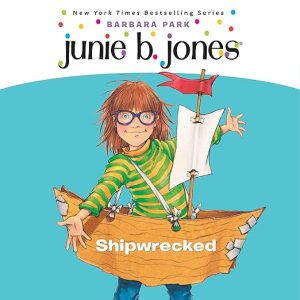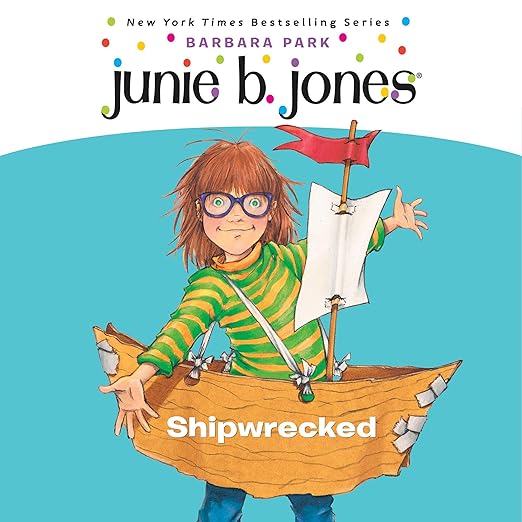
Room One is staging a play about explorers hunting for the New World, and Junie B. Jones has already decided she is the star of the whole entire production, thank you very much. The 23rd audiobook in Barbara Park's bestselling chapter-book series drops the funniest first grader in children's fiction into a classroom disaster in the making: actors dropping to the flu one by one, a bossy classmate named May scheming for a bigger role, and a ship that may never make it to land. I put this one on during a gray, rainy afternoon drive, the kind of hour that begs for something loud and funny through the car speakers, and Junie B.'s particular brand of six-year-old logic did exactly the job it was built for.
Junie B Takes Over When the Play Falls Apart
What makes this entry work, more than twenty books into a series that shows no sign of running out of steam, is how completely Park trusts her narrator's logic even when it is obviously, gloriously wrong. Junie B. does not understand why her classmates find her confidence off-putting, and the book never explains it to her either. It just lets her plow forward, certain the play will be saved by sheer force of her own opinion, while the actual plot quietly proves her wrong at every turn. That gap between what Junie B. believes about herself and what is actually happening around her is the engine of the whole series, and book 23 runs it as smoothly as any entry before it.
The New World pageant setup gives Park more to work with than a typical school-day plot. Sea captains, ships, and a genuine production crisis once half the cast catches the flu give the story real logistical chaos to work with, which means the humor gets to come from panic and mismanagement rather than just Junie B.'s usual stream of consciousness. May, the self-appointed rival for the lead role, is drawn with just enough specificity that young listeners will recognize her from their own classrooms, not a cartoon villain, just a kid who also wants to be the star and is not being especially gracious about it.
The critical praise excerpted alongside this listing is worth taking seriously rather than treating as jacket-copy filler. Time Magazine calls Junie B. 'a feisty six-year-old with an endearing penchant for honesty', and Publishers Weekly credits Park with convincing beginning readers that 'Junie B., and reading, are lots of fun', which together explain the series' staying power better than plot summary alone can. Park was not just writing jokes for kids, she was building a voice so specific that four different major outlets, Kirkus, USA Today, Time, and Publishers Weekly, independently landed on the same core observation: this character makes reading itself feel like Junie B.'s idea, not a chore assigned by an adult.
Lana Quintal Never Turns Junie B Into a Joke
Lana Quintal has narrated enough of this series to have Junie B.'s cadence fully internalized, and it shows in the way she handles the character's famously non-standard grammar. She does not perform Junie B.'s mistakes as a bit, she just talks the way a real six-year-old talks, run-on thoughts and all, which is exactly the right choice for material that would curdle into caricature under a heavier hand. A narrator who winks at the audience about how Junie B. talks turns the character into a joke about kids rather than a genuine kid, and Quintal never makes that mistake here.
At 55 minutes, this is built for a single sitting, whether that is a car ride, a bedtime chapter, or a rainy-day listen with a sibling curled up nearby. The pacing supports read-aloud energy without ever feeling rushed, which is a real needle to thread in a book this short. One of the attached reviews mentions an eight-year-old fan who finds the series 'funny and engaging', and that is precisely the demographic this format serves best, kids old enough to catch the humor in Junie B.'s misunderstandings, young enough to still be delighted rather than embarrassed by them.
New Listeners Can Start Here Without Earlier Volumes
Junie B. Jones has picked up a reputation in some circles for modeling bad grammar and mouthy behavior, and one of the attached reviews addresses this directly, noting genuine confusion about why the books draw pushback given how often Junie B.'s own journal writing shows her correcting herself after a teacher or parent steps in. That structural detail is worth knowing going in: the series is not holding up Junie B.'s worst instincts as an ideal, it is showing a kid working through them in real time, which is a very different thing than it sounds like from a skimmed synopsis.
This is book 23, which raises the obvious question of whether new listeners need the earlier volumes first. They do not, structurally. Park writes each entry as a self-contained school-day or event-based story, and Shipwrecked assumes no prior context beyond understanding who Junie B. is in broad strokes. Parents looking for a true starting point should still consider book one for the sake of watching the character develop, but a family that stumbles onto number 23 first will not be lost for a single scene.
Barbara Park wrote Junie B. Jones until her death in 2013, and Shipwrecked belongs to the tail end of a run that eventually reached 28 core books plus spinoffs, a genuine publishing phenomenon by any measure. That longevity matters for a listener deciding where to start, since a series this extensive can feel intimidating from the outside, but each book's self-contained structure means the sheer size of the catalog is an invitation to keep going rather than a barrier to entry.
For Kids Working Through Their Own Performance Anxiety
This is a strong pick for kids roughly five to eight, especially ones who already gravitate toward chaotic school-story humor or who are working through their own performance anxiety about a class play, recital, or presentation. It also works well as a family listen, the humor lands for adults driving the car as much as it does for the kid in the back seat, which is not nothing after twenty-plus entries in a series that could easily have started coasting by now.
Skip this one if you want a deeper emotional arc or a story that pushes past standard classroom-comedy stakes; the chapter-book landscape has other options for that. This is exactly what it presents itself as, a quick, funny, slightly chaotic school-play story, and it has no ambition to be more than that. For the audience it is built for, early readers not quite ready for full novels, or younger siblings listening in while an older kid does homework, that is precisely the point, not a limitation.
A Few Questions About Junie B. Jones #23: Shipwrecked
Do I need to listen to the earlier Junie B. Jones audiobooks before this one?
No. Barbara Park writes each entry as a self-contained school-day story, and this 23rd audiobook assumes only basic familiarity with who Junie B. is, not a chapter-by-chapter history of the series.
Is this Junie B. Jones audiobook appropriate for a five-year-old, or better for older kids?
It works well read-aloud style for kids as young as five, but the humor and classroom-politics plot land best for independent listeners around six to eight.
Why do some reviews mention these books being challenged or banned?
Junie B. Jones has occasionally drawn criticism over her exaggerated grammar and sass, but the series consistently shows her correcting herself after guidance from a teacher or parent, which several longtime fans point to directly in their reviews.
How long is the Junie B. Jones Shipwrecked audiobook?
It runs 55 minutes, short enough for a single car ride, bedtime chapter, or rainy-afternoon listen.