Quick Take
- Narration: Nick Podehl brings tremendous comic energy to Julius and his menagerie, differentiating each animal personality with just enough cartoon flair to stay funny without becoming exhausting over a 2.5-hour listen.
- Themes: Unlikely heroism, friendship under pressure, Roman history through absurdity
- Mood: Boisterous and laugh-out-loud funny, with genuine heart underneath the chaos
- Verdict: A brilliantly silly adventure that sneaks real Roman history past young listeners who are too busy laughing to notice they’re learning anything.
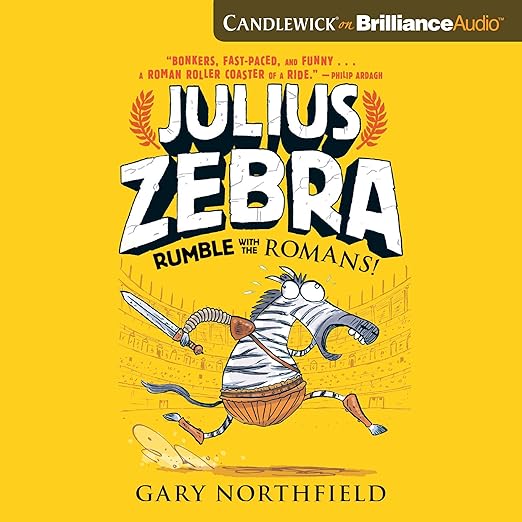
I was driving my niece home from soccer practice on a Thursday afternoon when we started Julius Zebra: Rumble with the Romans!, and I want to tell you that by the time we pulled into the driveway neither of us wanted to get out of the car. She was nine years old and completely fixated on whether Julius and his gang of misfit animals were going to survive their first bout in the Colosseum. I sat in the driveway for an extra ten minutes, engine running, pretending I needed to hear just one more scene.
Gary Northfield’s debut in the Julius Zebra series is one of those children’s books that earns the word fun in the most honest sense. Julius himself is an endearing idiot, well-meaning, impulsive, perpetually convinced that things will somehow work out, and surrounded by companions who are significantly smarter but no less in trouble. The premise is clean and inspired: a group of African animals get captured by Roman soldiers, shipped to Rome, and thrown into gladiatorial training. If they can win over the crowds, they win their freedom. If they fail to entertain, they face considerably worse outcomes.
What Podehl Brings to the Colosseum
Nick Podehl is one of the more versatile narrators working in children’s audiobooks, and this material is exactly the kind of thing he’s built for. He plays Julius with a cheerful cluelessness that never tips over into irritating, it’s the voice of a zebra who genuinely believes every bad situation is about to improve, which is funnier than it sounds. The supporting cast gets equally distinct treatment: the anxious gnu, the sardonic crocodile, the earnest warthog. Each animal registers as a separate character rather than a parade of variations on the same voice, which matters a great deal in a story that relies so heavily on banter and group dynamics. One reviewer noted the series has pictures with comments from the characters that make it a mix between graphic novel and ordinary novella. The audiobook obviously cannot replicate that visual dimension, but Podehl’s pacing and vocal characterization fill the gap more than adequately, the comedy lands even when you cannot see the illustrated reaction shots.
The History That Hides in Plain Sight
Northfield is clearly someone who did genuine research and then committed to burying it completely under layers of absurdist comedy. Details about Roman gladiatorial culture, the social function of the Colosseum, the relationship between crowds and fighters, the training regimens, it’s all here, but wrapped in enough chaos and animal-personality humor that a ten-year-old will absorb it without feeling like they’ve been assigned anything educational. One reviewer specifically called it educative regarding roman gladiators between mentions of how much the pacing helped their commute. That balance is genuinely difficult to achieve. Most children’s historical fiction either leans too heavily into the lesson or abandons accuracy for pure entertainment. Northfield threads the needle with impressive consistency.
The Pacing and What It Gets Right
At two hours and thirty-five minutes, this audiobook sits in a comfortable range for middle-grade listeners, long enough to develop real momentum and character investment, short enough for a single car trip or a few bedtime sessions. The pacing is fast without being frantic. Northfield understands that comedy needs breath; a joke that lands immediately after the setup is less funny than one allowed a half-second to register. Podehl honors this, and the result is that genuinely silly moments hit with the timing of a well-constructed bit rather than a series of rapid-fire gags. My only note is that the middle section, during the gladiatorial training sequences, runs slightly longer than it needs to before the Colosseum payoff arrives. But this is a minor complaint in the context of a story that is otherwise well-shaped.
Who Should Listen and Who Should Skip
If you have children ages seven through twelve with any interest in ancient Rome, funny animals, or adventure stories with a genuinely chaotic spirit, this audiobook belongs in your next road trip playlist. It also works for adults who are not too proud to laugh at a zebra’s strategic miscalculations in the arena. Parents doing school units on Roman history will find it a natural companion piece that motivates further reading.
Skip it if your household prefers quieter, more emotionally grounded stories. Julius Zebra does not do quiet or grounded. It does loud, funny, and surprisingly warm, and it does all three very well. Also note that the original print edition is a hybrid graphic novel format; the audiobook is a straight narrative reading, which means the illustrated panels and visual gag annotations do not transfer. Listeners who have read the print version may find the audio a slightly leaner experience. New listeners coming to the story through audio will have nothing to miss.
Frequently Asked Questions
Do I need to know anything about Roman history before listening to Julius Zebra: Rumble with the Romans!?
Not at all. The book works as a completely standalone comedy adventure, and any Roman history embedded in the story is introduced through the plot itself. It’s actually a good first introduction to gladiatorial culture for younger listeners.
The original book is a graphic novel hybrid with illustrated panels. How much does that format translate to audio?
The illustrated comments and visual gags do not transfer directly, but Nick Podehl’s narration and voice characterization fill in enough of the comedy that new listeners will not feel like they’re missing critical content. Readers of the print edition may notice the absence of visual elements.
Is this the first book in the Julius Zebra series, and do I need to start here?
Yes, this is book one in the Julius Zebra series, and it’s the right place to start. The characters, premise, and setting are all established here from scratch, so new listeners are in exactly the right place.
Is the humor in Julius Zebra appropriate for a wide age range, or does it skew very young?
The comedy lands comfortably for ages seven through twelve, and several reviewers mention adults enjoying it alongside children. The humor is absurdist rather than simplistic, so it does not feel condescending to older listeners, though it never strays into territory that would be inappropriate for a seven-year-old.