Quick Take
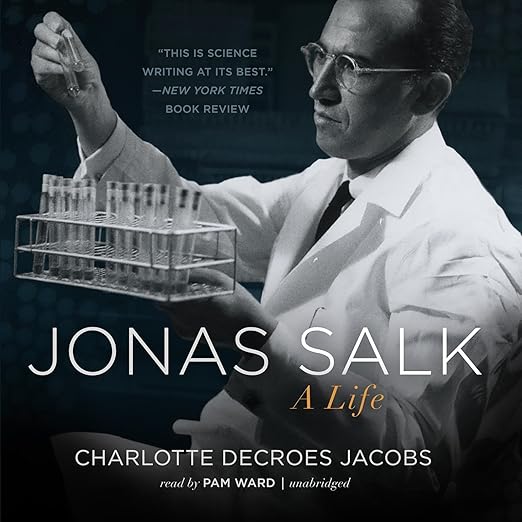
- Narration: Pam Ward delivers a measured, authoritative performance that suits the biography’s serious scholarly register without losing emotional warmth.
- Themes: Scientific ambition, institutional betrayal, the gap between public heroism and private rejection
- Mood: Absorbing and quietly melancholic, the kind of biography that stays with you
- Verdict: Charlotte DeCroes Jacobs’s exhaustively researched account reveals a figure far more complicated than the sainted vaccine pioneer most people think they know.
I came to this one already knowing the basic story: April 12, 1955, Jonas Salk’s polio vaccine confirmed effective, the country erupted in celebration, schoolchildren wept with relief. I thought I understood what that moment meant. I was wrong. It took me most of a Saturday afternoon and a long Sunday morning walk to finish Pam Ward’s narration of Charlotte DeCroes Jacobs’s biography, and by the end I felt I had spent twenty hours watching a man receive the wrong kind of fame and spend the rest of his life unable to escape it.
Jacobs worked from sealed personal archives and hundreds of interviews to produce what she rightly calls the first complete biography of Salk. It shows. The material here goes far beyond the vaccine narrative most people know, and Pam Ward’s measured, clear delivery gives each revelation space to land without theatrical emphasis.
The Ostracism That Followed the Triumph
The biographical detail that dominates this book is not the polio breakthrough itself but what came immediately after it. Salk’s scientific peers, most notably Albert Sabin, despised him for what they saw as his appropriation of others’ contributions, his relentless courting of the press, and his willingness to bypass the conventional peer-review channels that the research community treated as sacred. When Salk remarked that “the worst tragedy that could have befallen me was my success,” it reads at first like false modesty. But Jacobs makes you understand he meant it literally. He was excluded from the National Academy of Sciences, denied the Nobel Prize that many outside the academy believed he deserved, and treated by his own colleagues as an outsider for the rest of his career.
Jacobs handles this complicated reality with real fairness. She does not entirely exonerate Salk from the charges his peers leveled. She acknowledges the questions about credit attribution and the media relationships that crossed lines the scientific establishment had drawn. But she also shows how the scientific community’s own politics, jealousies, and institutional self-interest shaped the verdict against him. The result is not a hagiography. It is something more valuable: a genuinely critical portrait that earns your sympathy without demanding it.
The Private Man Behind the Public Hero
One reviewer called Salk an enigmatic man, and Jacobs’s access to the sealed archives explains both why that description stuck and why it is insufficient. The book gives us Salk’s strained marriage, the distance between him and his sons, his later relationship with the artist Francoise Gilot who was also Picasso’s former partner, and the way his obsessive drive to be useful to humanity corroded nearly every close personal relationship he maintained. Jacobs does not sensationalize any of this. She presents it as consequence rather than character flaw, which feels honest given the evidence she has assembled.
The biography also restores credit for work that has been largely forgotten. Most people do not know that Salk played a significant role in developing the first influenza vaccine, or that he conceived and fought to build the Salk Institute as a place where the sciences and humanities could develop alongside each other rather than in opposition. His final years were spent pursuing an AIDS vaccine, work that was dismissed during his lifetime but which later researchers acknowledged as laying groundwork that mattered. Jacobs recovers all of this without straining. The material is simply there, documented and sourced, waiting for someone to assemble it properly.
What Pam Ward Brings to This Twenty-Hour Account
A biography this dense with institutional detail and interpersonal texture could easily become dry in audio form. Ward avoids that problem. Her pacing is deliberate without being slow, and she makes clear distinctions between the moments Jacobs is presenting documented fact, drawing on interview material, and offering interpretive analysis. That kind of tonal clarity matters in a scholarly biography read over many hours. Ward does not sentimentalize the sad passages or drain the irony from the moments when Salk observes his own exclusion with apparent bewilderment. She trusts the material.
At twenty hours and fifteen minutes, this is a substantial listen. It earns its length. Jacobs does not pad, and Ward does not rush. If you have the patience for a serious, fully documented biographical account of a complicated scientific career, the time investment returns something real.
Who Should Listen and Who Should Skip
This biography belongs on the shelf of anyone with genuine interest in the history of twentieth-century medicine, the sociology of scientific reputation, or the strange ways that public heroism can coexist with professional rejection. It will reward listeners who already know the broad outlines of the polio vaccine story and want to understand what it actually cost. Those looking for a quick inspirational narrative about a great man’s triumph should look elsewhere. The inspiration here is harder-earned and more durable for it.
Frequently Asked Questions
Does Jacobs take a side in the dispute between Salk and his scientific critics?
Not entirely. She documents the charges against Salk fairly, including the questions about credit attribution and his use of media attention, but she also shows how institutional jealousy and political infighting shaped the scientific community’s verdict against him. The biography is critical without being prosecutorial.
How much of the book focuses on the polio vaccine versus Salk’s later career?
The vaccine breakthrough is treated as a centerpiece but not the whole story. Jacobs devotes significant attention to Salk’s role in developing the influenza vaccine, his vision for the Salk Institute, and his AIDS research in the 1980s and 1990s, work that was largely dismissed during his lifetime.
Is this audiobook accessible to listeners without a science background?
Yes. Jacobs writes as a biographer first and a medical historian second. The scientific concepts are explained clearly for general readers, and the focus throughout is on the human story rather than the technical details of virology or immunology.
How does Pam Ward’s narration handle the book’s more emotionally difficult passages, particularly around Salk’s family life?
Ward is restrained rather than dramatic. She treats the material about Salk’s strained relationships with his family and his later partnership with Francoise Gilot the same way she treats the institutional conflicts: with clear, measured delivery that lets the documented facts carry their own weight.