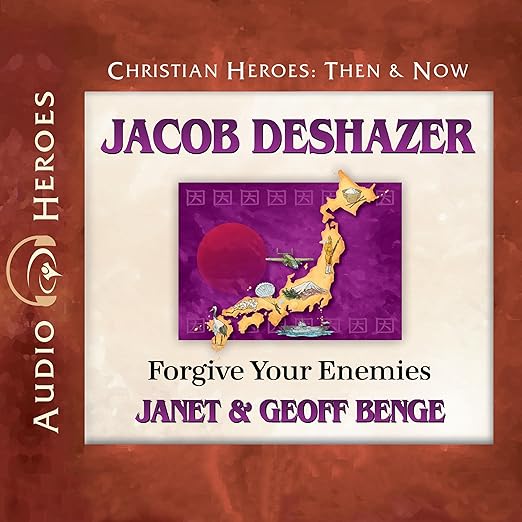
Quick Take
- Narration: Tim Gregory brings the same measured authority here as across the Christian Heroes series, the WWII combat sequences land with appropriate weight, and he handles the spiritual transformation passages without letting them feel abrupt.
- Themes: Forgiveness and reconciliation, faith as conversion under duress, WWII and the Doolittle Raid
- Mood: Historically charged and emotionally serious, with the arc of a redemption story told across decades
- Verdict: Among the most historically distinctive entries in the Christian Heroes series, the Doolittle Raid, Japanese captivity, and thirty years of missionary work in Japan make for a biography with unusual dramatic range.
I listened to this one across two long drives, and what struck me most was how much historical weight the story carries before the explicitly spiritual content begins. Jacob DeShazer participated in the Doolittle Raid, the first American airstrike on the Japanese home islands after Pearl Harbor, launched from an aircraft carrier in April 1942. He bailed out over China in the dark, was captured by Japanese forces, was held as a prisoner of war, and endured years of beatings and malnourishment in conditions that were designed to destroy a man. That is where the spiritual conversion happens: not in a church or a revival meeting, but in a Japanese prison cell, with a Bible that guards permitted him to borrow for three weeks. That arc, military action, captivity, conversion, reconciliation, is unusually rich material for biographical treatment.
Janet Benge builds the book with the same structural approach she uses across the Christian Heroes series: open in medias res in a moment of high tension (here, the jump from the B-25 into darkness over China), then follow the life forward through its complications and turning points. The formula works because Benge has genuine skill at selecting which details carry narrative energy and which can be compressed. The Doolittle Raid background is sufficiently explained that listeners without prior WWII knowledge can follow the context without feeling lost.
The Conversion in the Cell
DeShazer’s conversion is the theological fulcrum of the biography, and Benge handles it with care. He was given access to a Bible for a limited period during his captivity, read through it intensively, and experienced what he described as a transformation in how he perceived his Japanese captors. The shift from hatred to compassion that he reported was not immediate or simple, but it was the foundation of the decision he made after the war to return to Japan as a missionary.
For young readers, this sequence is probably the most challenging part of the book to hold, not because it is presented poorly, but because the internal experience of religious conversion is inherently difficult to narrate in a way that feels emotionally real rather than formulaic. Benge avoids the hagiographic trap of making it sound frictionless. Tim Gregory’s narration in these sections is appropriately unhurried, giving the material room to breathe. The three weeks with the Bible do not resolve into a sudden transformation; the book acknowledges the ongoing work of that change through his years of captivity.
Thirty Years in Japan as Mission Work
The second half of the biography, covering DeShazer’s return to Japan after the war and his thirty years as a missionary to the people who imprisoned him, is where the title earns itself. The idea of returning to serve the country that held you prisoner and subjected you to conditions of deliberate cruelty is not easy to present without either sentimentalizing it or making it seem psychologically implausible. Benge manages both risks by keeping the practical details of the mission work present and by not oversimplifying what forgiveness meant in DeShazer’s experience.
One reviewer noted the story’s connection to Mitsuo Fuchida, the Japanese naval officer who led the Pearl Harbor attack and later became a Christian partly through reading DeShazer’s testimony tract. Benge includes this dimension, which gives the biography an additional layer: DeShazer’s story becoming a document that shaped the spiritual history of the man who carried out the attack that put America in the war. That kind of narrative interconnection elevates the biography beyond a single life.
WWII History as Entry Point for Young Listeners
The Doolittle Raid is not commonly covered in elementary school history curricula, which means this biography can introduce young listeners to a significant and dramatic WWII chapter they may not have encountered elsewhere. The historical content is accurate and does not sanitize the violence of combat or captivity, though it is calibrated for the middle-grade audience without graphic detail. The military history provides genuine grounding that prevents the spiritual biography from floating free of historical context.
Who Should Listen and Who Should Skip
Recommended for Christian families with children ages nine through fourteen, and for adults interested in WWII history alongside faith memoir. The Doolittle Raid context makes this particularly well-suited for homeschool settings studying the Pacific theater. Tim Gregory’s narration is consistent with his best work in the series.
The spiritual conversion and missionary content will engage listeners already interested in faith history, but listeners who come primarily for WWII action will find the latter two-thirds of the book shifts significantly in register. That shift is honest to DeShazer’s actual life, but it is worth knowing in advance.
Frequently Asked Questions
Do you need to know about the Doolittle Raid before listening to this biography?
No prior knowledge is required. Benge provides enough background on the Doolittle Raid and its place in WWII to make the context clear for listeners encountering it for the first time.
How graphically is the Japanese prisoner of war experience depicted?
The captivity is described honestly, beatings, malnourishment, isolation, but the treatment is calibrated for middle-grade readers rather than graphic in detail. It conveys the seriousness of what DeShazer endured without content that would be inappropriate for the intended age range of nine and up.
Is this biography connected to the story of Mitsuo Fuchida, who led the Pearl Harbor attack?
Yes. Fuchida eventually became a Christian partly through reading DeShazer’s published testimony. Benge includes this dimension, which gives the biography an additional layer of historical resonance beyond DeShazer’s own story.
How does this compare to other volumes in the Christian Heroes series in terms of historical content?
This volume has unusually rich military history, the Doolittle Raid, WWII Pacific theater, Japanese captivity, which distinguishes it from many series entries focused on missionary or social work in less historically documented contexts. Reviewers consistently rate it among the series’ stronger entries.