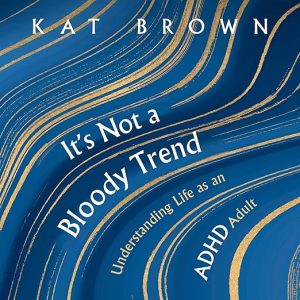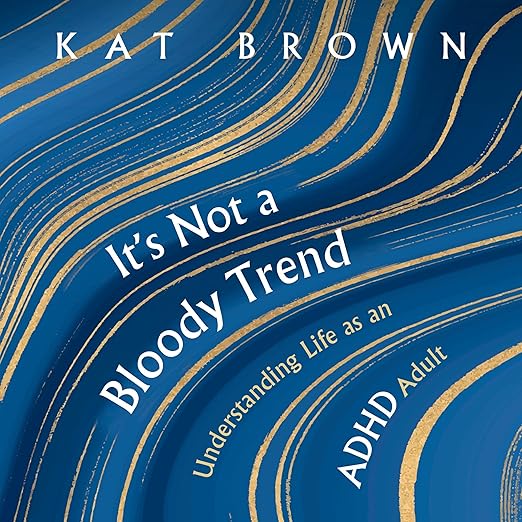
How many books have you started because the title finally said the thing out loud? That is the transaction Kat Brown offers, and this audiobook works partly because she reads it herself. It's Not A Bloody Trend runs eight hours and four minutes, and its premise arrives early and unhedged: no one should have to live feeling defective, and everyone deserves what Brown calls "a user manual to their brain", which is the promise the rest of the book spends its time keeping. The condition under discussion is ADHD, and her position is that it needs a rebrand rather than a debunking.
Sledgehammer and Laugh-Out-Loud in the Same Breath
The book is built as a layman's guide rather than a memoir, though Brown's own experience runs all the way through it. She works across the areas where the condition actually causes damage in adult life: money, work, self-medicating, relationships, hormones and self-esteem. That last cluster is what separates it from the enormous shelf of productivity-adjacent ADHD titles, because the description is explicit that something once associated more with hyper boys than with adults is now recognized in people of all genders and ages. Brown pairs her personal account with extensive interviews, conducted both with other ADHDers and with clinical experts, so the book alternates between testimony and evidence instead of choosing one.
The tone is the other distinguishing feature. The description promises a writer who "cheerfully smashes the stereotypes" using scientific evidence, historical context and practical support, and the two endorsements printed on the page pull in the same direction from different angles. Professor Tanya Byron calls it "A sledgehammer of a book putting to bed all the cynicism and misinformation around a condition that affects so many hidden, brilliant people". Leanne Maskell, who wrote her own ADHD guide, describes it as "Laugh out loud funny and deeply validating". Sledgehammer and laugh-out-loud is an unusual pairing to promise in the same breath, and the listener reactions suggest both halves land.
Brown's Own Diagnosis Fuels the Narration
Self-narration is not a decorative extra here; it is structural. The book rests on Brown's own diagnosis and on interviews she conducted herself, which means long stretches are her account of her own life and her framing of somebody else's. A hired reader would have to perform that intimacy, while Brown simply has it. The comic register matters just as much. This is a book whose humor is bound up with genuine frustration, and the distance between a joke and a grievance in ADHD writing is often a quarter-second of timing that only the person who wrote the sentence knows where to place.
The reader reactions are short but pointed. One sums the book up as "a good read for this ADHD woman" and adds: "Informative but fun at the same time." Another aims it squarely at the recently diagnosed: "Newly diagnosed with ADHD? This book is down to earth and helpful." The third review is the one I found most telling, and its title does most of the work: "It’s like chatting with an old friend who gets you." The body describes a household running joke about the volume of books ordered weekly and abandoned a fifth of the way in, and then this one being finished cover to cover in twenty-four hours. For a book written for people who struggle to finish books, that is close to the most relevant endorsement available.
Filed as Teen Content, Written for Adults
The categories attached to this page will mislead you. The title sits under teen and young adult listening and carries a children's health tag, while the description is explicitly about adult life: finances, work, self-medicating, relationships, hormones and self-esteem, addressed to people of all ages. Nothing in the copy reads as written for a thirteen-year-old. Parents hunting for a guide to a child's diagnosis should treat those labels with real suspicion, and adults who scrolled past because of them should look again.
The second issue is one the format creates rather than the author. A book offering itself as a user manual invites flipping, and you will want to find the material on money eleven months from now without dragging a progress bar around hunting for it. Eight continuous hours make a poor reference tool. If you expect to return to particular sections, a text edition alongside the audio will earn its cost quickly. Third, and this is a boundary rather than a fault, the book is a guide and a piece of advocacy, not a diagnostic instrument. Brown's stated reader is anyone wondering whether what has always felt wrong with them might be undiagnosed ADHD, and that wondering is deliberately where she leaves you.
Answering the Charge That ADHD Is Fashionable
Newly diagnosed adults are the obvious core audience, and one reviewer says exactly that in two sentences. Undiagnosed adults who recognize themselves in the description are the second group, since Brown wrote the book for that specific suspicion. The third group is everyone standing next to them: partners, colleagues and friends who want the condition explained without either the pity register or the productivity-hack register. The material on relationships and self-esteem is what I would put in front of that reader first, because it addresses the part outsiders usually get wrong.
Anyone still deciding whether the title is a stunt should note what it is answering. The book exists because the claim that ADHD is fashionable rather than real has become common enough to need eight hours of evidence, historical context and lived testimony ranged against it. Brown reads it herself, which is the right decision for something this personal, and the listeners who have posted describe finishing it fast, which for this audience and this subject is not a small compliment. Expect an argument delivered with jokes rather than a clinical overview delivered flat.
Good to Know
Is this audiobook for adults or for teenagers?
For adults, despite the teen and children's health labels on the page. The description addresses finances, work, self-medicating, relationships, hormones and self-esteem, and it frames ADHD as a condition long misread as something only hyperactive boys experienced. Parents seeking a guide to a child's diagnosis should look elsewhere.
Is the audiobook usable as a reference you come back to?
Not easily. It is organized by life area, which suggests a manual you would dip into, but eight hours of linear audio makes finding the section on money or hormones awkward months later. Listeners who expect to revisit chapters should consider keeping a text edition alongside it.