Quick Take
- Narration: Madison Niederhauser delivers Nischwitz’s argument with clean, unhurried clarity, she handles the shift between scientific research summaries and practical recommendations without losing the book’s sense of building urgency.
- Themes: Biological dentistry, oral microbiome and systemic disease, nutritional approaches to dental health
- Mood: Informative and quietly provocative, the kind of book that makes you look at a routine dental appointment with new skepticism
- Verdict: The most substantive biological dentistry guide currently in audio form, and the PDF companion is genuinely worth downloading before you start listening.
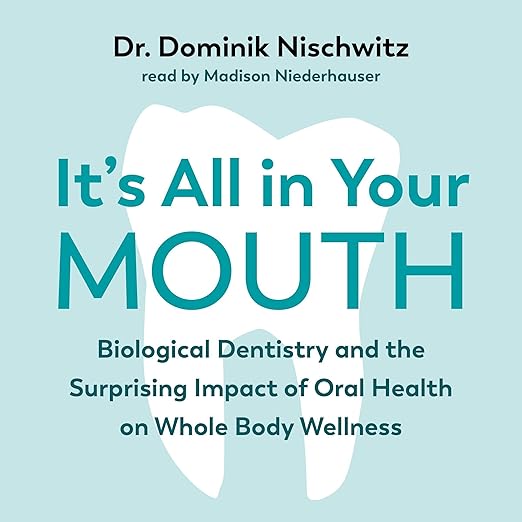
I had a root canal scheduled when I first listened to It’s All in Your Mouth, which gave the experience a certain uncomfortable immediacy that I suspect is not uncommon for listeners picking up this particular title. Dr. Dominik Nischwitz’s book is not an anti-dentistry screed, he is a dentist himself, one trained in Germany’s growing biological dentistry tradition, but it is a sustained argument that conventional dental practice in the United States has been making decisions based on outdated assumptions about the mouth’s relationship to the rest of the body, and some of those decisions are causing harm.
The timing of my listening gave Nischwitz’s root canal chapter a different weight than it might have otherwise. I’m not saying I canceled the procedure. I am saying I asked different questions at my pre-op consultation.
The European Perspective That American Dentistry Has Been Slow to Absorb
Nischwitz frames the book as a corrective: many chronic conditions including obesity, stroke, diabetes, Alzheimer’s, heart disease, and certain cancers have their origins, at least partially, in the oral environment. This is not fringe medicine. The oral-systemic connection is supported by a growing body of peer-reviewed research, and Nischwitz cites this research with enough specificity to distinguish his claims from wellness speculation.
What is genuinely controversial, and the book is honest about this, is the argument that conventional dental materials and procedures, particularly amalgam fillings and root canals, are causing harm that goes unacknowledged in standard practice. The amalgam question has more supporting evidence than the dental establishment has historically credited. The root canal argument is more contested. Nischwitz is a practitioner in the biological dentistry tradition, which means he has professional commitments that may shape which studies he foregrounds. That is worth a reader knowing, while also recognizing that the status quo has its own institutional biases in the other direction.
The Microbiome Chapter Is the Book’s Firmest Ground
The sections on the oral microbiome are where Nischwitz is most clearly supported by current science, and they are the book’s most genuinely informative material. The argument is not that bacteria in the mouth are uniformly bad but that the composition of the oral microbiome matters enormously for both local dental health and systemic disease risk, and that conventional dentistry’s antibacterial approach, the war-on-bacteria model underlying most mouthwash and many treatment protocols, may be disrupting microbial balance in ways that create downstream problems.
This connects to the nutrition sections, which draw on ancestral diet research and the work of Weston A. Price, whose 1930s fieldwork comparing the dental health of traditional versus industrialized-diet populations remains one of the most interesting datasets in dental anthropology. Nischwitz uses Price as a foundation for recommendations about fat-soluble vitamins, mineral balance, and the specific dietary conditions that support remineralization rather than decay.
Madison Niederhauser and the PDF Companion
Niederhauser’s narration is steady and credible throughout. She reads Nischwitz’s clinical passages, which are denser than the conversational wellness material that often surrounds biological dentistry content, with appropriate deliberateness. The pacing is particularly good in the microbiome and nutrition sections, where the technical vocabulary benefits from a measured cadence.
The listing explicitly notes that a PDF companion is available in the Audible library alongside the audio. This is worth acting on before you start listening. The book contains specific protocols, supplement recommendations, and what sounds like table or chart-formatted information that does not translate well to audio alone. Listeners who download and reference the PDF will get substantially more from the material than those who listen without it.
Who Should Listen and Who Should Set Expectations Accordingly
Listen if you have chronic health conditions that conventional medicine has struggled to address, are curious about the biological dentistry tradition and its evidence base, or are skeptical of amalgam fillings and want a coherent framework for understanding that skepticism. Also listen if you have already read Weston A. Price’s Nutrition and Physical Degeneration and want a bridge between that nutritional anthropology and modern microbiome science.
Set expectations if you are a dental professional looking for clinical protocols, the book is patient-level rather than practitioner-level, as reviewers with dental backgrounds have noted. And approach the root canal and amalgam chapters with appropriate critical reading, because these are areas where the evidence is genuinely mixed and Nischwitz’s professional commitments in biological dentistry may shape his framing of that ambiguity.
Frequently Asked Questions
Is the PDF companion included with this audiobook, and how important is it to download before listening?
Yes, the listing explicitly states the PDF is available in your Audible library with the audio. It is worth downloading before you start listening. The book contains protocols, recommendations, and data that work better in visual format, and audio-only listeners will miss some of the reference material the author clearly designed as part of the complete work.
How should listeners evaluate the book’s claims about root canals and amalgam fillings?
With critical attention to sources. The amalgam-mercury concern has more supporting research than conventional dentistry has historically acknowledged, and the direction of evidence has been shifting. The root canal argument is more contested. Nischwitz is a biological dentist, and his professional framework shapes which studies he foregrounds. Treat his claims as a starting point for your own research rather than a settled conclusion, and consult multiple sources before making clinical decisions.
Does It’s All in Your Mouth require prior knowledge of dental health or the microbiome?
No. The book introduces technical concepts as it builds its argument, and Niederhauser’s narration is paced for a general health reader rather than a specialist. Reviewers who found it too basic were dental professionals applying clinical standards to a patient-level text. General health readers will find it accessible.
How does this compare to Mary Otto’s Teeth, which also examines American dental care critically?
The two books address entirely different aspects of dental care. Otto’s Teeth is investigative journalism about systemic inequity in oral health access. Nischwitz’s book is a clinical and scientific argument about what biological dentistry offers that conventional practice does not. They share a critical posture toward the dental establishment but from opposite directions: Otto from the social justice side, Nischwitz from the integrative medicine side.