In Brief
- Read by: Iggy Toma handles the dual first-person POV with real comedic timing, capturing Dex's cheerful obliviousness and Tripp's restrained longing as distinct voices without overplaying either.
- At its heart: friends-to-lovers, sexual discovery, accidental commitment
- Vibe: Chaotic and warm, equal parts farce and genuine feeling
- Short version: A fun, affectionate sports romance that earns its emotional beats by taking Dex's discovery seriously even when the plot around him is gloriously absurd.
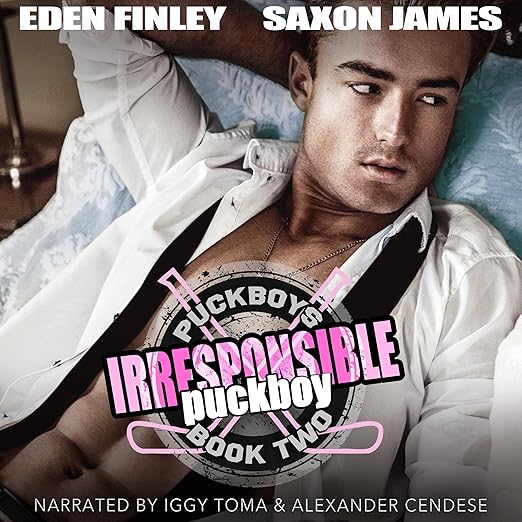
I started Irresponsible Puckboy on a Friday afternoon intending to listen for an hour. I finished it early Saturday morning. Eden Finley and co-author Saxon James, writing under Finley's name, have a knack for building comedic situations that somehow keep deepening rather than collapsing under their own weight, and this second installment in the Puckboys series does that better than the first.
The setup is efficient: Tripp has been in love with his best friend Dex for years. Dex has always identified as straight and remains cheerfully oblivious to everything Tripp feels and, as it turns out, to a lot of what he himself feels. When Dex's relationship falls apart, he stumbles into what he frames as a solution to his PR problem, an accidental marriage that creates team management headaches and forces him into close proximity with the one person he can't afford to lose.
Where This One Lands
The book's real achievement is how it handles Dex's sexual discovery. The temptation in this kind of romance is to treat the straight-to-queer journey either as a conversion narrative or as a comedy of errors where the character is simply too dense to notice obvious feelings. Finley does neither. Dex's obliviousness feels genuine rather than contrived, and when his understanding of himself begins to shift, the writing takes it seriously. Reviewer ine Vanherle noted that under all the antics there is a romance with real emotional growth, and that is the crucial distinction. The chaos is the plot, but the feeling underneath it is not a joke.
Reviewer freetheghost came to this as a first entry in the series rather than reading in order, and found it worked fine as a standalone, though the mention of other characters did create some interest in the broader Puckboys world. That accessibility is a feature worth noting for listeners who are not already committed to the series.
Iggy Toma's narration is a significant part of why this works as well as it does in audio. The comedic rhythm of Dex's chapters requires a reader who can make himbo energy sound genuinely lovable rather than exhausting, and Toma finds that register consistently. Tripp's chapters carry a different weight, more restrained, more aware of what he stands to lose, and the tonal shift between the two POVs is handled well. Reviewer Lisa L Teetz described the build as sweet, funny, swoony, and smoking hot, and the audio format services all four of those qualities: the comedy lands, the tension accumulates, and the eventual payoff has been properly earned by the time it arrives.
For listeners who enjoy the friends-to-lovers trope specifically, the fact that the story is told from both sides of the dynamic makes it more satisfying than versions told from one character's perspective alone. Tripp's chapters carry all the longing. Dex's chapters carry the dramatic irony. The interplay between them is what gives the romance its shape.
Weak Spots in Irresponsible Puckboy
The plot mechanics are deliberately silly. An accidental marriage, a PR team in crisis, team management issuing ultimatums. Readers who want their sports romance grounded in realistic hockey procedure will need to adjust their expectations accordingly. The hockey serves mainly as backdrop and stakes-generator rather than as a seriously rendered sports narrative. That's a legitimate choice and consistent with the series's tone, but it means this is a character and relationship book that happens to be set in a hockey context rather than a sports book that features romance.
Who Should Listen to Irresponsible Puckboy
MM romance readers who enjoy comedic setups with genuine emotional cores will be well served here. It is also a strong choice for listeners specifically interested in sexual discovery narratives within romance, since that thread is handled with more care than the plot summary would suggest. This is the second book in the Puckboys series but functions as a standalone. Skip it if you need your hockey fiction to take the sport itself seriously, or if chaotic comedic plotting frustrates rather than entertains you.
Do you need to read the first Puckboys book before Irresponsible Puckboy, or does it stand alone?
It works as a standalone. Reviewer freetheghost started here without reading the first book and had no trouble following the story. Prior characters appear but are not required context.
How does Iggy Toma handle the dual first-person narration between Tripp and Dex?
Well. Toma distinguishes the two voices tonally rather than just acoustically: Dex's chapters carry comedic lightness while Tripp's carry more restraint and longing, and the shift between POVs reads as natural rather than jarring.
Is the hockey content in Irresponsible Puckboy realistically rendered, or is it mainly backdrop?
Mainly backdrop. The sport provides setting, stakes, and the team management subplot, but the book's energy is in the relationship dynamics rather than in authentic hockey detail. Readers expecting serious sports fiction should adjust expectations.